
We read your photo as:
State and explain one specific example of what a child/young person with additional needs/challenge in this area of development might experience/demonstrate in their occupational performance.
Psychology
ScanSolve AI Answer
Answer
The age group you have been given is: School-aged children (6-12 years)
Physical Development: (sensory development and reflexes if applicable)
- Explanation: During this age, children refine their gross motor skills (running, jumping, throwing) and fine motor skills (writing, drawing, using tools). Their strength, coordination, and balance improve significantly.
- Example of challenge: A child with developmental coordination disorder (DCD) might struggle with tasks requiring fine motor control, such as holding a pencil correctly or cutting with scissors. This impacts their occupational performance in school, making it difficult to complete written assignments or participate in art activities.
Cognitive & Language Development:
- Explanation: Cognitively, children develop more logical and organized thinking, improve memory, and begin to understand abstract concepts. Language skills expand rapidly, with increased vocabulary, complex sentence structures, and improved conversational abilities.
- Example of challenge: A child with dyslexia might experience significant difficulty with reading fluency and comprehension, as well as written expression. This impacts their occupational performance by making it challenging to learn from textbooks, follow written instructions, or complete essays in school.
Emotional & Social Development: (if applicable)
- Explanation: Emotionally, children learn to identify and manage their feelings, develop self-esteem, and cope with stress. Socially, they form stronger friendships, understand social rules, develop empathy, and learn cooperation and negotiation skills.
- Example of challenge: A child with Autism Spectrum Disorder (ASD) may have difficulty understanding social cues, engaging in reciprocal conversations, or forming peer relationships. This impacts their occupational performance by making it challenging to participate in group projects, navigate playground interactions, or build friendships at school.
Moral and spiritual development (if applicable):
- Explanation: Children in this age group begin to understand rules and fairness, distinguishing between right and wrong based on intentions rather than just consequences. They start to develop personal values and may show curiosity about spiritual or existential questions.
- Example of challenge: A child with Oppositional Defiant Disorder (ODD) might consistently defy rules, argue with authority figures, and show a lack of remorse for their actions. This demonstrates a challenge in developing a strong internal moral compass and understanding the impact of their behavior on others.
Importance of Play (Leisure) for this age group:
- Explanation: Play is crucial for school-aged children as it fosters social skills (cooperation, conflict resolution), emotional regulation (managing frustration, expressing joy), cognitive development (problem-solving, creativity), and physical health (gross motor skills, endurance). It also provides a vital outlet for stress relief and self-expression, allowing them to practice roles and skills learned in other contexts.
Was this helpful?
Still stuck on this one?
Ask a follow-up, and the answer starts from this question.
Got a different question?Ask your own question
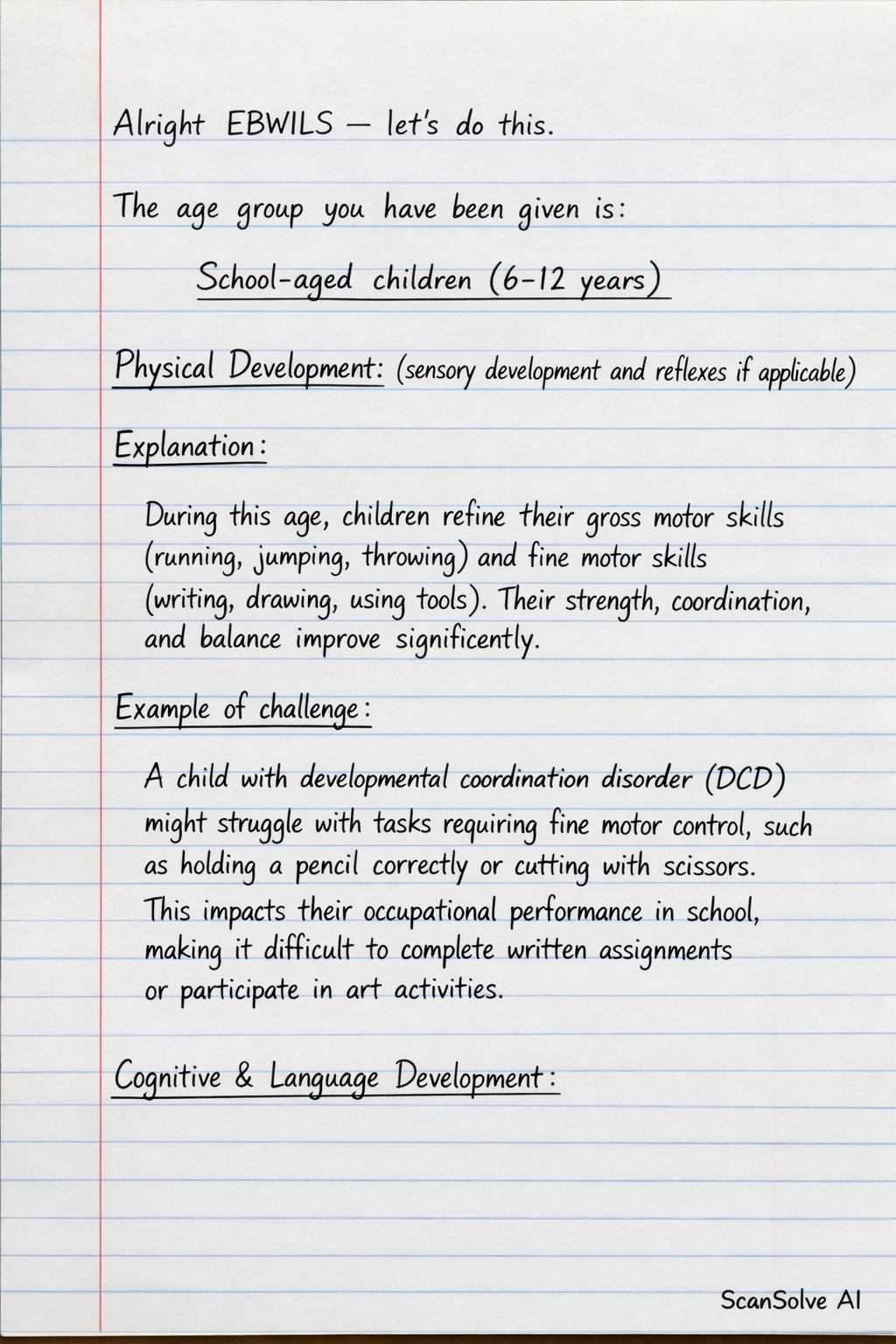
Handwritten Step-by-Step Solution
Get this as a handwritten image on WhatsApp — like a tutor wrote it for you.
Try on WhatsApp