
We read your photo as:
Assuming that there are no changes in the fixed deposit amount and the interest rate in 2012, calculate the total interest receivable for the year ended 31 December, 2012.
ScanSolve AI Answer
Answer
Step-by-step solution
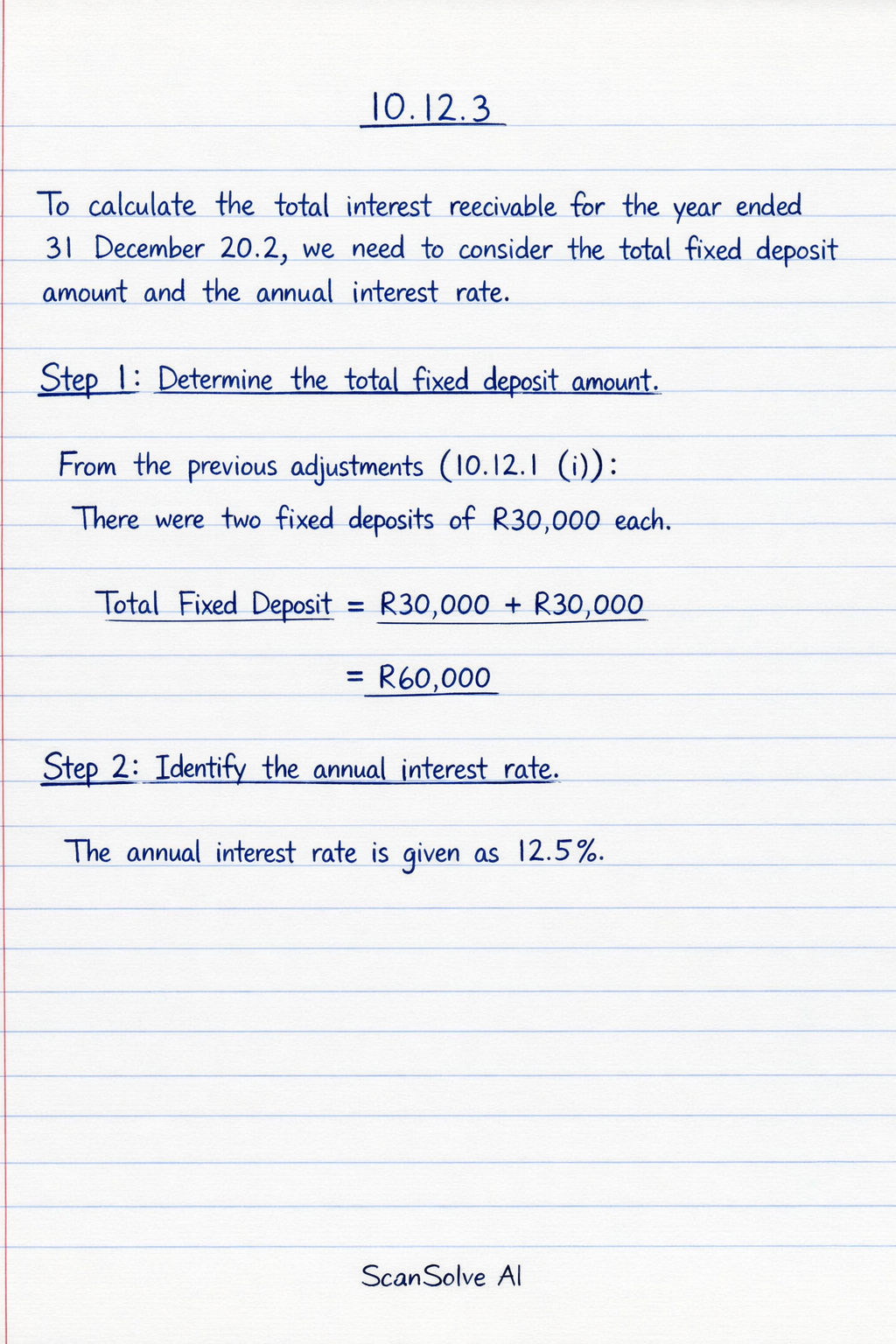
3 steps10.12.3
To calculate the total interest receivable for the year ended 31 December 20.2, we need to consider the total fixed deposit amount and the annual interest rate.
Determine the total fixed deposit amount.
From the previous adjustments (10.12.1 (i)), there were two fixed deposits of R30 000 each.
Identify the annual interest rate.
The annual interest rate is given as 12.5%.
Calculate the total interest receivable for the year 20.2.
Since there are no changes in the fixed deposit amount or interest rate, and both deposits were in place by the end of 20.1, the full amount will earn interest for the entire year 20.2.
The total interest receivable for the year ended 31 December 20.2 is .
Try one yourself
A new problem that tests the same skill.
Still stuck on this one?
Ask a follow-up, and the answer starts from this question.
More Accounting Questions
Handwritten Step-by-Step Solution
Get this as a handwritten image on WhatsApp — like a tutor wrote it for you.
Try on WhatsApp