
We read your photo as:
b) Mr. Dumi Dhlomo is 57 years old and works at a Medical Research Company in Pretoria. The table below shows Mr. Dhlomo's annual income details. Using the income details, determine his (i) Taxable Income in the table provided. (ii) Claculate the Tax payable as per his marginal tax rate.
ScanSolve AI Answer
Answers
2 partsStep-by-step solution
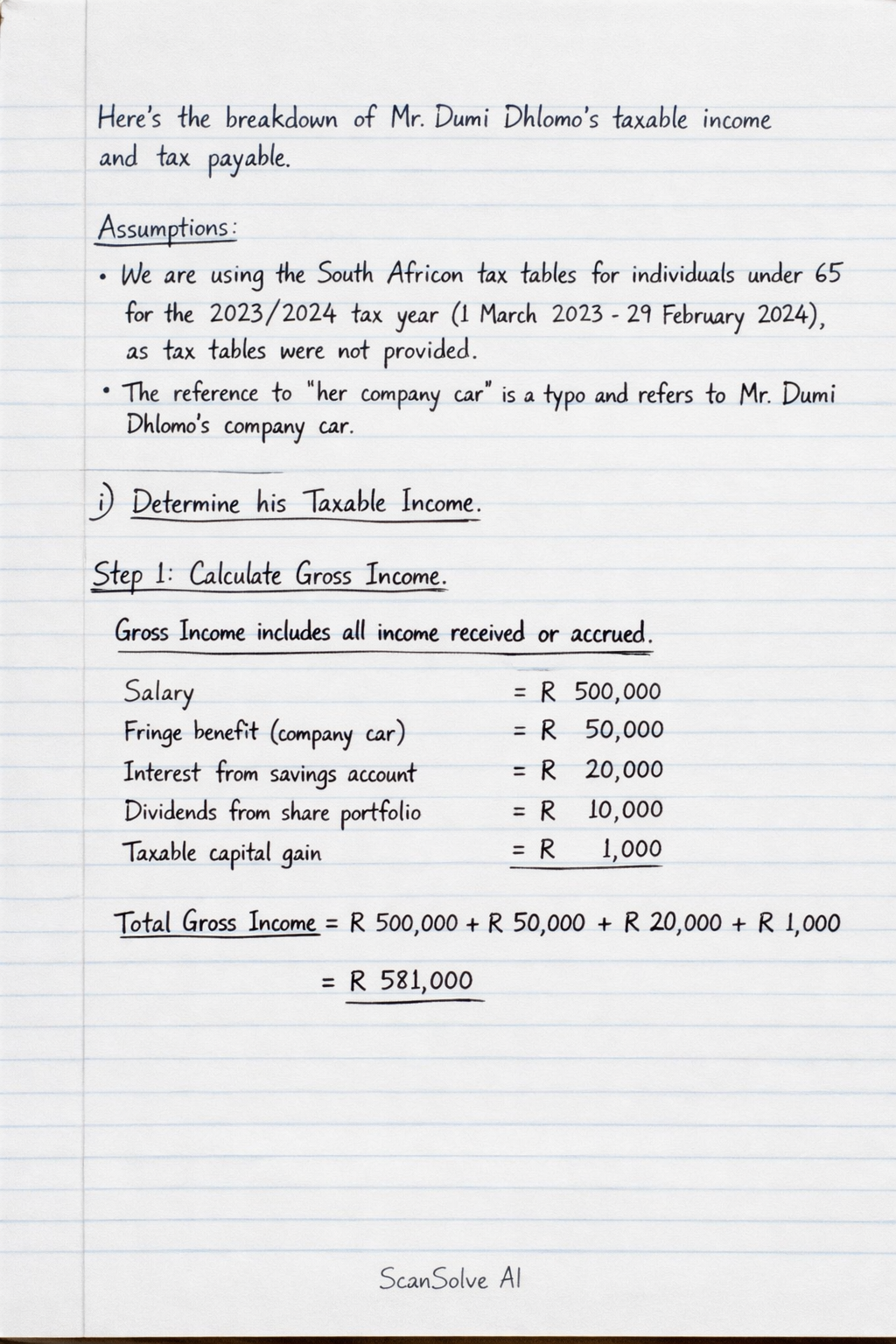
8 stepsHere's the breakdown of Mr. Dumi Dhlomo's taxable income and tax payable.
Assumptions:
- We are using the South African tax tables for individuals under 65 for the 2023/2024 tax year (1 March 2023 - 29 February 2024), as tax tables were not provided.
- The reference to "her company car" is a typo and refers to Mr. Dumi Dhlomo's company car.
Part i· 4 steps
Determine his Taxable Income.
Calculate Gross Income.
Gross Income includes all income received or accrued.
Apply exemptions to determine income subject to tax before deductions.
- Interest Exemption: For individuals under 65, the first R23 800 of interest income is exempt. Mr. Dhlomo is 57, so his R20 000 interest is fully exempt.
- Dividends Exemption: Dividends from South African companies are generally exempt from income tax for individuals. So, R10 000 dividends are fully exempt.
- Capital Gains Exclusion: The first R40 000 of annual capital gains is excluded for individuals. Mr. Dhlomo's capital gain of R1 000 is fully excluded. Income subject to tax before deductions = Salary + Fringe benefit
Calculate allowable deductions for retirement fund contributions.
Total contributions = Pension fund contributions + Retirement annuity contributions
The deduction limit for retirement fund contributions is the lowest of:
- R350 000
- 27.5% of the greater of remuneration (R550 000) or taxable income (before this deduction).
- Actual contributions: R100 000 The lowest of these three amounts is R100 000. Therefore, the full R100 000 is deductible.
Calculate Taxable Income.
Taxable Income = Income subject to tax before deductions - Allowable deductions
Part ii
Calculate the Tax payable as per his marginal tax rate.
Determine the applicable tax bracket for Taxable Income of R450 000 (for individuals under 65, 2023/2024 tax year).
Mr. Dhlomo's taxable income of R450 000 falls into the bracket: R372 101 - R512 800.
The tax formula for this bracket is R77 362 + 31% of taxable income above R372 100. His marginal tax rate is 31%.Calculate normal tax.
Subtract applicable rebates.
Mr. Dhlomo is 57, so only the primary rebate applies (R17 235 for 2023/2024).
Subtract medical tax credit.
The qualifying medical tax credit is R0 (as provided in the table).
Try one yourself
A new problem that tests the same skill.
Still stuck on this one?
Ask a follow-up, and the answer starts from this question.
More Accounting Questions
Handwritten Step-by-Step Solution
Get this as a handwritten image on WhatsApp — like a tutor wrote it for you.
Try on WhatsApp