
We read your photo as:
Distinguish between an accounting estimate and an accounting error. Also explain the treatment of costs for Chalk Pie under IAS 38.
ScanSolve AI Answer
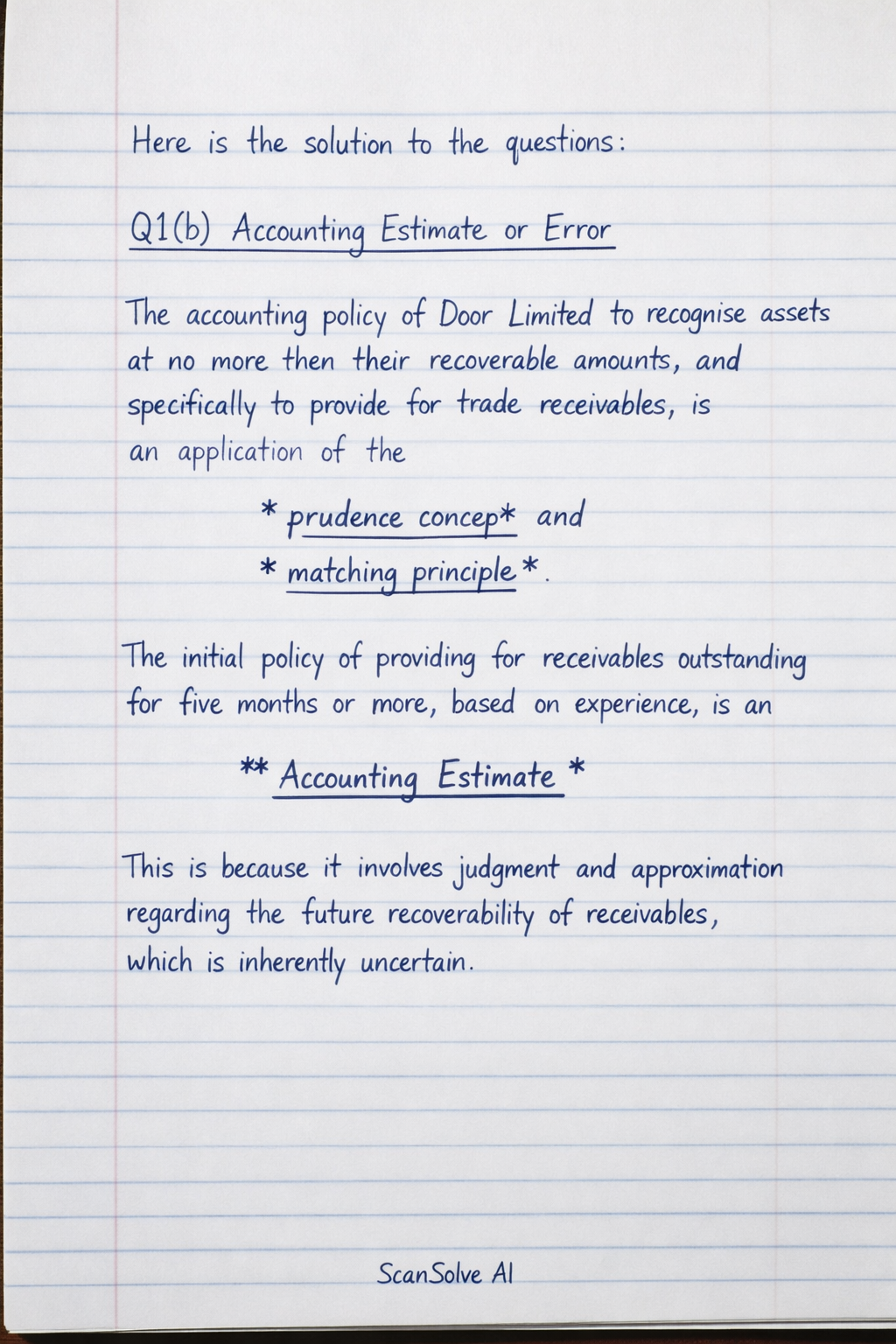
Here is the solution to the questions:
Q1(b) Accounting Estimate or Error
The accounting policy of Door Limited to recognise assets at no more than their recoverable amounts, and specifically to provide for trade receivables, is an application of the prudence concept and matching principle.
The initial policy of providing for receivables outstanding for five months or more, based on experience, is an accounting estimate. This is because it involves judgment and approximation regarding the future recoverability of receivables, which is inherently uncertain.
The decision to provide in full for amounts outstanding for four months or more due to the economy entering a period of recession is a change in accounting estimate. It is not an error because it reflects new information (the recession) and a revised judgment about the expected future economic benefits from the receivables. It is a prospective adjustment, meaning it affects current and future periods, not prior periods. An accounting error would be a mathematical mistake, a misapplication of accounting policy, or an oversight.
Q1(c) Treatment of Costs for Chalk Pie
Under IAS 38 Intangible Assets, costs are capitalised as part of an intangible asset only if they are directly attributable to preparing the asset for its intended use and meet the recognition criteria (probable future economic benefits and reliably measurable cost). Other costs are expensed.
-
Legal costs of acquiring the copyrights (N30 Million): These costs are directly attributable to acquiring and securing the legal rights to the dancer's performance. They are necessary to bring the intangible asset (copyright) into existence and make it capable of generating future economic benefits.
- Treatment: This cost will be capitalised as an Intangible Asset (Copyrights) on the Statement of Financial Position. It will then be amortised over its useful life (e.g., eight years, or a shorter period if the economic benefits are expected to last less than eight years).
-
Operational loss (studio time lost, and so on) (N12 Million): These losses are inefficiencies or initial operating losses incurred due to the dancer's inability to perform. They are not directly attributable costs necessary to bring the copyright into its intended use. IAS 38 specifically states that initial operating losses incurred before an asset achieves planned performance are expensed.
- Treatment: This cost will be expensed to the Profit or Loss in the period it was incurred.
-
Advertising campaign to launch the dancer (N9.5 Million): Costs of advertising and promotional activities are generally expensed as incurred. They do not create an intangible asset that meets the recognition criteria of IAS 38 because the entity cannot control the future economic benefits arising from the advertising in a way that can be reliably measured and attributed to the advertising itself as an asset.
- Treatment: This cost will be expensed to the Profit or Loss in the period it was incurred.
Summary of Treatment:
- Legal costs of acquiring copyrights: N30 Million will be recognised as an Intangible Asset on the Statement of Financial Position.
- Operational loss: N12 Million will be recognised as an expense in the Profit or Loss.
- Advertising campaign: N9.5 Million will be recognised as an expense in the Profit or Loss.
Still stuck on this one?
Ask a follow-up, and the answer starts from this question.
More Accounting Questions
Handwritten Step-by-Step Solution
Get this as a handwritten image on WhatsApp — like a tutor wrote it for you.
Try on WhatsApp