
We read your photo as:
Which farming enterprise has the worst debt ratio?
ScanSolve AI Answer
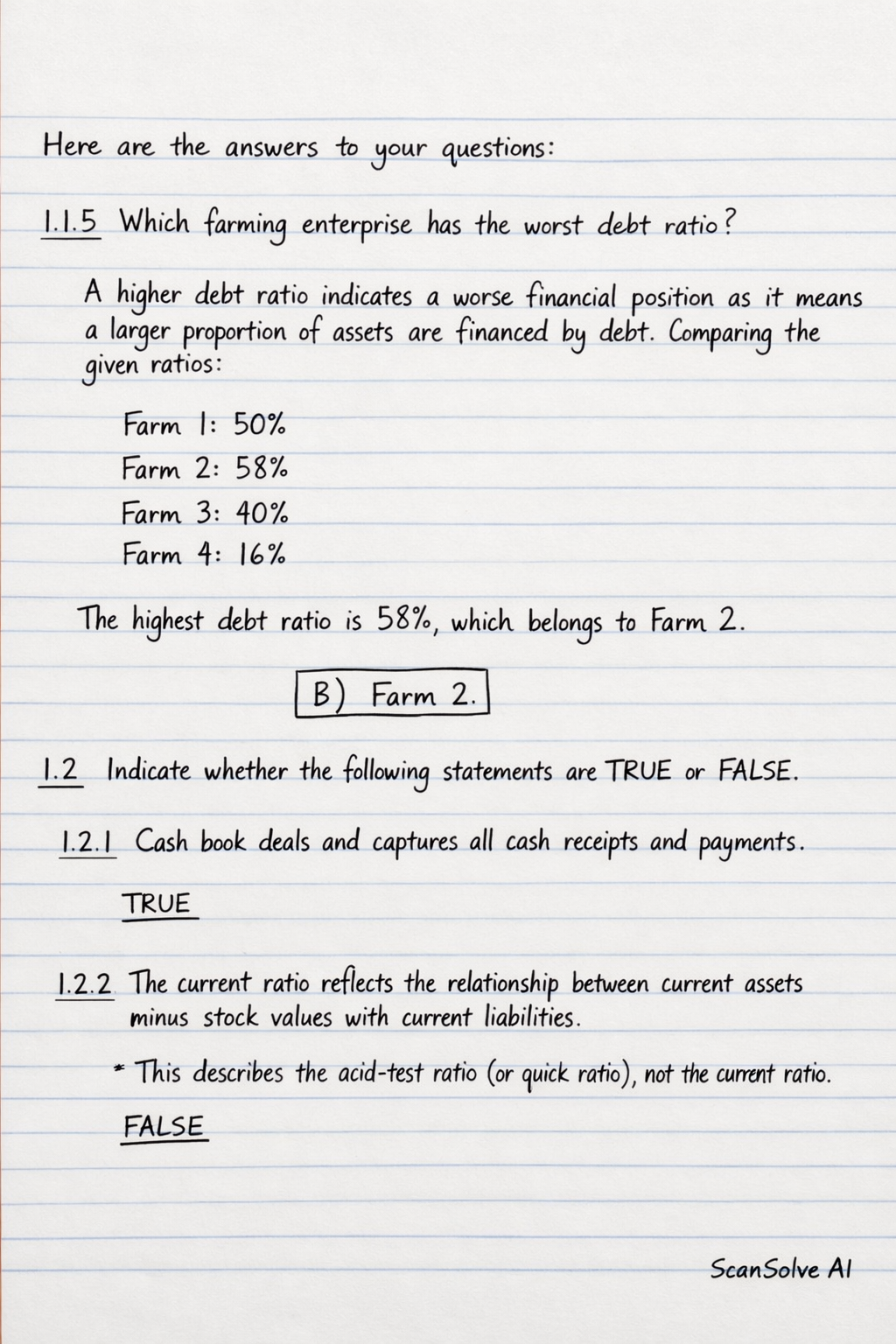
Here are the answers to your questions:
1.1.5 The following are debt ratios of four farming enterprises operating in the same area: Farm 1 = 50%, Farm 2 = 58%, Farm 3 = 40% and Farm 4 = 16%.
Which farming enterprise has the worst debt ratio?
- A higher debt ratio indicates a worse financial position as it means a larger proportion of assets are financed by debt. Comparing the given ratios:
- Farm 1: 50%
- Farm 2: 58%
- Farm 3: 40%
- Farm 4: 16% The highest debt ratio is 58%, which belongs to Farm 2.
- B
1.2 Indicate whether the following statements are TRUE or FALSE.
1.2.1 Cash book deals and captures all cash receipts and payments.
- TRUE
1.2.2 The current ratio reflects the relationship between current assets minus stock values with current liabilities.
- This describes the acid-test ratio (or quick ratio), not the current ratio.
- FALSE
1.2.3 All cash payments are captured in the debit side of the cash book.
- Cash payments are captured on the credit side of the cash book; cash receipts are on the debit side.
- FALSE
1.2.4 The acid test ratio is an income statement analysis item that is important in analysing profitability.
- The acid-test ratio is a liquidity ratio, not an income statement item, and it assesses short-term solvency, not profitability.
- FALSE
1.2.5 Land is the most important capital asset in farming.
- TRUE
QUESTION 2
2.1 Explain the meaning of the term remuneration to providers of foreign capital.
- Remuneration to providers of foreign capital refers to the payments made to individuals or entities from outside the country who have supplied financial resources (capital) to a business or economy. These payments compensate them for the use of their funds.
2.2 Name the THREE items that fall under remuneration to providers of foreign Capital.
- Interest (for loans)
- Dividends (for equity investments)
- Royalties/Fees (for intellectual property or specific agreements)
2.3 Give THREE types of analysis used when analysing financial statements.
- Ratio analysis
- Trend analysis
- Common-size analysis
2.4 Define liquidity.
- Liquidity is the ability of an individual or entity to meet its short-term financial obligations as they fall due. It measures how easily assets can be converted into cash without significant loss of value.
Still stuck on this one?
Ask a follow-up, and the answer starts from this question.
More Accounting Questions
Handwritten Step-by-Step Solution
Get this as a handwritten image on WhatsApp — like a tutor wrote it for you.
Try on WhatsApp