
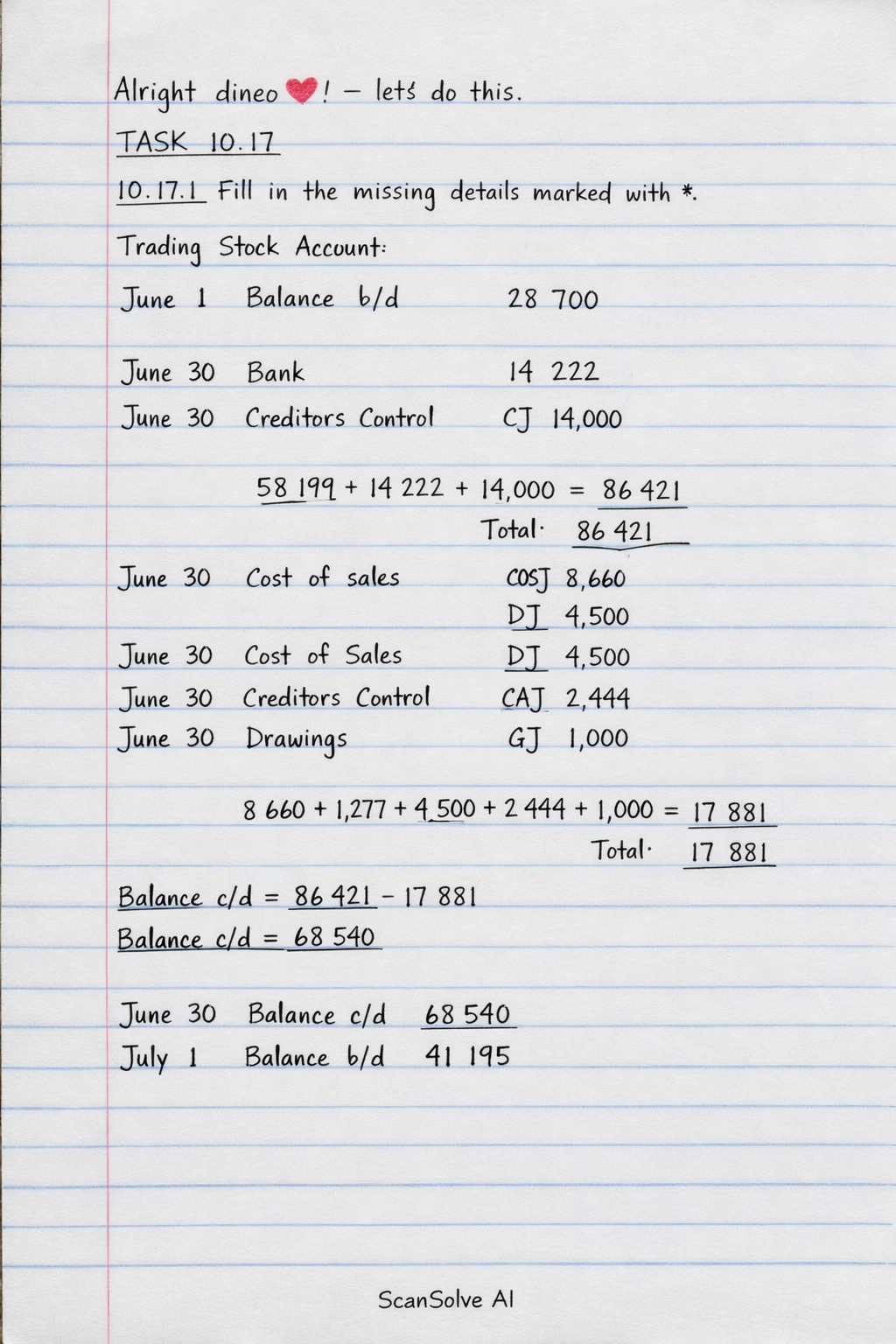
We read your photo as:
Fill in the missing details marked with *. Explain each transaction that took place to give rise to the entries above. What does the figure R41 195 mean? How can you verify the figure R41 195? What if your verification revealed a figure of R40 000? What entries would you make?
ScanSolve AI Answer
TASK 10.17
10.17.1 Fill in the missing details marked with *.
Here are the completed details for the Trading Stock Account:
| Dr | 20.7 | B6 | Cr | ||||
|---|---|---|---|---|---|---|---|
| June 1 | Balance | b/d | 28 700 | ||||
| June 30 | Bank | CPJ | 14 222 | June 30 | Bank | CRJ | 400 |
| June 30 | Creditors Control | CJ | 14 000 | June 30 | Cost of sales | COSJ | 8 660 |
| June 30 | Cost of sales | GJ | 1 277 | June 30 | Cost of Sales | DJ | 4 500 |
| June 30 | Creditors Control | CAJ | 2 444 | ||||
| June 30 | Drawings | GJ | 1 000 | ||||
| June 30 | Balance | c/d | 41 195 | ||||
| 58 199 | 58 199 | ||||||
| July 1 | Balance | b/d | 41 195 |
10.17.2 Explain each transaction that took place to give rise to the entries above.
-
Debit Side:
- June 1 Balance b/d R28 700: This is the opening balance of trading stock on hand at the beginning of June.
- June 30 Bank R14 222 (CPJ): The business purchased trading stock for cash.
- June 30 Creditors Control R14 000 (CJ): The business purchased trading stock on credit.
- June 30 Cost of sales R1 277 (GJ): This represents trading stock returned by a customer, which increases the stock on hand and reduces the cost of sales.
-
Credit Side:
- June 30 Bank R400 (CRJ): The business returned trading stock to a supplier and received cash for it.
- June 30 Cost of sales R8 660 (COSJ): This is the cost of trading stock sold for cash.
- June 30 Cost of Sales R4 500 (DJ): This is the cost of trading stock sold on credit.
- June 30 Creditors Control R2 444 (CAJ): The business returned trading stock to a supplier on credit.
- June 30 Drawings R1 000 (GJ): The owner took trading stock for personal use.
- June 30 Balance c/d R41 195: This is the closing balance of trading stock on hand at the end of June.
10.17.3 What does the figure R41 195 mean?
The figure R41 195 represents the closing balance of trading stock at the end of the financial period, 30 June 20.7. It is the value of all unsold inventory that the business has on hand at that date.
10.17.4 How can you verify the figure R41 195?
The figure R41 195 can be verified by conducting a physical stock count (or inventory count) of all trading stock on hand at the close of business on 30 June 20.7. The physically counted stock should then be valued using an appropriate inventory valuation method (e.g., FIFO or weighted average) and compared to the balance in the Trading Stock account.
10.17.5 What if your verification revealed a figure of R40 000? What entries would you make?
If the physical verification revealed a figure of R40 000, there would be a stock deficit (shortage) of R1 195 (R41 195 - R40 000).
The entries to adjust for this deficit would be:
- Debit the Stock Loss account with R1 195.
- Credit the Trading Stock account with R1 195.
- The journal entry would be recorded in the General Journal (GJ).
Still stuck on this one?
Ask a follow-up, and the answer starts from this question.
More Accounting Questions
Handwritten Step-by-Step Solution
Get this as a handwritten image on WhatsApp — like a tutor wrote it for you.
Try on WhatsApp