
In the General journal R28 750.00 is recorded on the debit column and that is correct and in the details column it is labelled as Trade payables (Langbooi Traders) the Vat Output is labelled on the credit column as R3750.00 And the purchases labeled on the credit coloumn as R25 000.00. Can you show me in detail how you got to calculate to get the answer R28 750.00 (trade payables).
ScanSolve AI Answer
Answer
You're asking for a detailed breakdown of how the R28,750 adjustment is calculated, and how it relates to the R25,000 and R3,750 figures you mentioned.
Step-by-step solution
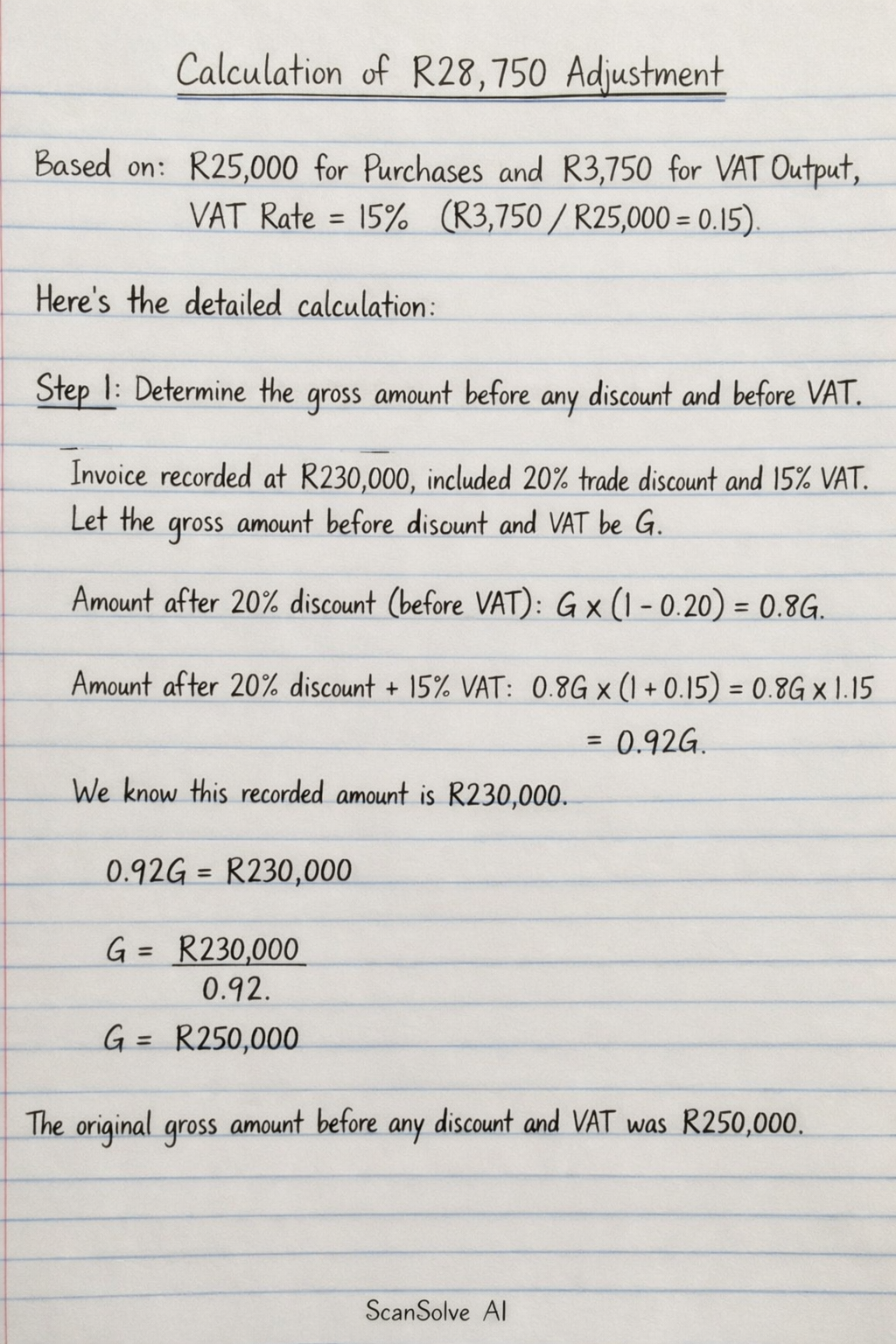
6 stepsBased on the figures you provided (R25,000 for Purchases and R3,750 for VAT Output, summing to R28,750), it implies a VAT rate of 15% (since ). We will use this VAT rate for the calculation.
Here's the detailed calculation for the R28,750 adjustment:
Determine the gross amount before any discount and before VAT.
The invoice was recorded at R230,000, which included a 20% trade discount and 15% VAT.
Let the gross amount before discount and VAT be .
Amount after 20% discount (before VAT) = .
Amount after 20% discount and with 15% VAT = .
We know this recorded amount is R230,000.The original gross amount before any discount and before VAT was R250,000.
Calculate the correct net amount before VAT.
The correct trade discount should have been 30% of the gross amount (R250,000).
Calculate the correct VAT amount.
Using the 15% VAT rate on the correct amount before VAT:
Calculate the correct total invoice amount (VAT inclusive).
Calculate the total adjustment needed.
The invoice was originally recorded at R230,000. The correct total invoice amount is R201,250.
This is the total amount by which the invoice was overstated.
Break down the total adjustment into its VAT and non-VAT components.
The total adjustment of R28,750 is VAT inclusive.
So, the R28,750 adjustment consists of R25,000 (excluding VAT) and R3,750 (VAT).
General Journal Entry for Lushaba Suppliers (the seller):
Lushaba Suppliers is the seller, and Langabooi Traders is their debtor. The original invoice was overstated, meaning Langabooi Traders owes Lushaba Suppliers too much. Lushaba Suppliers needs to reduce their sales revenue and their VAT Output liability, and reduce the amount owed by the debtor.
The R28,750 is the total adjustment to the debtor's account. The R25,000 reduces the sales revenue, and the R3,750 reduces the VAT liability.
Still stuck on this one?
Ask a follow-up, and the answer starts from this question.
More Accounting Questions
Handwritten Step-by-Step Solution
Get this as a handwritten image on WhatsApp — like a tutor wrote it for you.
Try on WhatsApp