
We read your photo as:
State four items of expenditure that can be written in a petty cashbook. Explain the imprest system.
ScanSolve AI Answer
Step-by-step solution
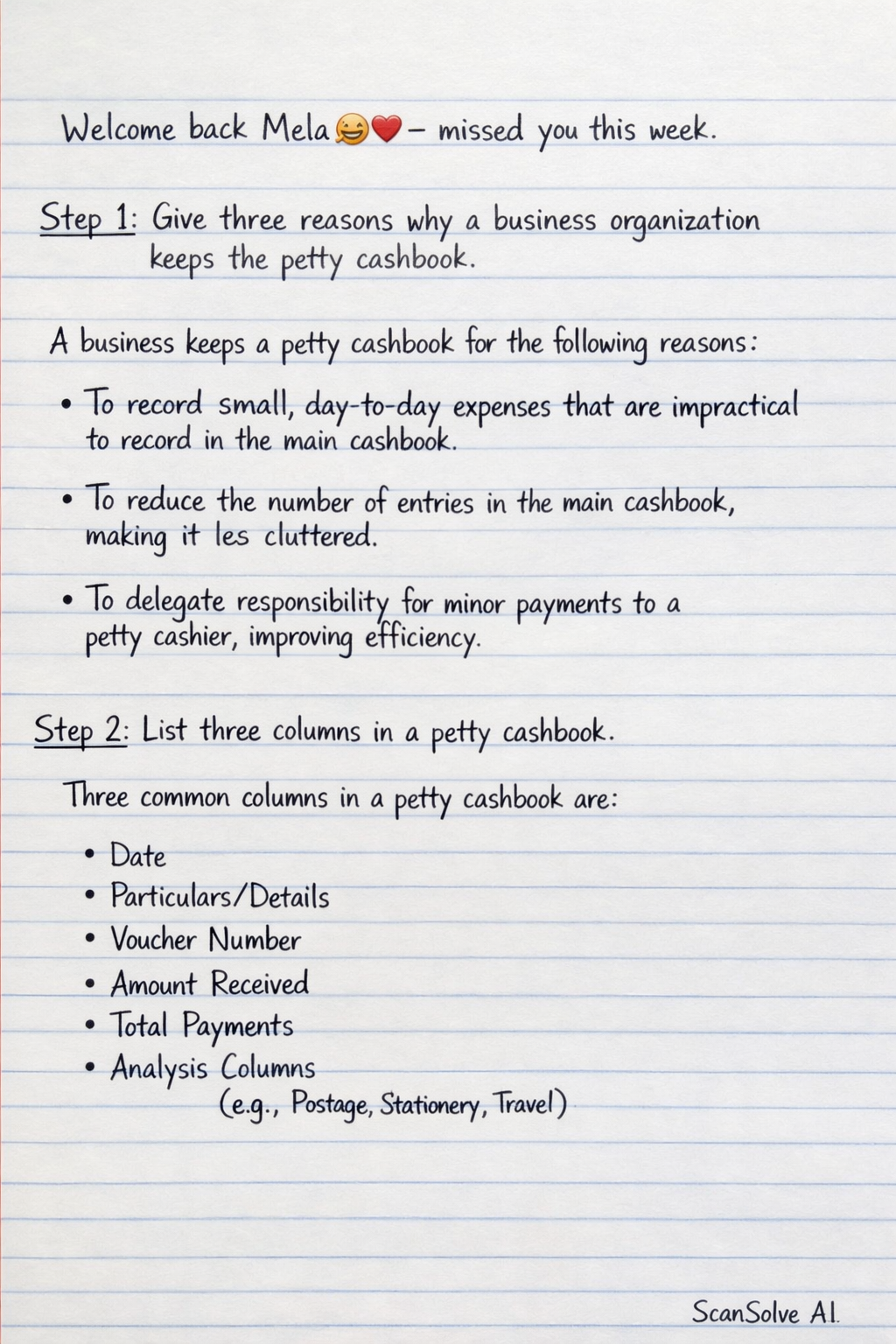
5 stepsGive three reasons why a business organization keeps the petty cashbook.
A business keeps a petty cashbook for the following reasons:
- To record small, day-to-day expenses that are impractical to record in the main cashbook.
- To reduce the number of entries in the main cashbook, making it less cluttered.
- To delegate responsibility for minor payments to a petty cashier, improving efficiency.
List three columns in a petty cashbook.
Three common columns in a petty cashbook are:
- Date
- Particulars/Details
- Voucher Number
- Amount Received
- Total Payments
- Analysis Columns (e.g., Postage, Stationery, Travel)
What are the differences between the imprest system and the ordinary cashbook?
The imprest system is a method of managing petty cash, while an ordinary cashbook records all major cash and bank transactions.
- The imprest system maintains a fixed amount of petty cash, which is reimbursed periodically to bring it back to the original float. It deals with small, frequent expenses.
- An ordinary cashbook records all receipts and payments, including large transactions, and its balance fluctuates based on actual inflows and outflows.
State four items of expenditure that can be written in a petty cashbook.
Four items of expenditure suitable for a petty cashbook are:
- Postage stamps
- Stationery supplies
- Tea/coffee for office staff
- Local travel expenses (e.g., bus fares)
Explain the imprest system.
The imprest system is a method of managing a petty cash fund where a fixed amount of money (the float) is given to a petty cashier. At regular intervals, or when the fund runs low, the cashier is reimbursed for the exact amount spent, restoring the fund to its original fixed amount. This system ensures that the total of cash on hand and the vouchers for expenses always equals the original float.
Still stuck on this one?
Ask a follow-up, and the answer starts from this question.
More Accounting Questions
Handwritten Step-by-Step Solution
Get this as a handwritten image on WhatsApp — like a tutor wrote it for you.
Try on WhatsApp