
How do i calculate the gross margin in accounting
Accounting
ScanSolve AI Answer
Answer
The gross margin is a profitability ratio that shows the percentage of revenue that exceeds the cost of goods sold (COGS). It indicates how efficiently a company uses its labor and supplies in producing goods or services.
Step-by-step solution
5 stepsIdentify the total revenue generated from sales.
Determine the cost of goods sold (COGS), which includes direct costs attributable to the production or purchase of the goods sold by a company.
Subtract COGS from Revenue to find the Gross Profit.
Divide the Gross Profit by Revenue.
Multiply the result by 100 to express it as a percentage.
For example, if a company has revenue of $100,000 and COGS of $60,000:
Gross Profit = $100,000 - $60,000 = $40,000
Gross Margin = ($40,000 / $100,000) \times 100% = 40%The gross margin is 40%.
Was this helpful?
Still stuck on this one?
Ask a follow-up, and the answer starts from this question.
Got a different question?Ask your own question
More Accounting Questions
QSo i am given opening inventory and and closing inventory and cost of sales also, so i'm told to…QCalculate the total gross margin for wheat.QCalculate the cost of sales and gross profit based on the provided trading account.QPrepare the calculation for Cost of Goods Sold and Gross Profit based on the provided figures.
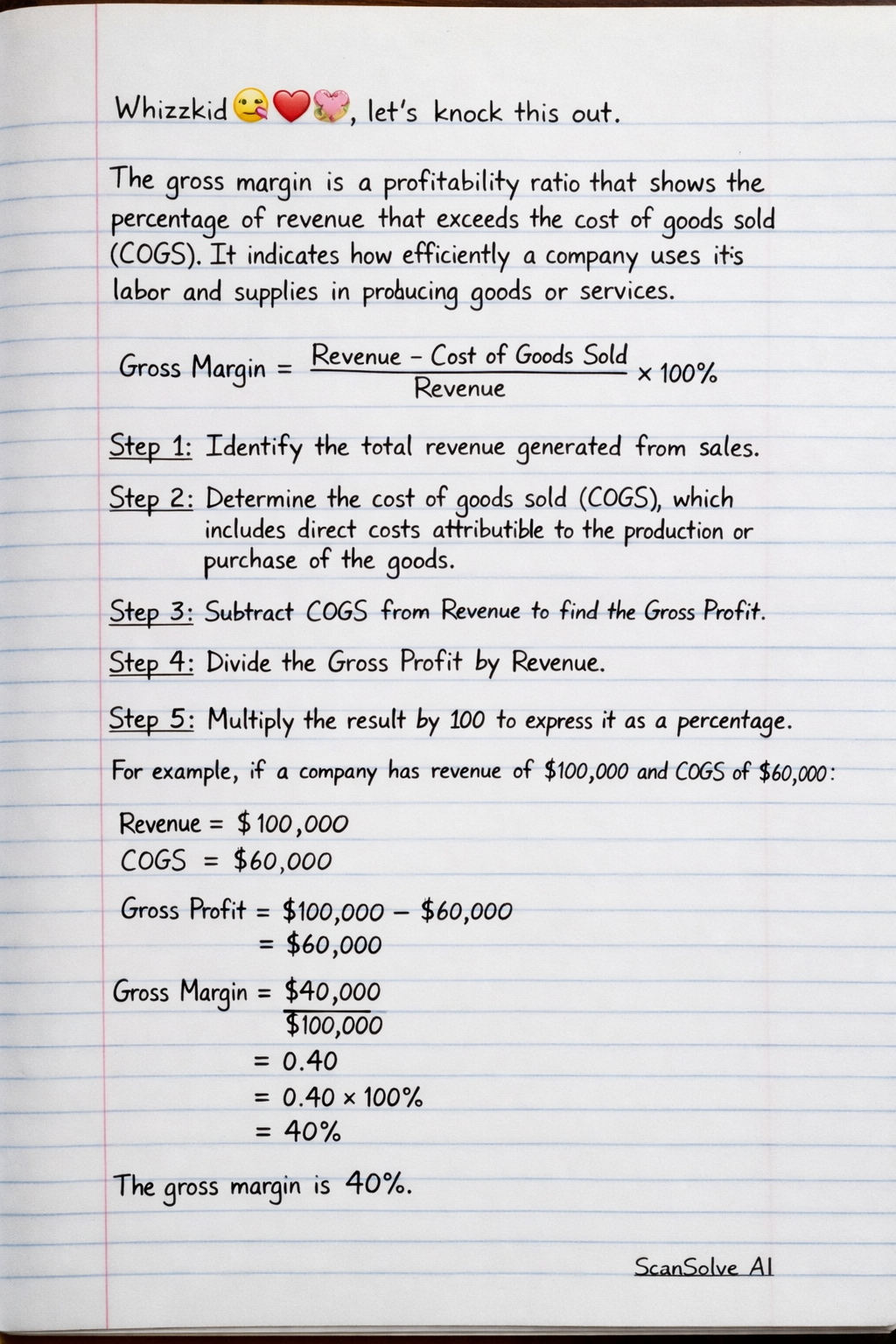
Handwritten Step-by-Step Solution
Get this as a handwritten image on WhatsApp — like a tutor wrote it for you.
Try on WhatsApp