
We read your photo as:
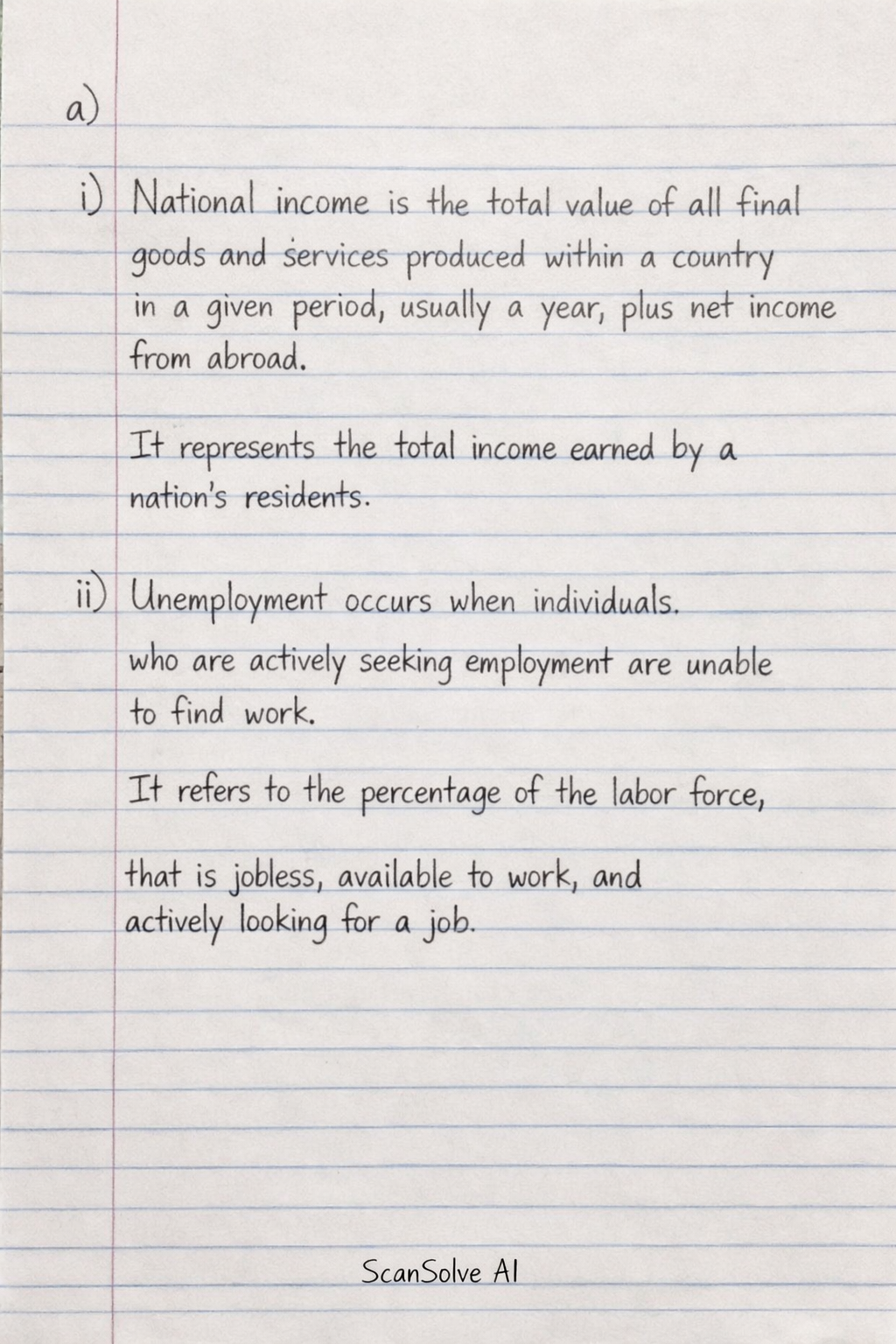
I) National income is the total value of all final goods and services produced within a country in a given period, usually a year, plus net income from abroad. It represents the total income ear
ScanSolve AI Answer
a)
i) National income is the total value of all final goods and services produced within a country in a given period, usually a year, plus net income from abroad. It represents the total income earned by a nation's residents.
ii) Unemployment occurs when individuals who are actively seeking employment are unable to find work. It refers to the percentage of the labor force that is jobless, available to work, and actively looking for a job.
b) Three reasons for measuring the national income of a country are:
- To assess economic performance: It helps evaluate the overall health and growth rate of an economy. A rising national income generally indicates economic expansion and improved living standards.
- For policy formulation: National income data provides crucial information for governments to formulate economic policies, such as fiscal and monetary policies, to address issues like inflation or unemployment.
- To facilitate international comparisons: It allows for comparison of a country's economic size and living standards with other nations, aiding in understanding relative development and economic power.
c) Three measures used by the Cameroon government to reduce unemployment are:
- Investment in Infrastructure: The government can initiate large-scale public works projects, such as building roads, bridges, and public facilities. These projects directly create jobs in construction and related industries, and indirectly stimulate economic activity.
- Support for Small and Medium Enterprises (SMEs): Providing financial assistance, tax incentives, and training programs to SMEs encourages their growth and expansion. SMEs are often significant job creators, absorbing a large portion of the labor force.
- Vocational Training and Skill Development: Implementing programs that equip the workforce with in-demand skills helps reduce structural unemployment. This ensures that job seekers have the necessary qualifications for available positions, improving employability.
d) Distinguishing between fiscal policy and physical policy (assuming "physical policy" is a typo for "monetary policy"):
- Fiscal Policy: This refers to the government's use of taxation and government spending to influence the economy. It is implemented by the executive and legislative branches of government to manage aggregate demand, stabilize the economy, and achieve macroeconomic goals like full employment and economic growth.
- Monetary Policy: This refers to actions undertaken by a country's central bank to control the money supply and credit conditions. Its primary tools include adjusting interest rates, conducting open market operations, and setting reserve requirements. The goal is to influence inflation, economic growth, and employment.
Still stuck on this one?
Ask a follow-up, and the answer starts from this question.
More Accounting Questions
Handwritten Step-by-Step Solution
Get this as a handwritten image on WhatsApp — like a tutor wrote it for you.
Try on WhatsApp