

This accounting problem is solved step by step below, with detailed explanations to help you understand the method and arrive at the correct answer.
ScanSolve AI Answer
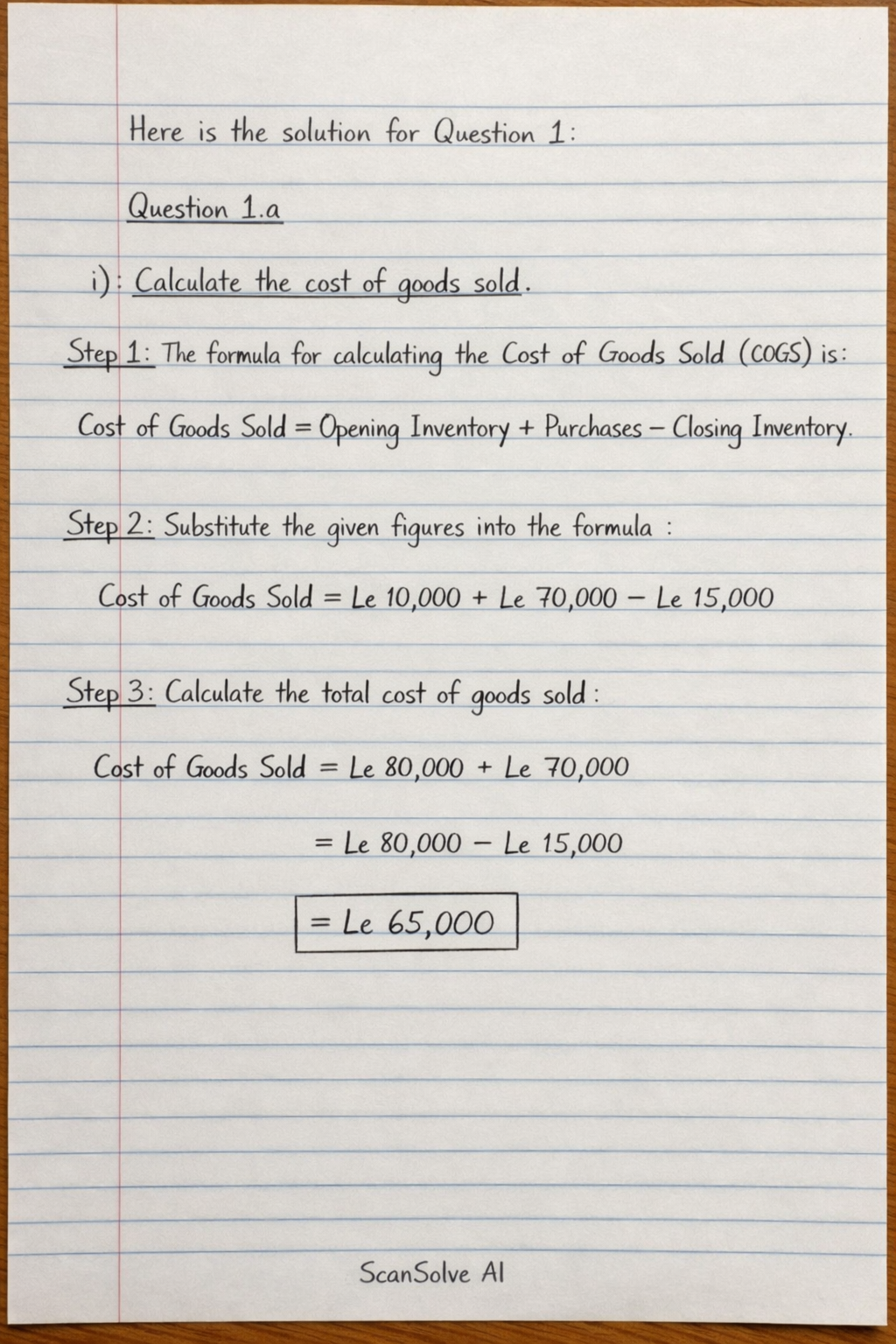
Here is the solution for Question 1: Question 1.a i) Calculate the cost of goods sold. Step 1: The formula for calculating the Cost of Goods Sold (COGS) involves the starting inventory, purchases made during the period, and the inventory remaining at the end. Cost of Goods Sold = Opening Inventory + Purchases - Closing Inventory Step 2: Substitute the given financial figures into the formula. Cost of Goods Sold = Le 10,000 + Le 70,000 - Le 15,000 Step 3: Perform the arithmetic to determine the total cost of goods sold. Cost of Goods Sold = Le 80,000 - Le 15,000 = Le 65,000 ii) Prepare a simple income statement. Step 1: Begin the income statement with the total sales revenue generated. Sales = Le 120,000 Step 2: Subtract the calculated Cost of Goods Sold from Sales to arrive at the Gross Profit. Gross Profit = Sales - Cost of Goods Sold Gross Profit = Le 120,000 - Le 65,000 = Le 55,000 Step 3: Calculate the total operating expenses by summing Wages and Rent, then subtract these from the Gross Profit to find the Net Profit. Operating Expenses = Wages + Rent Operating Expenses = Le 20,000 + Le 5,000 = Le 25,000 Net Profit = Gross Profit - Operating Expenses Net Profit = Le 55,000 - Le 25,000 = Le 30,000 iii) Explain the effect of closing inventory on profit. Closing inventory directly impacts the Cost of Goods Sold (COGS) and, consequently, the reported profit. A higher closing inventory reduces the COGS, which means a larger gross profit and ultimately a higher net profit for the accounting period. Conversely, a lower closing inventory increases the COGS, leading to a smaller gross profit and a reduced net profit. This is because closing inventory represents goods not yet sold, so a larger amount means fewer goods are expensed as COGS. iv) Identify and explain two users of the financial statements. • Investors: These individuals or entities use financial statements to evaluate a company's financial performance, profitability, and stability. Their analysis helps them make informed decisions about whether to buy, hold, or sell shares in the company, assessing the potential returns and risks associated with their investment. • Creditors: Banks, suppliers, and other lenders rely on financial statements to assess a company's creditworthiness and its ability to repay debts. They examine liquidity, solvency, and profitability ratios to determine whether to grant loans, extend credit terms, or continue existing credit arrangements. Question 1.b i) Calculate contribution per unit. Step 1: The contribution per unit is found by subtracting the variable cost per unit from the selling price per unit. Contribution per unit = Selling price per unit - Variable cost per unit Step 2: Substitute the provided values into the formula. Contribution per unit = Le 50 - Le 30 Step 3: Calculate the resulting contribution per unit. Contribution per unit = Le 20 ii) Compute the break-even point in units. Step 1: The break-even point in units is calculated by dividing the total fixed costs by the contribution per unit. Break-even point (units) = Fixed CostContribution per unit Step 2: Substitute the given fixed cost and the calculated contribution per unit into the formula. Break-even point (units) = Le 10,000Le 20 per unit Step 3: Perform the division to find the break-even point in units. Break-even point (units) = 500 units iii) What is the profit if 1,000 units are sold? Step 1: First, calculate the total contribution generated from selling 1,000 units. Total Contribution = Units sold × Contribution per unit Total Contribution = 1,000 units × Le 20 per unit = Le 20,000 Step 2: Subtract the total fixed costs from the total contribution to determine the profit. Profit = Total Contribution - Fixed Cost Profit = Le 20,000 - Le 10,000 = Le 10,000 iv) Explain one advantage and one limitation of marginal costing. • Advantage: Marginal costing is highly beneficial for short-term decision-making because it clearly distinguishes between fixed and variable costs. This allows management to easily assess the impact of various decisions, such as pricing strategies, accepting special orders, or make-or-buy choices, by focusing on the contribution each unit makes towards covering fixed costs and generating profit. • Limitation: A significant limitation is that marginal costing does not comply with Generally Accepted Accounting Principles (GAAP) for external financial reporting. Under marginal costing, inventory is valued only at its variable production costs, excluding fixed overheads. This can lead to an understatement of inventory values on the balance sheet and may not provide a true and fair view of the company's financial position for external stakeholders. What's next?