

This accounting problem is solved step by step below, with detailed explanations to help you understand the method and arrive at the correct answer.
ScanSolve AI Answer
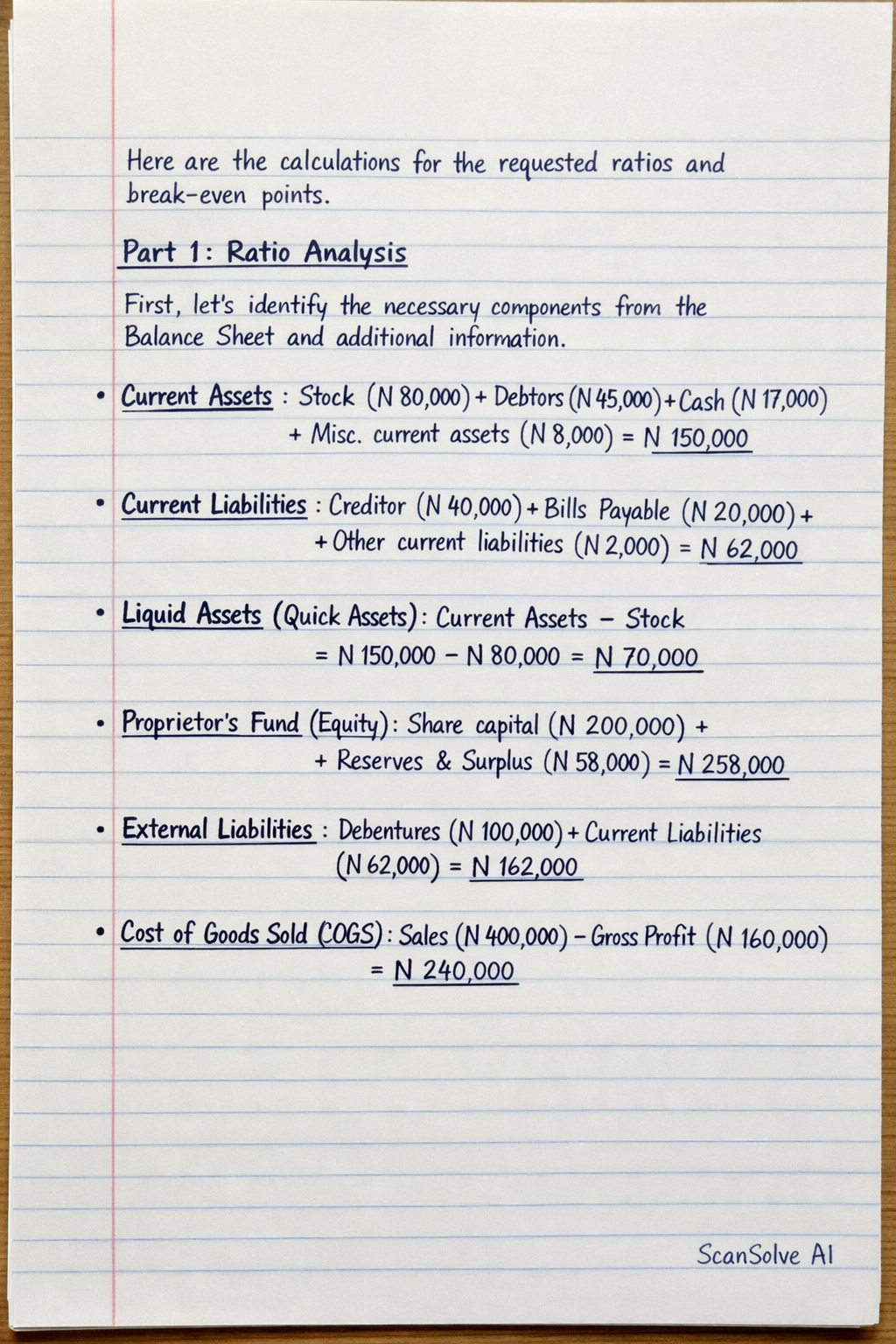
Here are the calculations for the requested ratios and break-even points. Part 1: Ratio Analysis First, let's identify the necessary components from the Balance Sheet and additional information. Current Assets: Stock (N 80,000) + Debtor (N 45,000) + Cash (N 17,000) + Misc. current assets (N 8,000) = N 150,000 Current Liabilities: Creditor (N 40,000) + Bills payable (N 20,000) + Other current liabilities (N 2,000) = N 62,000 Liquid Assets (Quick Assets): Current Assets - Stock = N 150,000 - N 80,000 = N 70,000 Proprietor's Fund (Equity): Share capital (N 200,000 - assuming this to match total liabilities) + Reserves and surplus (N 58,000) = N 258,000 External Liabilities: Debentures (N 100,000) + Current Liabilities (N 62,000) = N 162,000 Cost of Goods Sold (COGS): Sales (N 400,000) - Gross Profit (N 160,000) = N 240,000 i. Current ratio Step 1: State the formula and substitute values. Current Ratio = Current AssetsCurrent Liabilities = N 150,000N 62,000 Step 2: Calculate the ratio. Current Ratio ≈ 2.42:1 Advice: A current ratio of 2.42:1 indicates strong short-term liquidity, suggesting the company can comfortably meet its short-term obligations. ii. Inventory turnover Step 1: State the formula and substitute values (assuming closing inventory is average inventory). Inventory Turnover = Cost of Goods SoldAverage Inventory = N 240,000N 80,000 Step 2: Calculate the turnover. Inventory Turnover = 3 times Advice: An inventory turnover of 3 times suggests that the company sells and replaces its inventory three times a year, which needs to be compared to industry benchmarks for a full assessment. iii. Proprietor's fund to Liabilities Step 1: State the formula and substitute values. Proprietor's Fund to Liabilities = Proprietor's FundExternal Liabilities = N 258,000N 162,000 Step 2: Calculate the ratio. Proprietor's Fund to Liabilities ≈ 1.59:1 Advice: This ratio indicates that the owners' equity is significantly higher than external debt, suggesting a strong financial structure and lower financial risk for investors. iv. Quick or liquid ratio Step 1: State the formula and substitute values. Quick Ratio = Liquid AssetsCurrent Liabilities = N 70,000N 62,000 Step 2: Calculate the ratio. Quick Ratio ≈ 1.13:1 Advice: A quick ratio of 1.13:1 shows good immediate liquidity, meaning the company can cover its current liabilities without relying on inventory sales. v. Average collection period Step 1: State the formula and substitute values (assuming 365 days in a year). Average Collection Period = (Average DebtorsCredit Sales) × 365 days = (N 45,000N 400,000) × 365 days Step 2: Calculate the average collection period. Average Collection Period ≈ 41.06 days Advice: An average collection period of approximately 41 days indicates how long it takes to collect receivables, which should be evaluated against the company's credit terms. --- QUESTION THREE (3) 3a. Break-even analysis for a company that sales toy guns in Jos city Given: Sales = N 200,000 Variable cost = N 120,000 Fixed cost = N 30,000 First, calculate the Contribution Margin (CM) and P/V Ratio: CM = Sales - Variable Cost = N 200,000 - N 120,000 = N 80,000 P/V Ratio = CM / Sales = N 80,000 / N 200,000 = 0.4 a) Break-even point Step 1: State the formula and substitute values. Break-even Point (in Sales Value) = Fixed CostP/V Ratio = N 30,0000.4 Step 2: Calculate the break-even point. Break-even Point = N 75,000 b) New Break-even point if selling price is reduced by 10% Step 1: Calculate the new P/V Ratio. Original Variable Cost Ratio = Variable Cost / Sales = N 120,000 / N 200,000 = 0.6. If selling price is reduced by 10%, the new selling price per unit is 0.9 × Original SP. The variable cost per unit remains the same. New P/V Ratio = (0.9 × SP) - VC0.9 × SP = 0.9 × SP - 0.6 × SP0.9 × SP = 0.3 × SP0.9 × SP = (0.3)/(0.9) = (1)/(3) Step 2: Calculate the new break-even point. New Break-even Point = Fixed CostNew P/V Ratio = N 30,0001/3 New Break-even Point = N 90,000 c) New Break-even point if variable cost increases by 10% Step 1: Calculate the new variable cost and new P/V Ratio. New Variable Cost = N 120,000 × (1 + 0.10) = N 132,000 New Contribution Margin = N 200,000 - N 132,000 = N 68,000 New P/V Ratio = N 68,000 / N 200,000 = 0.34 Step 2: Calculate the new break-even point. New Break-even Point = Fixed CostNew P/V Ratio = N 30,0000.34 New Break-even Point ≈ N 88,235.29 d) New Break-even point if fixed cost increases by 10% Step 1: Calculate the new fixed cost. New Fixed Cost = N 30,000 × (1 + 0.10) = N 33,000 The P/V Ratio remains 0.4. Step 2: Calculate the new break-even point. New Break-even Point = New Fixed CostP/V Ratio = N 33,0000.4 New Break-even Point = N 82,500 --- 3b. Profitability data for a management consultant Given: Fixed expenses = N 4,000 Break-even point (Sales Value) = N 10,000 i. P/V ratio Step 1: State the formula and substitute values. P/V Ratio = Fixed ExpensesBreak-even Point (Sales Value) = N 4,000N 10,000 Step 2: Calculate the P/V Ratio. P/V Ratio = 0.4 or 40\% ii. Profit when sales are N 20,000 Step 1: State the formula and substitute values. Profit = (Sales × P/V Ratio) - Fixed Expenses Profit = (N 20,000 × 0.4) - N 4,000 Step 2: Calculate the profit. Profit = N 8,000 - N 4,000 = N 4,000 iii. New break-even point if selling price is reduced by 20% Step 1: Calculate the new P/V Ratio. Original P/V Ratio = 0.4, which means Variable Cost is 60% of Sales (1 - 0.4). Let original Selling Price per unit be SP and Variable Cost per unit be VC. So, VC = 0.6 × SP. If selling price is reduced by 20%, New SP = 0.8 × SP. Variable cost per unit remains the same. New P/V Ratio = New SP - VCNew SP = 0.8 × SP - 0.6 × SP0.8 × SP = 0.2 × SP0.8 × SP = 0.25 Step 2: Calculate the new break-even point. New Break-even Point = Fixed ExpensesNew P/V Ratio = N 4,0000.25 New Break-even Point = N 16,000