

This accounting problem is solved step by step below, with detailed explanations to help you understand the method and arrive at the correct answer.
ScanSolve AI Answer
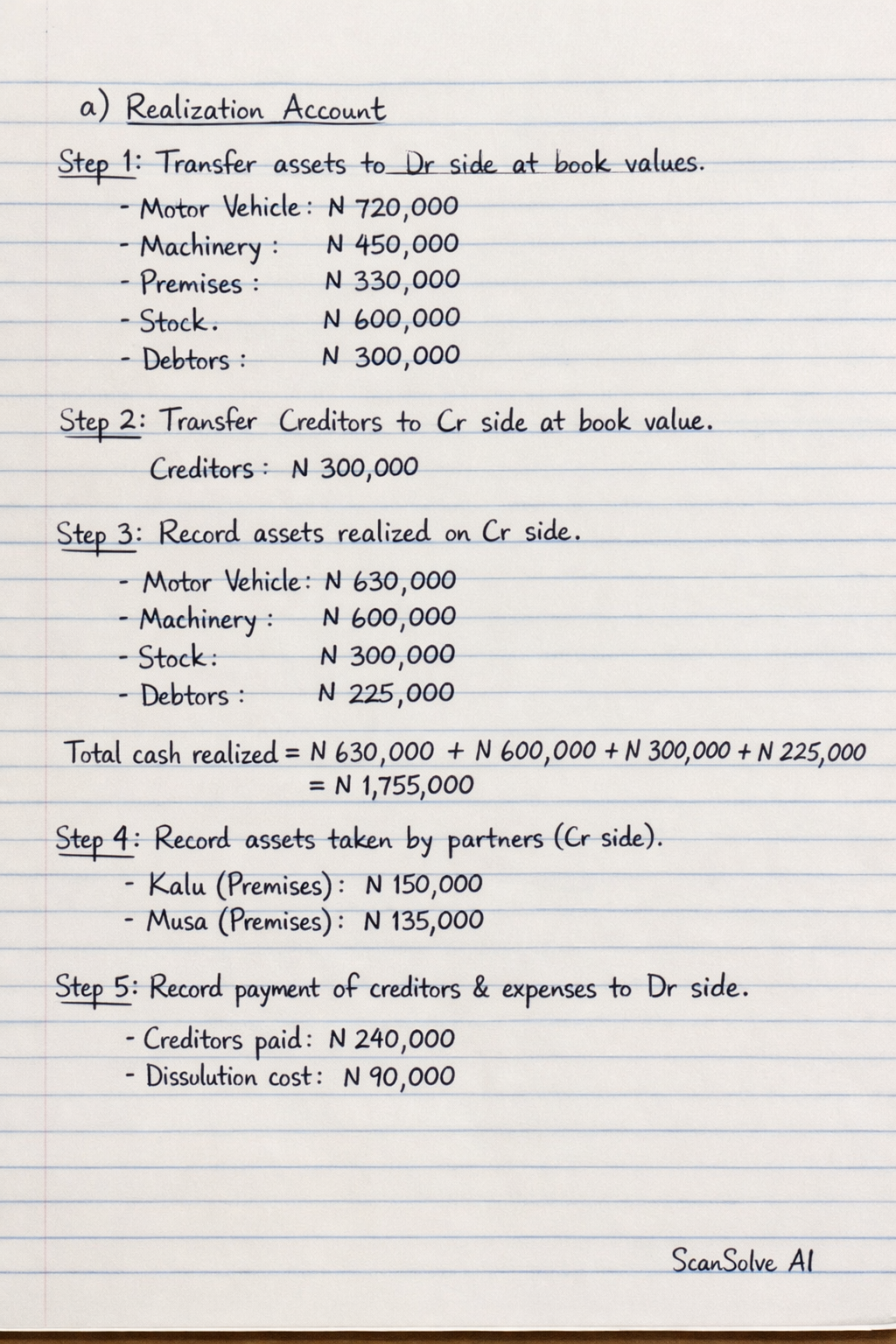
Here are the required accounts for the dissolution of the partnership: a) Realization Account Step 1: Transfer all assets (excluding bank/cash) to the debit side of the Realization Account at their book values. Motor vehicle: N 720,000 Machinery: N 450,000 Premises: N 330,000 Stock: N 600,000 Debtors: N 300,000 Step 2: Transfer external liabilities (Creditors) to the credit side of the Realization Account at their book value. Creditors: N 300,000 Step 3: Record the realization of assets on the credit side. Motor vehicle: N 630,000 Machinery: N 600,000 Stock: N 300,000 Debtors: N 225,000 Total cash realized = N 630,000 + N 600,000 + N 300,000 + N 225,000 = N 1,755,000 Step 4: Record assets taken over by partners on the credit side. Kalu (Premises): N 150,000 Musa (Premises): N 135,000 Step 5: Record the payment of creditors and dissolution expenses on the debit side. Creditors paid: N 240,000 Dissolution cost: N 90,000 Step 6: Calculate the profit or loss on realization and distribute it to partners' capital accounts in their profit-sharing ratio (2:3). Total Debits = (720,000 + 450,000 + 330,000 + 600,000 + 300,000) + 240,000 + 90,000 = N 2,730,000 Total Credits = 300,000 + 1,755,000 + 150,000 + 135,000 = N 2,340,000 Loss on Realization = N 2,730,000 - N 2,340,000 = N 390,000 Kalu's share of loss = N 390,000 × (2)/(5) = N 156,000 Musa's share of loss = N 390,000 × (3)/(5) = N 234,000 |l|r|l|r| Realization Account & N & & N \\ To Motor vehicle & 720,000 & By Creditors & 300,000 \\ To Machinery & 450,000 & By Bank (Assets realized) & 1,755,000 \\ To Premises & 330,000 & By Kalu's Capital A/c (Premises) & 150,000 \\ To Stock & 600,000 & By Musa's Capital A/c (Premises) & 135,000 \\ To Debtors & 300,000 & By Kalu's Capital A/c (Loss) & 156,000 \\ To Bank (Creditors paid) & 240,000 & By Musa's Capital A/c (Loss) & 234,000 \\ To Bank (Dissolution expenses) & 90,000 & & \\ Total & 2,730,000 & Total & 2,730,000 \\ b) Partners' Capital Account Step 1: Bring down the opening balances of Capital and Current Accounts to the credit side. Kalu: Capital N 750,000, Current N 360,000 Musa: Capital N 675,000, Current N 195,000 Step 2: Debit partners for assets taken over and their share of realization loss. Kalu (Premises): N 150,000 Musa (Premises): N 135,000 Kalu (Loss): N 156,000 Musa (Loss): N 234,000 Step 3: Calculate the final payment to each partner (balancing figure) and transfer to the Bank Account. Kalu's Credit = 750,000 + 360,000 = N 1,110,000 Kalu's Debit = 150,000 + 156,000 = N 306,000 Kalu's final payment = 1,110,000 - 306,000 = N 804,000 Musa's Credit = 675,000 + 195,000 = N 870,000 Musa's Debit = 135,000 + 234,000 = N 369,000 Musa's final payment = 870,000 - 369,000 = N 501,000 |l|r|r|l|r|r| Partners' Capital Account & Kalu (N) & Musa (N) & & Kalu (N) & Musa (N) \\ To Realization A/c (Premises) & 150,000 & 135,000 & By Balance b/d (Capital) & 750,000 & 675,000 \\ To Realization A/c (Loss) & 156,000 & 234,000 & By Balance b/d (Current) & 360,000 & 195,000 \\ To Bank A/c (Final payment) & 804,000 & 501,000 & & & \\ Total & 1,110,000 & 870,000 & Total & 1,110,000 & 870,000 \\ c) Bank Account Step 1: Bring down the opening bank overdraft balance to the credit side. Bank overdraft: N 120,000 Step 2: Debit the account for cash received from asset realization. Realization A/c (Assets realized): N 1,755,000 Step 3: Credit the account for payments made for creditors, dissolution expenses, and final payments to partners. Realization A/c (Creditors paid): N 240,000 Realization A/c (Dissolution expenses): N 90,000 Kalu's Capital A/c (Final payment): N 804,000 Musa's Capital A/c (Final payment): N 501,000 Step 4: The Bank Account should balance, indicating the dissolution process is complete. |l|r|l|r| Bank Account & N & & N \\ To Realization A/c (Assets realized) & 1,755,000 & By Balance b/d (Overdraft) & 120,000 \\ & & By Realization A/c (Creditors paid) & 240,000 \\ & & By Realization A/c (Dissolution expenses) & 90,000 \\ & & By Kalu's Capital A/c (Final payment) & 804,000 \\ & & By Musa's Capital A/c (Final payment) & 501,000 \\ Total & 1,755,000 & Total & 1,755,000 \\ That's 5 down. You've completed all the questions for today!