
We read your photo as:
On acquisition date, subsidiary's retained earnings represent
ScanSolve AI Answer
Answer
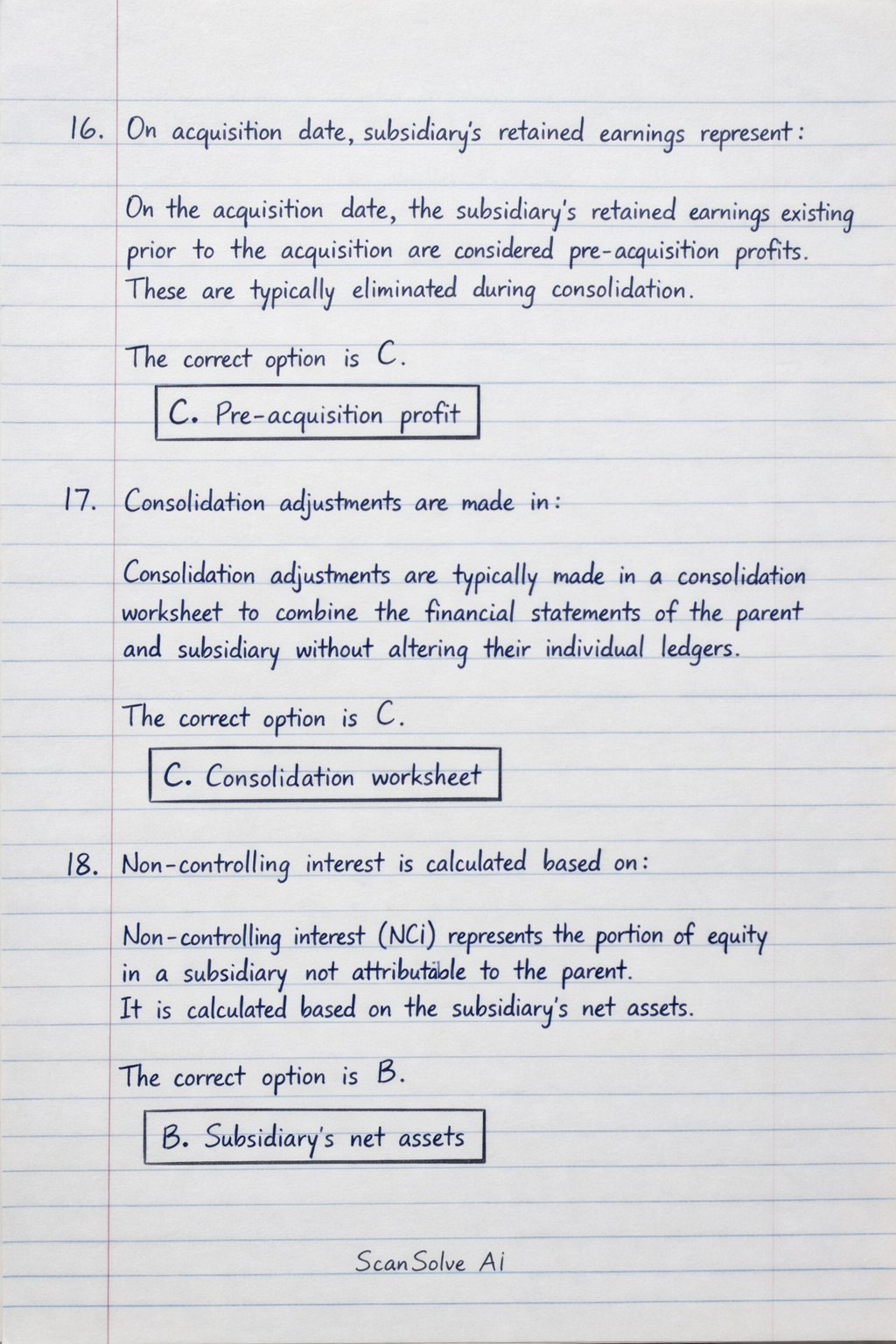
16. On acquisition date, subsidiary's retained earnings represent:
On the acquisition date, the subsidiary's retained earnings existing prior to the acquisition are considered pre-acquisition profits. These are typically eliminated during consolidation.
- The correct option is C.
17. Consolidation adjustments are made in:
Consolidation adjustments are typically made in a consolidation worksheet to combine the financial statements of the parent and subsidiary without altering their individual ledgers.
- The correct option is C.
18. Non-controlling interest is calculated based on:
Non-controlling interest (NCI) represents the portion of equity in a subsidiary not attributable to the parent. It is calculated based on the subsidiary's net assets.
- The correct option is B.
19. Consolidated financial statements present the group as:
Consolidated financial statements present the financial position and results of operations of a parent and its subsidiaries as if they were a single economic entity.
- The correct option is B.
20. Which standard governs consolidation under IFRS?
IFRS 10 Consolidated Financial Statements sets out the principles for the presentation and preparation of consolidated financial statements.
- The correct option is C.
21. Functional currency is determined based on:
Under IAS 21, the functional currency is the currency of the primary economic environment in which an entity operates.
- The correct option is C.
22. Foreign currency monetary items are translated using:
Under IAS 21, monetary items (e.g., cash, receivables, payables) are translated using the closing rate at the reporting date.
- The correct option is C.
23. Non-monetary items measured at historical cost are translated using:
Under IAS 21, non-monetary items measured at historical cost (e.g., property, plant, and equipment, inventory) are translated using the exchange rate at the date of the transaction (historical rate).
- The correct option is B.
24. Foreign operation results are translated using:
For translating the financial statements of a foreign operation, income and expense items are typically translated at average rates for the period, while assets and liabilities are translated at the closing rate.
- The correct option is C.
25. On disposal of a foreign operation, cumulative exchange differences are:
Upon the disposal of a foreign operation, the cumulative exchange differences previously recognized in other comprehensive income are reclassified from equity to profit or loss.
- The correct option is C.
26. Which item is considered monetary?
Monetary items are assets and liabilities to be received or paid in a fixed or determinable number of units of currency. Trade receivables represent a right to receive a fixed amount of cash.
- The correct option is C.
27. Which standard governs foreign exchange under IFRS?
IAS 21 The Effects of Changes in Foreign Exchange Rates is the standard that governs accounting for foreign currency transactions and foreign operations.
- The correct option is B.
Try one yourself
A new problem that tests the same skill.
Still stuck on this one?
Ask a follow-up, and the answer starts from this question.
More Accounting Questions
Handwritten Step-by-Step Solution
Get this as a handwritten image on WhatsApp — like a tutor wrote it for you.
Try on WhatsApp