
What is the difference between calculating of cost of sales and cost of goods sold
ScanSolve AI Answer
Answer
For most inventory-based businesses, you can consider them to be the same. If a problem provides "Cost of Sales," you should generally treat it as the Cost of Goods Sold for calculating gross margin unless specified otherwise.
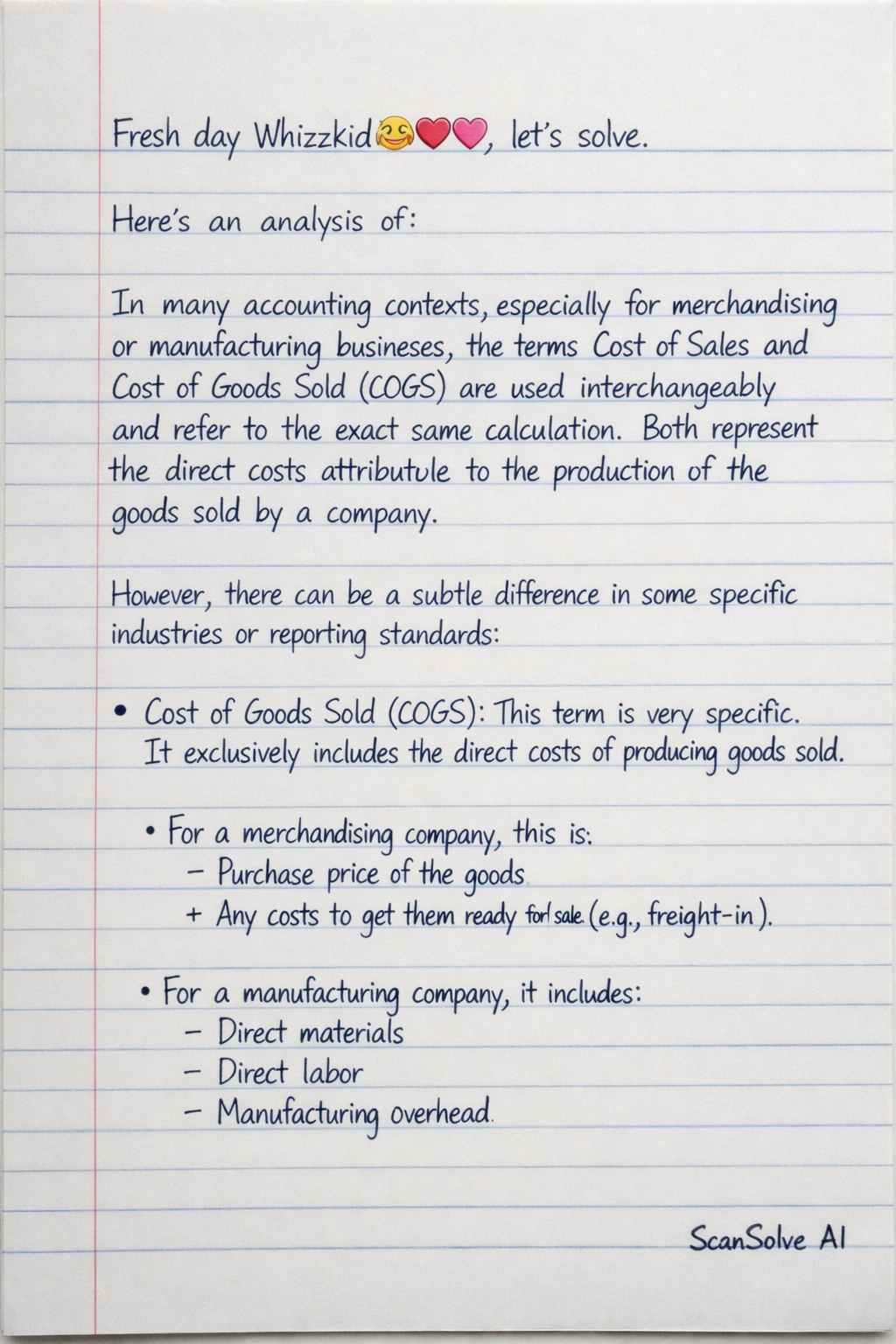
In many accounting contexts, especially for merchandising or manufacturing businesses, the terms Cost of Sales and Cost of Goods Sold (COGS) are used interchangeably and refer to the exact same calculation. Both represent the direct costs attributable to the production of the goods sold by a company.
However, there can be a subtle difference in some specific industries or reporting standards:
-
Cost of Goods Sold (COGS): This term is very specific. It exclusively includes the direct costs of producing the goods sold. For a merchandising company, this is the purchase price of the goods plus any costs to get them ready for sale (e.g., freight-in). For a manufacturing company, it includes direct materials, direct labor, and manufacturing overhead.
-
Cost of Sales: This term can sometimes be broader. While it often means the same as COGS, in certain service industries or for specific reporting, "Cost of Sales" might include not only the direct cost of goods but also other direct costs associated with generating revenue, such as direct labor for service providers, or even some direct selling expenses like sales commissions or freight-out.
Still stuck on this one?
Ask a follow-up, and the answer starts from this question.
More Accounting Questions
Handwritten Step-by-Step Solution
Get this as a handwritten image on WhatsApp — like a tutor wrote it for you.
Try on WhatsApp