
We read your photo as:
This image displays an Accounts Receivable Ledger, which is a subsidiary ledger that records the credit sales and cash receipts for each customer. It provides a detailed breakdown of how much each c
Accounting
ScanSolve AI Answer
Answer
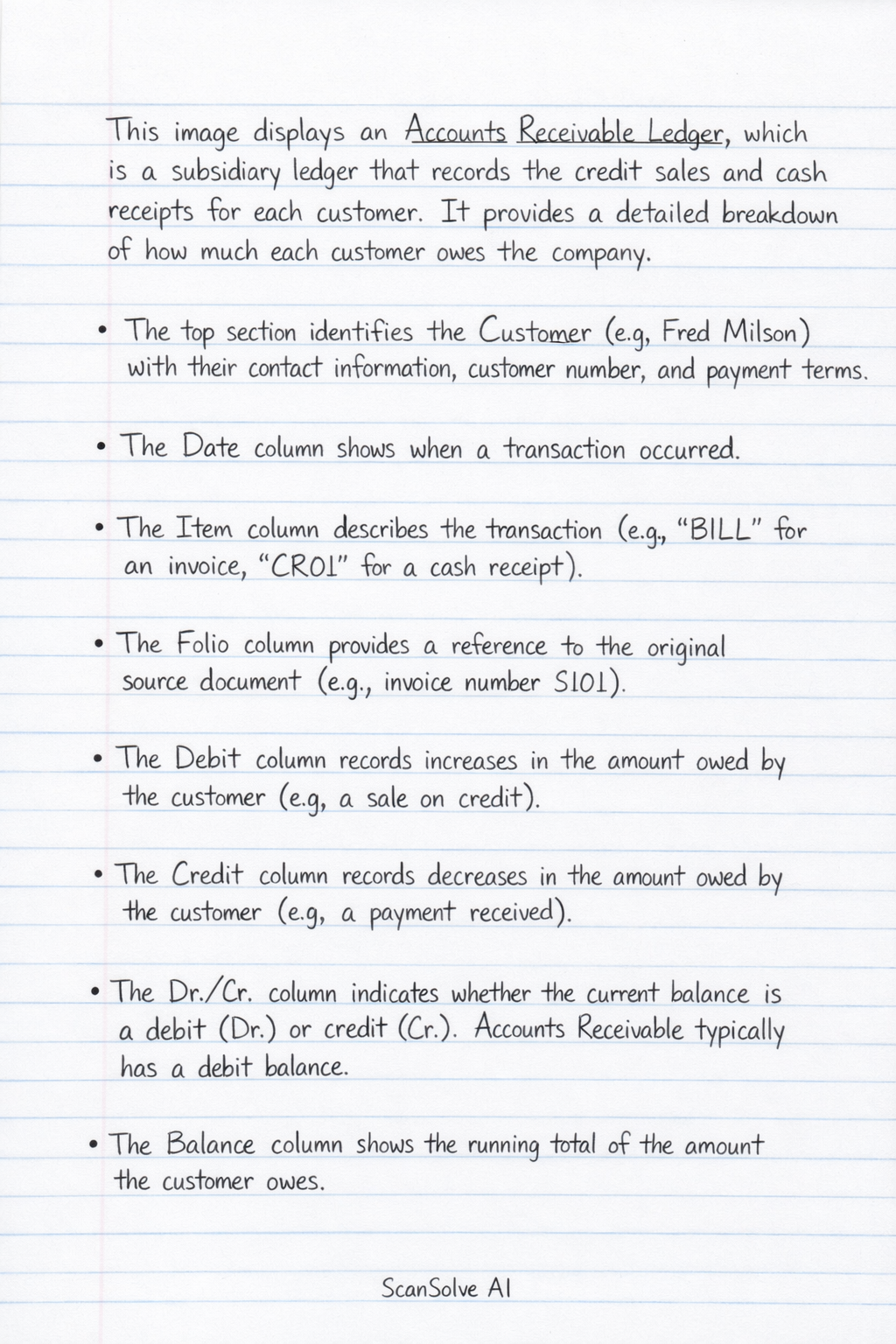
This image displays an Accounts Receivable Ledger, which is a subsidiary ledger that records the credit sales and cash receipts for each customer. It provides a detailed breakdown of how much each customer owes the company.
- The top section identifies the Customer (e.g., Fred Milson) with their contact information, customer number, and payment terms.
- The Date column shows when a transaction occurred.
- The Item column describes the transaction (e.g., "BILL" for an invoice, "CR01" for a cash receipt).
- The Folio column provides a reference to the original source document (e.g., invoice number S101).
- The Debit column records increases in the amount owed by the customer (e.g., a sale on credit).
- The Credit column records decreases in the amount owed by the customer (e.g., a payment received).
- The Dr./Cr. column indicates whether the current balance is a debit (Dr.) or credit (Cr.). Accounts Receivable typically has a debit balance.
- The Balance column shows the running total of the amount the customer owes.
For example, for Fred Milson:
- On Jan 17, a bill (S101) for
\1,449.99$1,449.99$ (Dr.). - On Jan 30, a cash receipt (CR01) for
\1,449.99$0.00$.
Was this helpful?
Still stuck on this one?
Ask a follow-up, and the answer starts from this question.
Got a different question?Ask your own question
More Accounting Questions
QThe image contains a ledger or accounting record, not a homework question. It shows financial…QWhat is a ledger in Accounting principlesQThe image contains an accounting ledger. The question is to extract the accounting entries and…QThis image displays a General Ledger template, which is a central record-keeping system for a…QDetermine the discrepancies in the Debtors Ledger
Handwritten Step-by-Step Solution
Get this as a handwritten image on WhatsApp — like a tutor wrote it for you.
Try on WhatsApp