
We read your photo as:
Calculate the total preference dividend and total ordinary dividend. Prepare journal entries for declaration and payment dates.
ScanSolve AI Answer
Answers
2 partsStep-by-step solution
6 stepsPart a· 2 steps
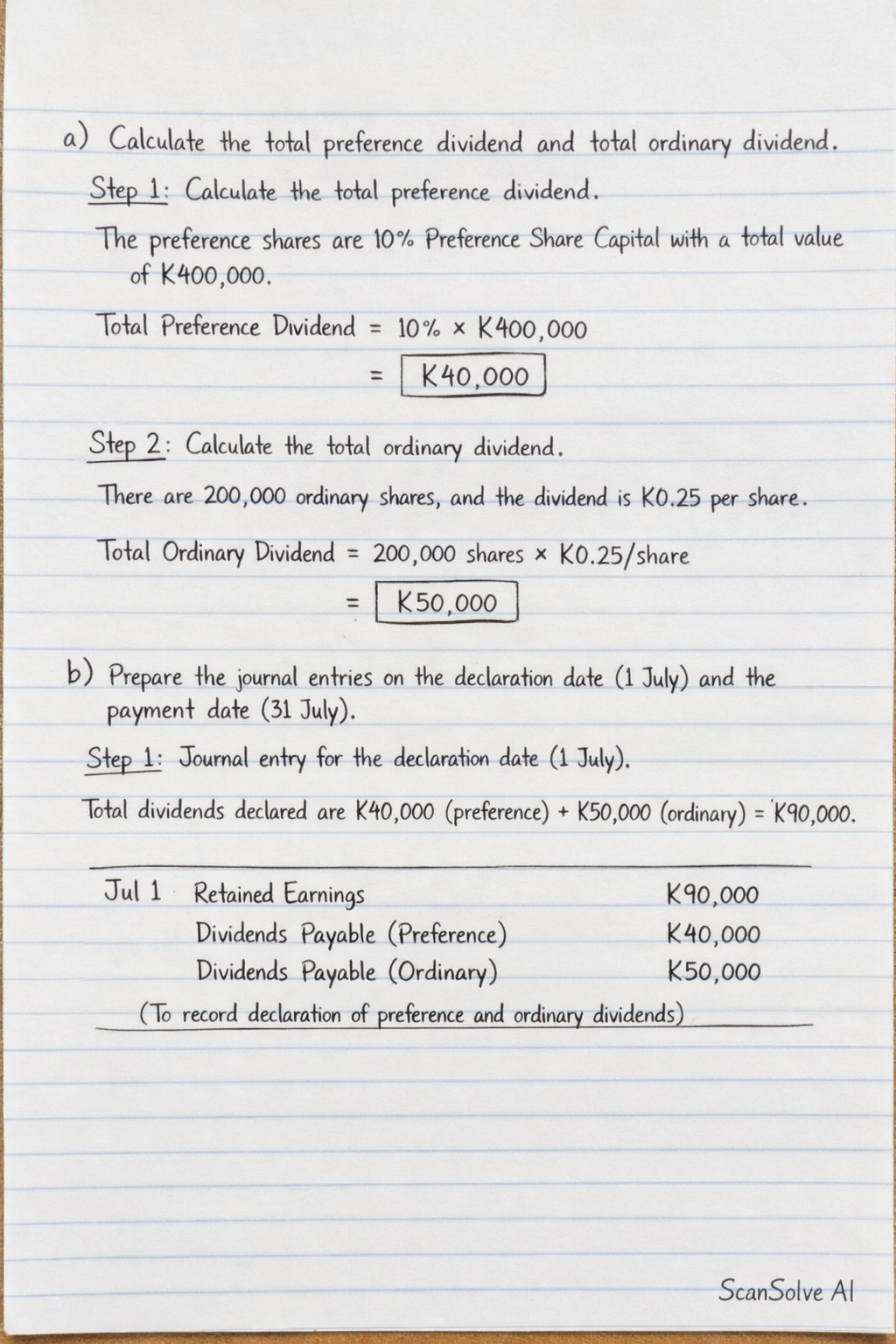
Calculate the total preference dividend and total ordinary dividend.
Calculate the total preference dividend.
The preference shares are 10% Preference Share Capital with a total value of K400,000.
Calculate the total ordinary dividend.
There are 200,000 ordinary shares, and the dividend is K0.25 per share.
Part b· 2 steps
Prepare the journal entries on the declaration date (1 July) and the payment date (31 July).
Journal entry for the declaration date (1 July).
The total dividends declared are K40,000 (preference) + K50,000 (ordinary) = K90,000.
\begin{align*} Jul 1 && Retained Earnings && K90,000 \ && Dividends Payable (Preference) && && K40,000 \ && Dividends Payable (Ordinary) && && K50,000 \ && (To record declaration of preference and ordinary dividends) \end{align*}Journal entry for the payment date (31 July).
\begin{align*} Jul 31 && Dividends Payable (Preference) && K40,000 \ && Dividends Payable (Ordinary) && K50,000 \ && Cash && && K90,000 \ && (To record payment of preference and ordinary dividends) \end{align*}
Part c
Show the updated Retained Earnings balance after both dividends are declared.
Identify the initial Retained Earnings balance.
Initial Retained Earnings balance = K350,000.
Subtract the total dividends declared from Retained Earnings.
Part d
Explain why Share Premium is not reduced when dividends are declared.
Share Premium represents the amount of capital contributed by shareholders above the par value of the shares. It is considered contributed capital. Dividends, on the other hand, are distributions of a company's accumulated profits, which are recorded in the Retained Earnings account. Therefore, dividends reduce Retained Earnings, not Share Premium, as Share Premium is not a source of distributable profits for regular dividends.
Still stuck on this one?
Ask a follow-up, and the answer starts from this question.
More Accounting Questions
Handwritten Step-by-Step Solution
Get this as a handwritten image on WhatsApp — like a tutor wrote it for you.
Try on WhatsApp