
We read your photo as:
Calculate the value of the closing stock on the FIFO stock valuation method and calculate the stockholding period (in days). Use the closing stock figure. Comment on your calculation in points.
ScanSolve AI Answer
It appears that the tables containing the full stock records (opening stock, purchases, and closing stock units/prices) are incomplete in the provided image. To accurately calculate the value of closing stock and the stockholding period, I need the following information:
- Opening stock: Number of units and cost per unit for March 2025.
- Purchases and returns: A complete list of all purchases (dates, units, and price per unit) made during the financial year.
- Closing stock units: The total number of units in stock on 28 February 2026.
Without this data, I cannot perform the calculations for questions 3.1.1 and 3.1.2. However, I can explain the methodology for each part.
3.1.1 Calculate the value of the closing stock on 28 February 2026 using the FIFO stock valuation method.
- Methodology (FIFO - First-In-First-Out): Under the FIFO method, it is assumed that the first goods purchased are the first ones sold. Therefore, the closing stock consists of the most recently purchased items.
- Steps (if data were available):
- Determine the total number of units in closing stock on 28 February 2026.
- Identify the most recent purchases that make up this closing stock quantity.
- Multiply the units from each of these recent purchases by their respective purchase prices to find the total value of the closing stock.
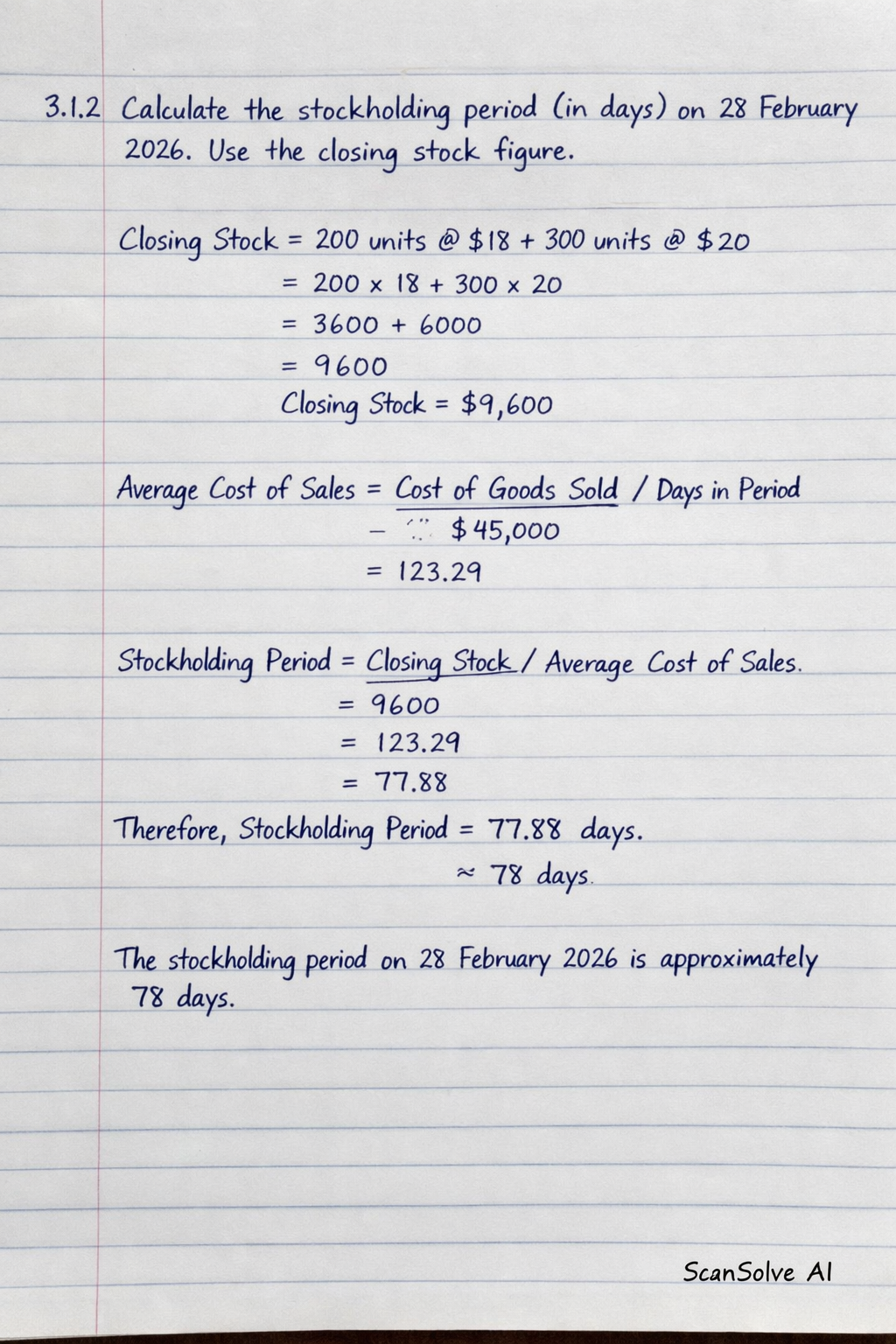
3.1.2 Calculate the stockholding period (in days) on 28 February 2026. Use the closing stock figure.
- Formula:
- Steps (if data were available):
- Calculate Cost of Sales: (The Closing Stock Value would be calculated in 3.1.1).
- Calculate Average Stock:
- Apply the Stockholding Period formula using the calculated Average Stock and Cost of Sales.
3.1.3 Comment on your calculation in QUESTION 3.1.2. Provide TWO points. The stockholding period on 28 February 2025 was 45 days.
Assuming a stockholding period could be calculated, here are two points for comment, using the previous year's figure of 45 days as a benchmark:
- Comparison to Previous Year: If the calculated stockholding period for 2026 is significantly lower than 45 days, it indicates improved efficiency in inventory management, meaning stock is being sold faster. If it's higher, it suggests slower sales or overstocking.
- Impact on Liquidity and Costs: A shorter stockholding period generally improves a business's liquidity as less capital is tied up in inventory. Conversely, a longer period increases carrying costs (storage, insurance, obsolescence risk) and can strain cash flow.
Please provide the complete tables for opening stock, purchases, and closing stock units so I can perform the calculations for 3.1.1 and 3.1.2. Send me the next one 📸
Still stuck on this one?
Ask a follow-up, and the answer starts from this question.
More Accounting Questions
Handwritten Step-by-Step Solution
Get this as a handwritten image on WhatsApp — like a tutor wrote it for you.
Try on WhatsApp