
We read your photo as:
Where does respiration occur in?
Biology
ScanSolve AI Answer
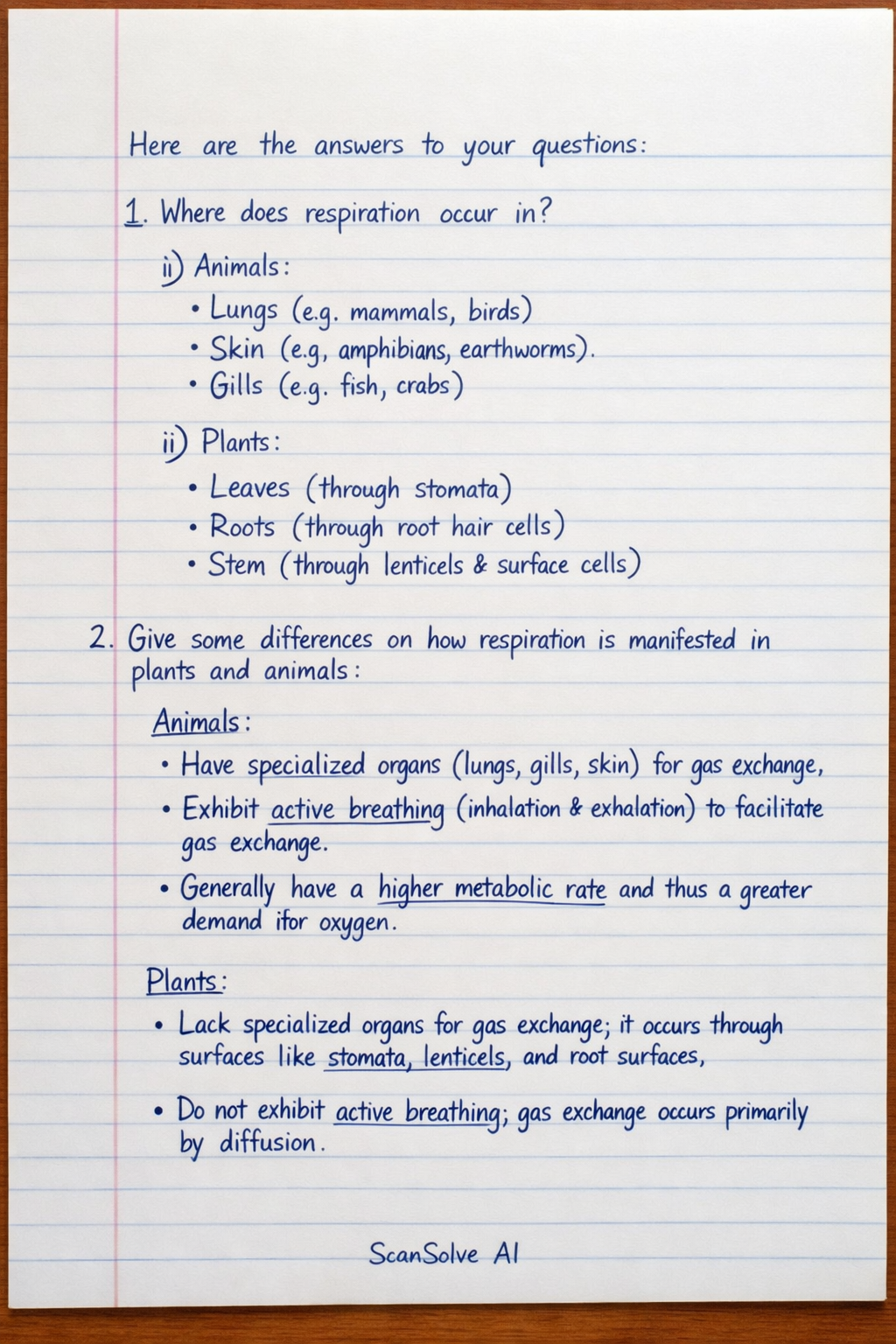
Here are the answers to your questions:
-
Where does respiration occur in?
- i) Animals:
- Lungs (e.g., mammals, birds)
- Skin (e.g., amphibians, earthworms)
- Gills (e.g., fish, crabs)
- ii) Plants:
- Leaves (through stomata)
- Roots (through root hair cells)
- Stem (through lenticels and general surface cells)
- i) Animals:
-
Give some differences on how respiration is manifested in plants and animals.
- Animals:
- Have specialized organs (lungs, gills, skin) for gas exchange.
- Exhibit active breathing (inhalation and exhalation) to facilitate gas exchange.
- Generally have a higher metabolic rate and thus a greater demand for oxygen.
- Plants:
- Lack specialized organs for gas exchange; it occurs through general surfaces like stomata, lenticels, and root surfaces.
- Do not exhibit active breathing; gas exchange occurs primarily by diffusion.
- Generally have a lower metabolic rate and thus a lower demand for oxygen compared to animals.
- Animals:
-
What is the difference between sensitivity in plants and animals?
- Sensitivity is the ability of an organism to sense and respond to changes or stimuli in its environment.
- Animals:
- Possess well-developed nervous systems and specialized sense organs (eyes, ears, nose, etc.) for rapid and complex detection of stimuli.
- Responses are often quick and involve locomotion or muscular movements.
- Plants:
- Lack a nervous system and specialized sense organs.
- Responses are generally slower and involve growth movements (tropisms) or changes in turgor pressure, rather than locomotion.
-
Growth:
- Growth is an irreversible increase in the size, mass, and complexity of an organism, resulting from processes like cell division, cell enlargement, and differentiation.
Was this helpful?
Still stuck on this one?
Ask a follow-up, and the answer starts from this question.
Got a different question?Ask your own question
More Biology Questions
Handwritten Step-by-Step Solution
Get this as a handwritten image on WhatsApp — like a tutor wrote it for you.
Try on WhatsApp