

This biology question covers important biological concepts and processes. The step-by-step explanation below helps you understand the underlying mechanisms and reasoning.
ScanSolve AI Answer
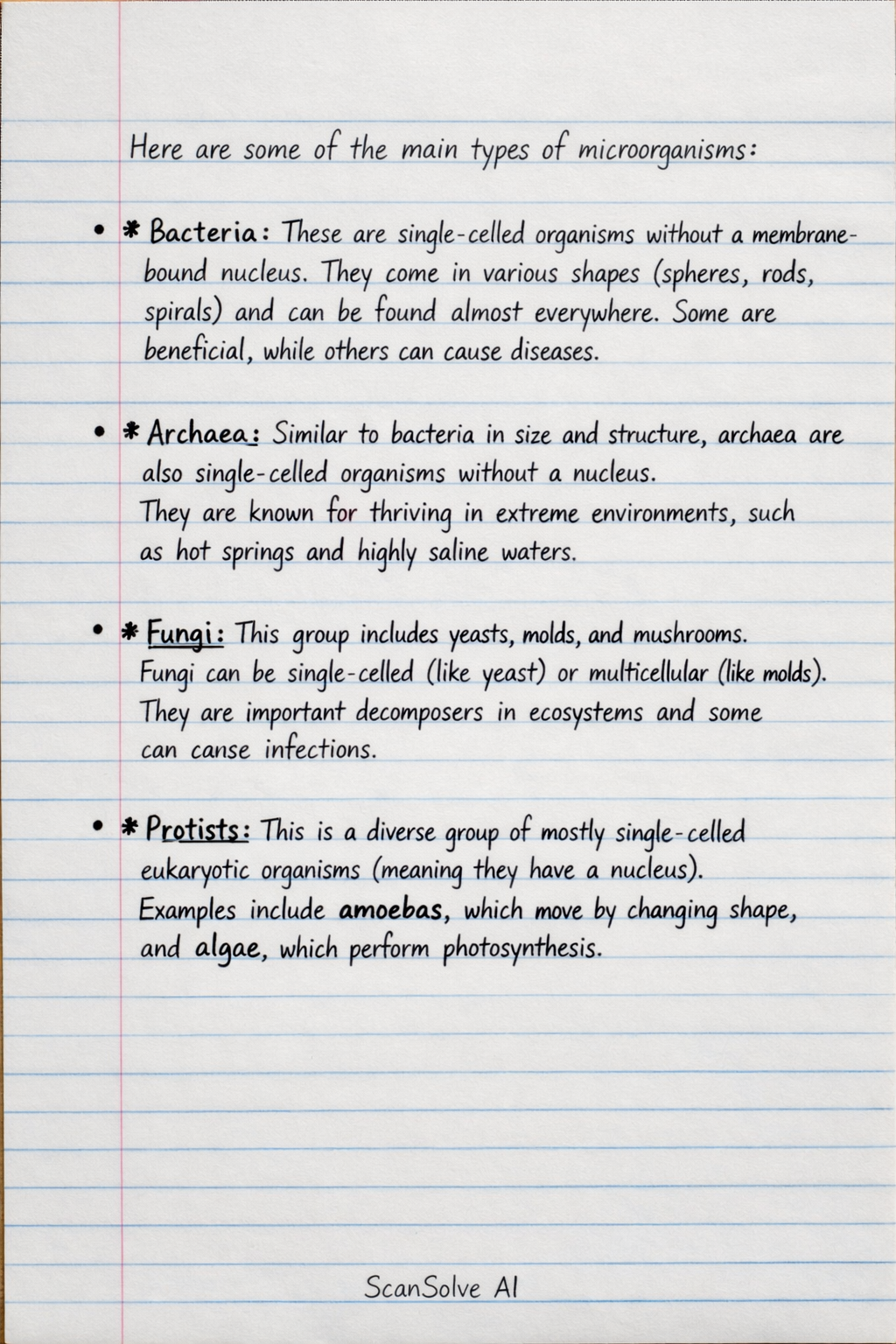
Here are some of the main types of microorganisms: Bacteria*: These are single-celled organisms without a membrane-bound nucleus. They come in various shapes (spheres, rods, spirals) and can be found almost everywhere. Some are beneficial, while others can cause diseases. Archaea*: Similar to bacteria in size and structure, archaea are also single-celled organisms without a nucleus. They are known for thriving in extreme environments, such as hot springs and highly saline waters. Fungi*: This group includes yeasts, molds, and mushrooms. Fungi can be single-celled (like yeast) or multicellular (like molds). They are important decomposers in ecosystems and some can cause infections. Protists: This is a diverse group of mostly single-celled eukaryotic organisms (meaning they have a nucleus). Examples include amoebas, which move by changing shape, and algae*, which perform photosynthesis. Viruses*: These are non-living infectious agents that are much smaller than bacteria. They consist of genetic material (DNA or RNA) enclosed in a protein coat and can only reproduce inside living host cells. That's 2 down. 3 left today — send the next one.