
We read your photo as:
What are microorganisms and what is their economic importance? Include definitions and examples.
ScanSolve AI Answer
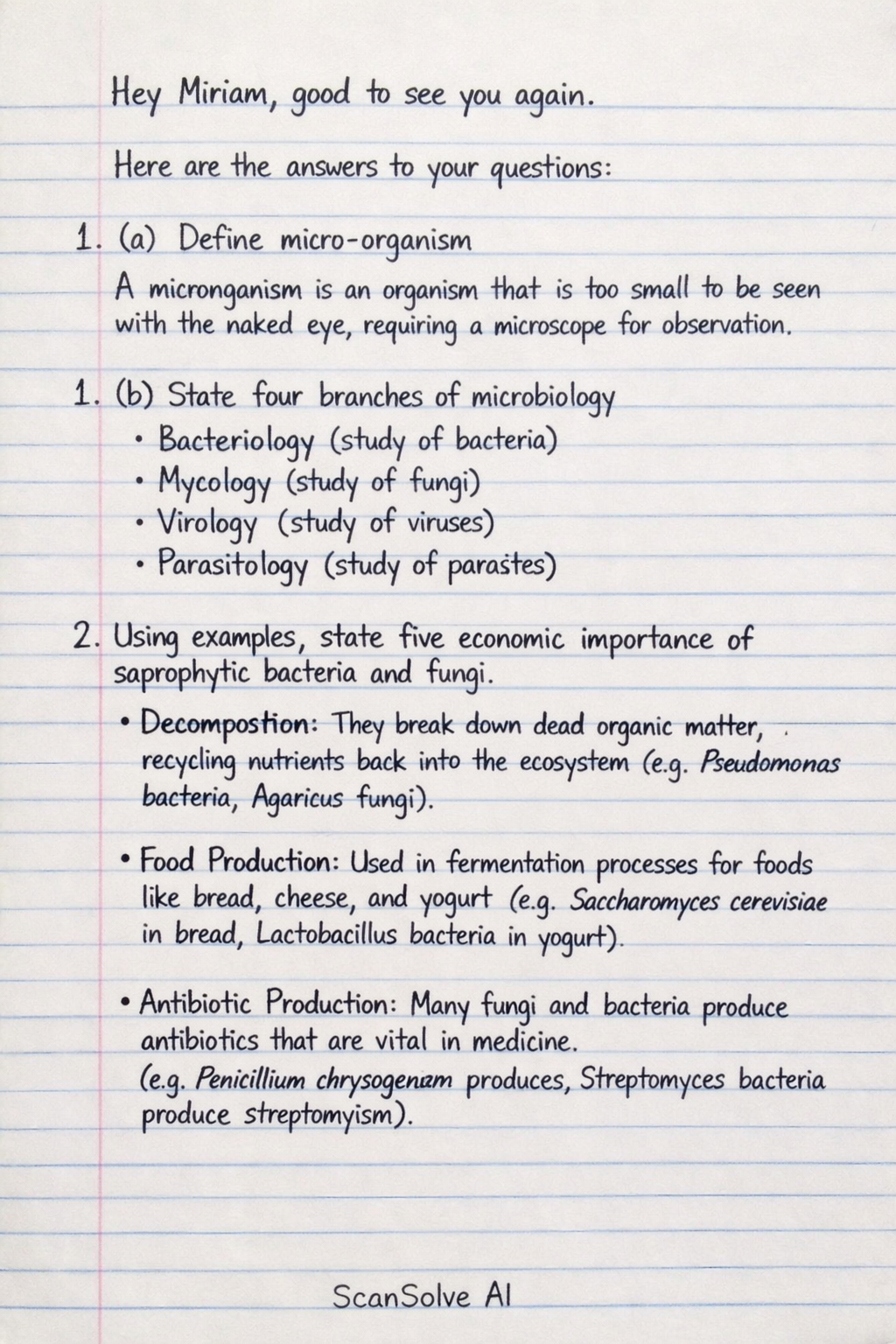
Here are the answers to your questions:
1. (a) Define micro-organism
A microorganism is an organism that is too small to be seen with the naked eye, requiring a microscope for observation.
1. (b) State four branches of microbiology
- Bacteriology (study of bacteria)
- Mycology (study of fungi)
- Virology (study of viruses)
- Parasitology (study of parasites)
2. Using examples, state five economic importance of saprophytic bacteria and fungi
- Decomposition: They break down dead organic matter, recycling nutrients back into the ecosystem (e.g., Pseudomonas bacteria, Agaricus fungi).
- Food Production: Used in fermentation processes for foods like bread, cheese, and yogurt (e.g., Saccharomyces cerevisiae in bread, Lactobacillus bacteria in yogurt).
- Antibiotic Production: Many fungi and bacteria produce antibiotics that are vital in medicine (e.g., Penicillium chrysogenum produces penicillin, Streptomyces bacteria produce streptomycin).
- Bioremediation: They can break down pollutants in the environment, helping to clean up contaminated sites (e.g., Pseudomonas species used in oil spill cleanup).
- Waste Treatment: Essential in sewage treatment plants to break down organic waste into less harmful substances.
3. Draw a well labelled diagram of bread mould
As an AI, I cannot draw diagrams. However, a well-labelled diagram of bread mould (Rhizopus stolonifer) would typically include:
- Sporangium: The sac-like structure containing spores.
- Sporangiophore: The stalk that supports the sporangium.
- Spores: Reproductive cells released from the sporangium.
- Rhizoids: Root-like structures that anchor the mould and absorb nutrients.
- Stolons: Horizontal hyphae that connect groups of sporangiophores.
- Hyphae: The thread-like filaments that make up the body of the fungus.
4. Describe any five shapes of bacteria
- Coccus (spherical): These bacteria are round or oval-shaped (e.g., Staphylococcus).
- Bacillus (rod-shaped): These bacteria are cylindrical or rod-like (e.g., Escherichia coli).
- Spirillum (spiral/helical): These are rigid, wavy, or spiral-shaped bacteria (e.g., Spirillum minus).
- Spirochete (flexible spiral): These bacteria have a thin, flexible, corkscrew-like spiral shape (e.g., Treponema pallidum).
- Vibrio (comma-shaped): These bacteria are curved rods, resembling a comma (e.g., Vibrio cholerae).
5. (a) A microbiology lab technician is preparing a culture medium and notices that it remains liquid after autoclaving. What are two possible errors that could have occurred, and how would you correct them?
- Error 1: Insufficient agar concentration. If not enough agar was added, the medium will not solidify.
- Correction: Add the correct amount of agar (typically 1.5-2% by weight) to the medium and re-autoclave.
- Error 2: Incorrect pH. Extreme pH levels can prevent agar from gelling properly.
- Correction: Adjust the pH of the medium to the optimal range (usually near neutral, pH 7.0-7.4) before autoclaving.
5. (b) A dairy farm wants to improve the quality and extend the shelf life of their yoghurt, which group of microorganisms would be the most beneficial to use in the yoghurt production process and why?
The most beneficial group of microorganisms would be Lactic Acid Bacteria (LAB). They are beneficial because they ferment lactose (milk sugar) into lactic acid. This acid lowers the pH of the milk, causing the milk proteins to coagulate and thicken, forming yogurt. The low pH also inhibits the growth of spoilage microorganisms, thereby extending the yogurt's shelf life and contributing to its characteristic flavor.
5. (c) A compost pile is not decomposing properly, and emitting a foul odour. What could be a likely cause related to the microbial activity within the compost and how could this problem be addressed?
A likely cause is the presence of anaerobic conditions within the compost pile. A foul odor often indicates that there is insufficient oxygen, leading to the growth of anaerobic bacteria which produce unpleasant-smelling byproducts (like hydrogen sulfide or ammonia) and decompose organic matter less efficiently.
This problem can be addressed by:
- Turning the compost pile: This introduces oxygen, promoting the activity of aerobic microorganisms.
- Adding bulking agents: Incorporating materials like wood chips or straw can create air pockets, improving aeration.
Still stuck on this one?
Ask a follow-up, and the answer starts from this question.
More Biology Questions
Handwritten Step-by-Step Solution
Get this as a handwritten image on WhatsApp — like a tutor wrote it for you.
Try on WhatsApp