
We read your photo as:
The pancreas secrete enzymes for the digestion of
ScanSolve AI Answer
Answer
Here are the solutions to the questions:
19. The pancreas secrete enzymes for the digestion of
- The pancreas produces pancreatic juice containing enzymes that digest all three major macronutrients: carbohydrates (e.g., amylase), proteins (e.g., trypsin, chymotrypsin), and fats (e.g., lipase). The correct option is D. The pancreas secretes enzymes for the digestion of .
20. In which of the following Nigerian states can montane vegetation be found
- Montane vegetation is characteristic of high-altitude regions. The Mambilla Plateau, located in Taraba State, is a high-altitude region in Nigeria known for its montane climate and vegetation. The correct option is C. Montane vegetation can be found in .
21. Darwin is considered the first scientist who correctly explained the theory of
- Charles Darwin is renowned for his theory of Organic evolution through natural selection, which he detailed in his book "On the Origin of Species." The correct option is D. Darwin is considered the first scientist who correctly explained the theory of .
22. The stem of a typical aquatic plant usually has many
- Aquatic plants (hydrophytes) often have specialized tissues called aerenchyma, which are large air-filled cavities or spaces within their stems and leaves. These air cavities provide buoyancy, allowing the plant to float, and facilitate gas exchange in submerged parts. The correct option is A. The stem of a typical aquatic plant usually has many .
23. Which of the following is likely to encourage inbreeding in plants?
- Inbreeding occurs when genetically related individuals mate. In plants, this is often facilitated by self-pollination.
- Monoecious plants have both male and female flowers on the same plant, which allows for self-pollination (geitonogamy) and thus encourages inbreeding.
- Dioecious plants have separate male and female plants, preventing self-pollination and promoting outcrossing.
- Protandrous flowers have male parts maturing before female parts, which discourages self-pollination within the same flower. The correct option is B. is likely to encourage inbreeding in plants.
24. A tall plant crossed with a dwarf one produces offspring of which half are tall and half are dwarf. What are the genotypes of the parents?
- Let 'T' represent the dominant allele for tallness and 't' represent the recessive allele for dwarfness.
- The dwarf offspring must have the genotype 'tt'. Since half the offspring are dwarf, one parent must be able to contribute a 't' allele, and the other parent must also be able to contribute a 't' allele.
- The dwarf parent must have the genotype 'tt'.
- For the tall parent, if it were homozygous dominant (TT), all offspring would be tall (TT x tt Tt).
- If the tall parent is heterozygous (Tt) and is crossed with a dwarf parent (tt):
- Parental genotypes: Tt (Tall) tt (Dwarf)
- Gametes from Tt: T, t
- Gametes from tt: t, t
- Offspring genotypes: Tt, Tt, tt, tt
- Offspring phenotypes: 50% Tall (Tt), 50% Dwarf (tt)
- This matches the given offspring ratio of half tall and half dwarf. The correct option is C. The genotypes of the parents are .
Try one yourself
A new problem that tests the same skill.
Still stuck on this one?
Ask a follow-up, and the answer starts from this question.
More Biology Questions
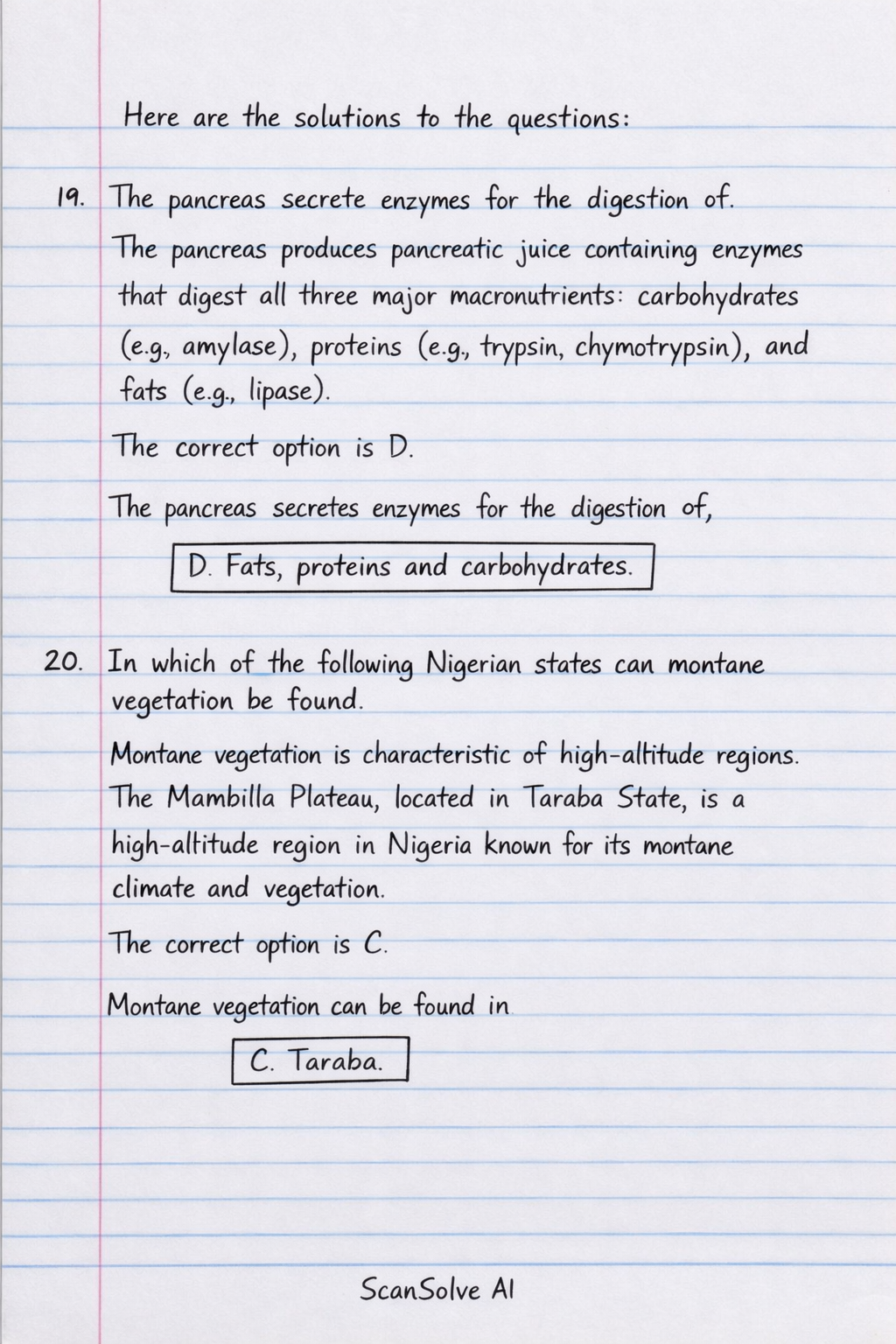
Handwritten Step-by-Step Solution
Get this as a handwritten image on WhatsApp — like a tutor wrote it for you.
Try on WhatsApp