
We read your photo as:
2 Give the correct biological term for each of the following descriptions. 1.3 Indicate whether each of the descriptions in COLUMN I apply to A ONLY, B ONLY, BOTH A AND B or NONE of the items in COLUM
ScanSolve AI Answer
Answer
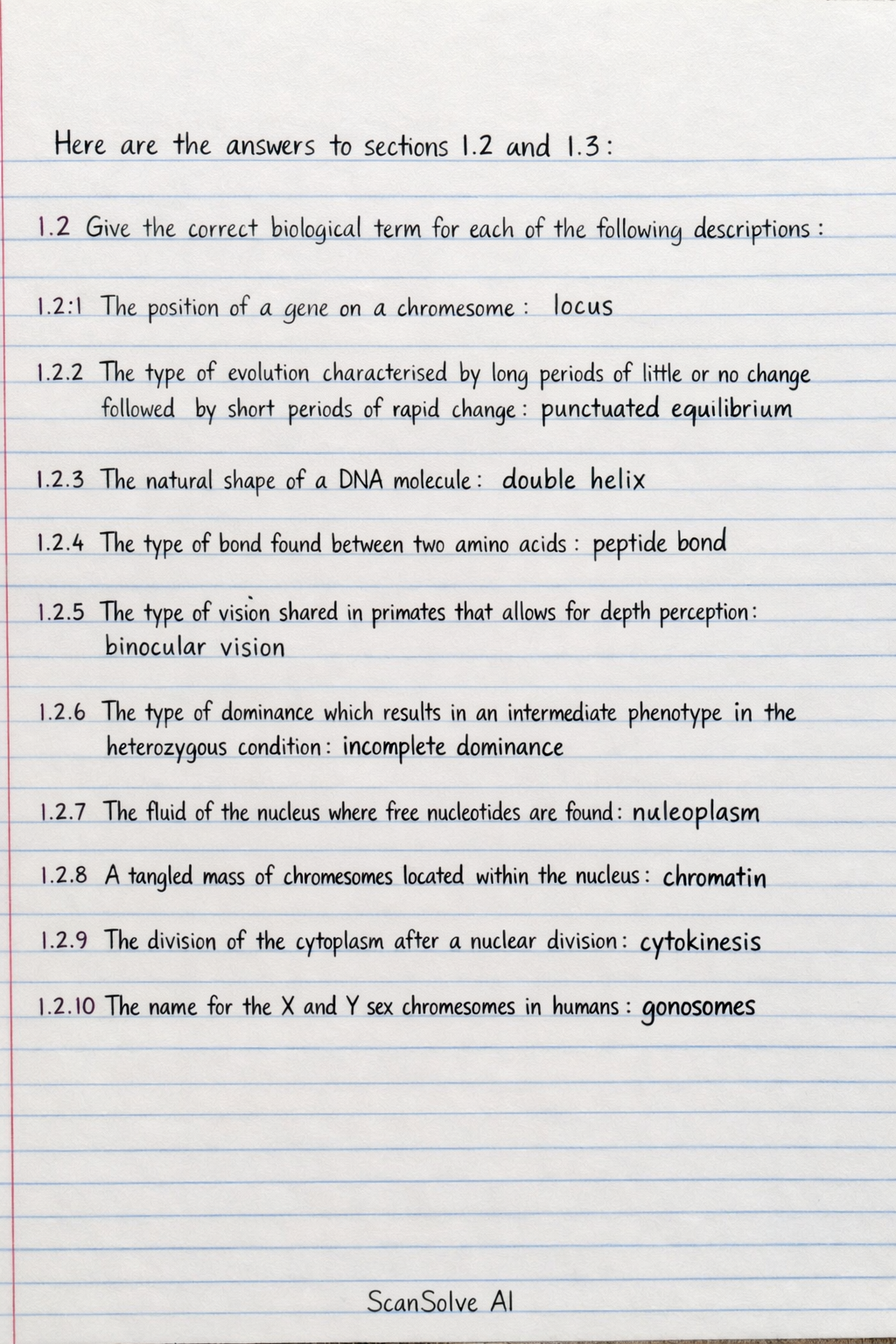
Here are the answers to sections 1.2 and 1.3:
1.2 Give the correct biological term for each of the following descriptions.
1.2.1 The position of a gene on a chromosome: locus
1.2.2 The type of evolution characterised by long periods of little or no change followed by short periods of rapid change: punctuated equilibrium
1.2.3 The natural shape of a DNA molecule: double helix
1.2.4 The type of bond found between two amino acids: peptide bond
1.2.5 The type of vision shared in primates that allows for depth perception: binocular vision
1.2.6 The type of dominance which results in an intermediate phenotype in the heterozygous condition: incomplete dominance
1.2.7 The fluid of the nucleus where free nucleotides are found: nucleoplasm
1.2.8 A tangled mass of chromosomes located within the nucleus: chromatin
1.2.9 The division of the cytoplasm after a nuclear division: cytokinesis
1.2.10 The name for the X and Y sex chromosomes in humans: gonosomes
1.3 Indicate whether each of the descriptions in COLUMN I apply to A ONLY, B ONLY, BOTH A AND B or NONE of the items in COLUMN II.
1.3.1 A genetic disorder caused by a chromosomal mutation:
1.3.2 The importance of meiosis:
1.3.3 The organelle where DNA is found in plants:
Try one yourself
A new problem that tests the same skill.
Still stuck on this one?
Ask a follow-up, and the answer starts from this question.
More Biology Questions
Handwritten Step-by-Step Solution
Get this as a handwritten image on WhatsApp — like a tutor wrote it for you.
Try on WhatsApp