
We read your photo as:
Choose a description from column B that best fits the term provided in column A. Write down the number of the term in column A followed by the letter of the description in column B eg 1.2.1 C. Give a suitable biological term for the following statements:
ScanSolve AI Answer
Step-by-step solution
15 stepsHere are the answers to the questions:
1.2 Choose a description from column B that best fits the term in column A. Write down the number of the term in column A followed by the letter of the description in column B eg 1.2.1 C
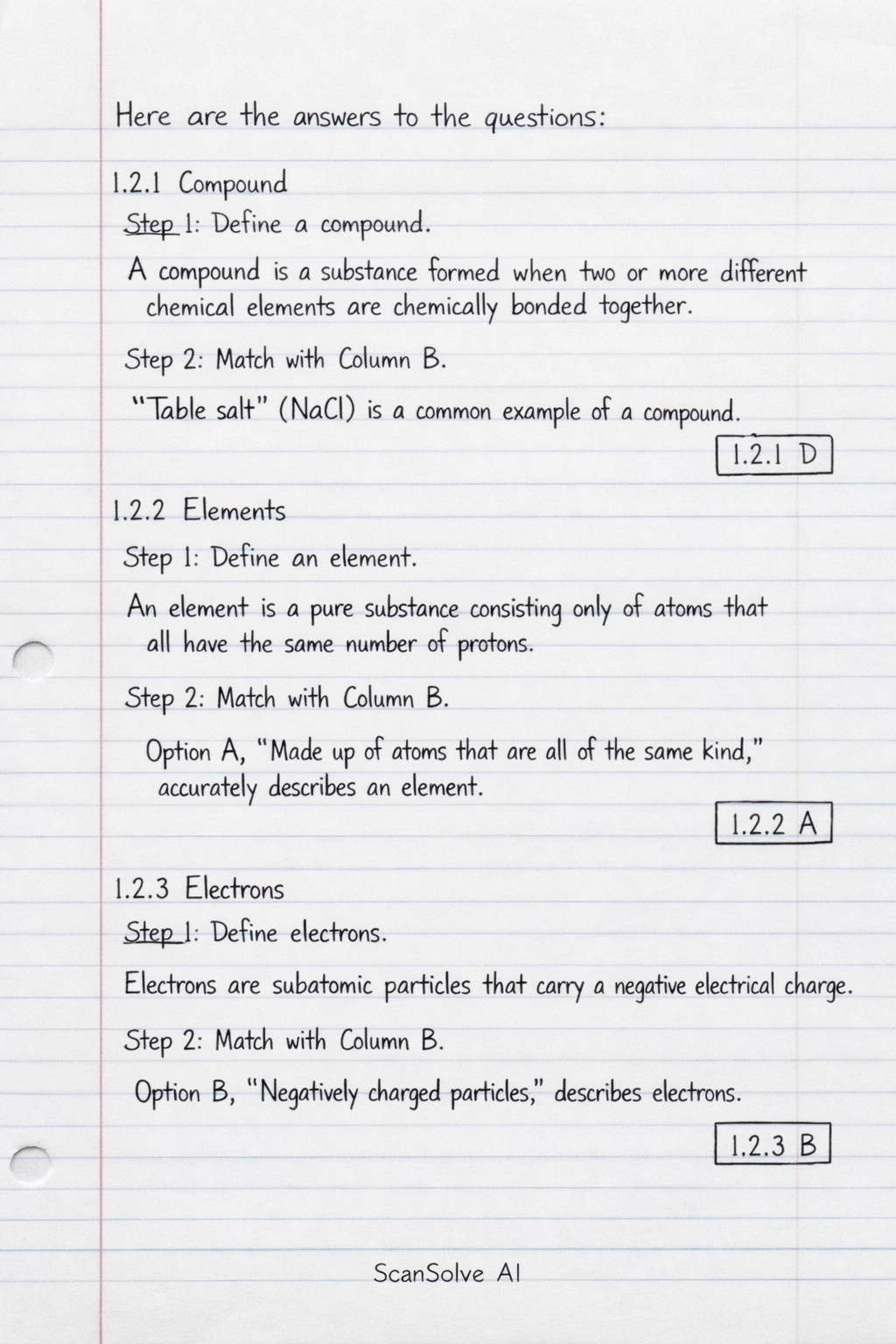
1.2.1 Compound
Define a compound.
A compound is a substance formed when two or more different chemical elements are chemically bonded together.
Match with Column B.
"Table salt" (NaCl) is a common example of a compound.
1.2.2 Elements
Define an element.
An element is a pure substance consisting only of atoms that all have the same number of protons.
Match with Column B.
Option A, "Made up of atoms that are all of the same kind", accurately describes an element.
1.2.3 Electrons
Define electrons.
Electrons are subatomic particles that carry a negative electrical charge.
Match with Column B.
Option B, "Negatively charged particles", describes electrons.
1.2.4 Nucleus
Define the nucleus.
The nucleus is the central part of an atom, containing protons and neutrons.
Match with Column B.
Option E, "Region where protons and electrons are found", is the only remaining option. While protons are found in the nucleus, electrons are found around the nucleus. However, given the other options are clearly matched, this is the intended answer for the nucleus in the context of the atom.
1.2.5 Neutrons
Define neutrons.
Neutrons are subatomic particles found in the nucleus that have no electrical charge.
Match with Column B.
Option C, "Particles that are not charged", describes neutrons.
1.3 Give a suitable biological term for the following statements.
1.3.1 When liquid turns into gas.
Identify the phase transition from liquid to gas.
This process is called vaporization, which includes evaporation and boiling.
1.3.2 Particles are close together, but can move around.
Identify the state of matter described.
This description fits the properties of a liquid, where particles are close but have enough energy to slide past each other.
1.3.3 Movement of particles from higher concentration to lower concentration.
Identify the process described.
This is the definition of diffusion, a passive transport mechanism.
1.3.4 When a liquid turns into a solid.
Identify the phase transition from liquid to solid.
This process is called freezing or solidification.
1.3.5 Matter where particles are closely packed and cannot move from position.
Identify the state of matter described.
This description fits the properties of a solid, where particles are held in fixed positions.
Still stuck on this one?
Ask a follow-up, and the answer starts from this question.
More Biology Questions
Handwritten Step-by-Step Solution
Get this as a handwritten image on WhatsApp — like a tutor wrote it for you.
Try on WhatsApp