
We read your photo as:
According to the Global Initiative for Chronic Obstructive Lung Disease (GOLD) criteria, a patient with an FEV₁ of 40% predicted would be classified as having:
Biology
ScanSolve AI Answer
Here are the answers to your questions:
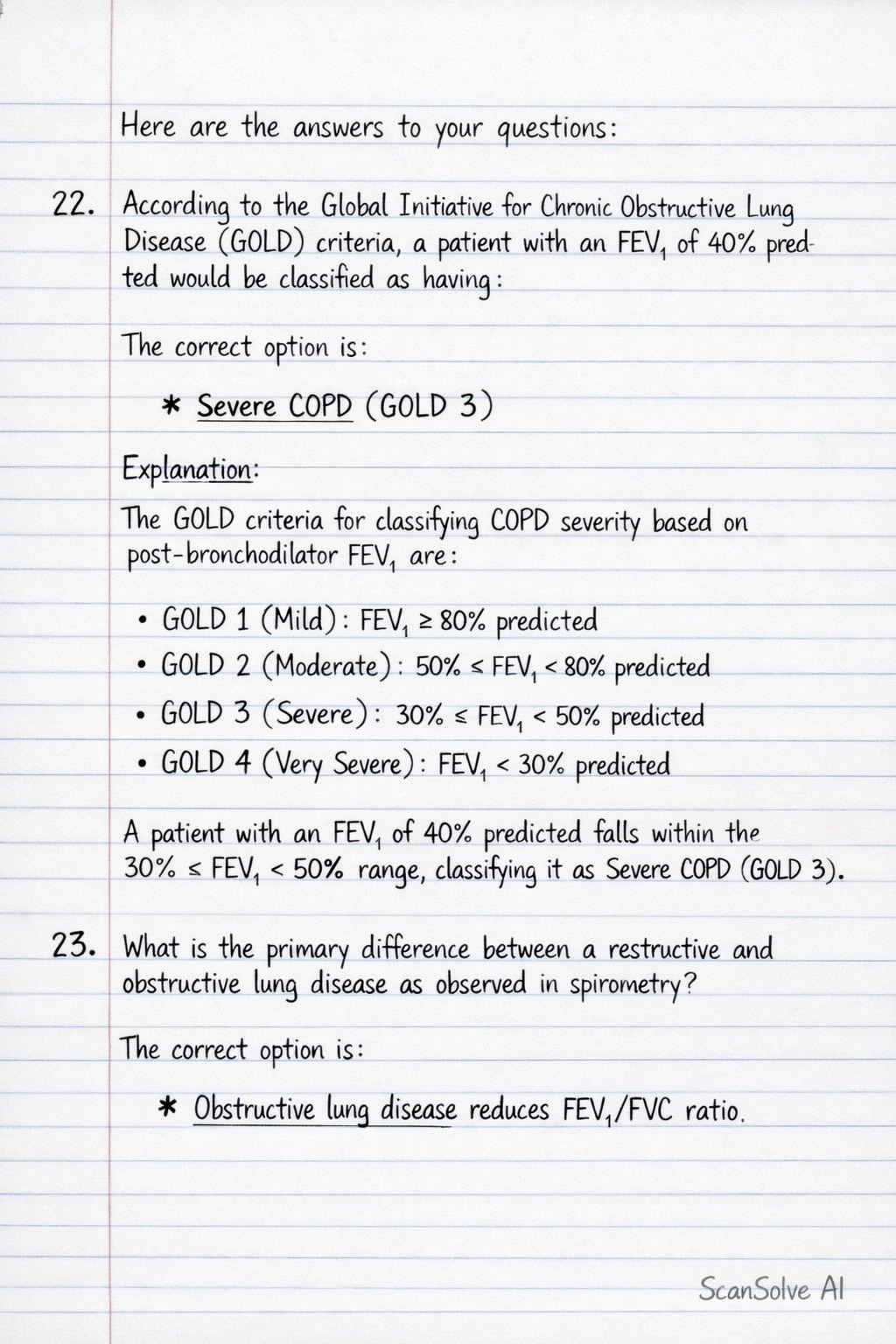
- According to the Global Initiative for Chronic Obstructive Lung Disease (GOLD) criteria, a patient with an FEV of 40% predicted would be classified as having: The correct option is:
- Severe COPD (GOLD 3)
Explanation: The GOLD criteria for classifying COPD severity based on post-bronchodilator FEV are:
- GOLD 1 (Mild): FEV predicted
- GOLD 2 (Moderate): FEV predicted
- GOLD 3 (Severe): FEV predicted
- GOLD 4 (Very Severe): FEV predicted A patient with an FEV of 40% predicted falls within the FEV range, classifying it as Severe COPD (GOLD 3).
- What is the primary difference between a restrictive and obstructive lung disease as observed in spirometry? The correct option is:
- Obstructive lung disease reduces FEV/FVC ratio
Explanation:
- Obstructive lung diseases (like COPD and asthma) are characterized by difficulty exhaling air due to airway obstruction. This leads to a disproportionate reduction in the forced expiratory volume in one second (FEV) compared to the forced vital capacity (FVC), resulting in a reduced FEV/FVC ratio (typically ).
- Restrictive lung diseases (like pulmonary fibrosis) are characterized by reduced lung volumes due to stiffness of the lungs or chest wall. Both FEV and FVC are reduced, but the FEV/FVC ratio often remains normal or even increased. The other options are incorrect: restrictive lung disease decreases total lung capacity and residual volume, and obstructive lung disease does not necessarily lead to increased lung compliance in all cases (though it can in emphysema).
- Which of the following is a key distinguishing factor between asthma and COPD in terms of pathophysiology? The options for this question are not visible in the image. Please provide the options for a complete answer.
Was this helpful?
Still stuck on this one?
Ask a follow-up, and the answer starts from this question.
Got a different question?Ask your own question
More Biology Questions
QInterpret these spirometry results and state the type of ventilatory defect indicated: FEV1/FVC…QInterpret the following spirometry results: FVC: 1.70L (Pred: 2.98L, LLN: 2.28L), FEV1: 1.19L (Pred…QWhich respiratory condition is primarily caused by long-term smoking?QInterpret these spirometry graphs and describe the ventilatory defect indicated.QThe patient presents with classic symptoms of pulmonary tuberculosis: persistent cough, low-grade…
Handwritten Step-by-Step Solution
Get this as a handwritten image on WhatsApp — like a tutor wrote it for you.
Try on WhatsApp