
We read your photo as:
The citric acid cycle intermediates are drained through ________ reactions
Biology
ScanSolve AI Answer
Answer
D
Cataplerotic
Step-by-step solution
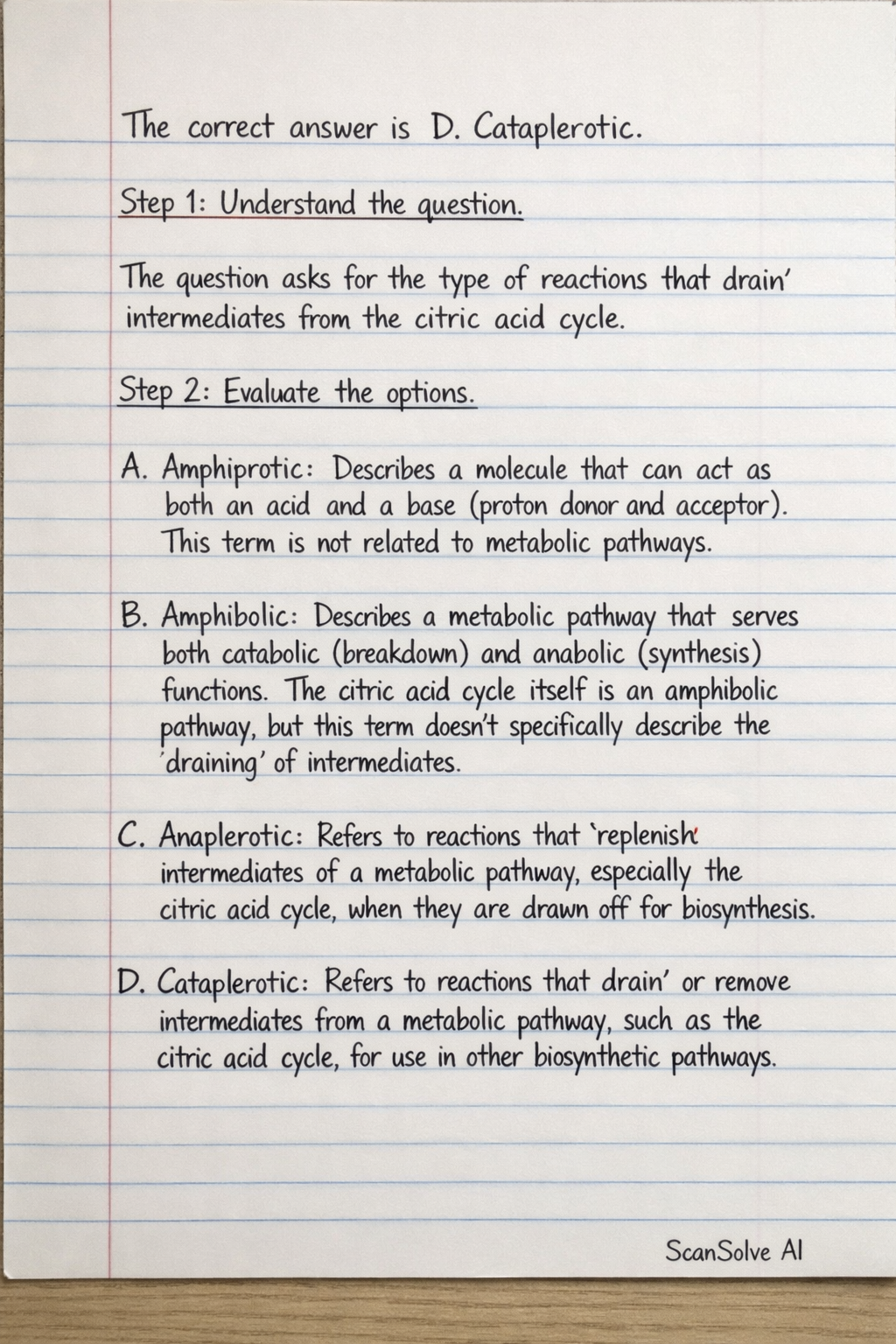
3 stepsThe correct answer is D. Cataplerotic.
Understand the question.
The question asks for the type of reactions that drain intermediates from the citric acid cycle.
Evaluate the options.
- A. Amphiprotic: Describes a molecule that can act as both an acid and a base (proton donor and acceptor). This term is not related to metabolic pathways.
- B. Amphibolic: Describes a metabolic pathway that serves both catabolic (breakdown) and anabolic (synthesis) functions. The citric acid cycle itself is an amphibolic pathway, but this term doesn't specifically describe the draining of intermediates.
- C. Anaplerotic: Refers to reactions that replenish intermediates of a metabolic pathway, especially the citric acid cycle, when they are drawn off for biosynthesis.
- D. Cataplerotic: Refers to reactions that drain or remove intermediates from a metabolic pathway, such as the citric acid cycle, for use in other biosynthetic pathways.
Select the best fit.
Since the question specifically asks about intermediates being "drained," the term cataplerotic accurately describes these reactions.
The final answer is .
Was this helpful?
Try one yourself
A new problem that tests the same skill.
Still stuck on this one?
Ask a follow-up, and the answer starts from this question.
Got a different question?Ask your own question
More Biology Questions
QThe fatty acids can be transported into and out of mitochondria through:QGlycolysis, kreb cycle and electron transport chainQDescribe the reactions in the scheme, identifying A and D.QIdentify A,B,C,D and E in the following sequence of reactionsQIdentify the process for removing excess carbon dioxide.
Handwritten Step-by-Step Solution
Get this as a handwritten image on WhatsApp — like a tutor wrote it for you.
Try on WhatsApp