
We read your photo as:
Describe the reactions in the scheme, identifying A and D.
ScanSolve AI Answer
Answer
Here are the answers to the questions based on the provided reaction scheme:
a)
i) Step I: Propan-1-ol () is converted to propanoic acid () using . This is an oxidation reaction.
ii) Step II: Propan-1-ol () is converted to propene () by heating with concentrated . This is a dehydration reaction.
b)
Step III: Sodium propanoate () is heated to produce ethane (). This is a decarboxylation reaction, specifically Kolbe electrolysis or soda lime decarboxylation. Assuming soda lime decarboxylation:
c)
- A: Propan-1-ol reacts with potassium metal to form solution A and . Solution A is potassium propoxide.
So, A is potassium propoxide ().
- D: Ethane () reacts with 1 mole of to form compound D and . This is a free radical substitution reaction.
So, D is chloroethane ().
- R: In the cleaning agent X, R is an alkyl chain. So, R is an alkyl group.
d)
Product C is formed from the reaction of propanoic acid () with Butan-1-ol () in the presence of concentrated and heat (Step IV). This is an esterification reaction.
The structural formula of product C (butyl propanoate) is:
\begin{center}
\begin{tikzpicture}[scale=0.8]
    \node (C1) at (0,0) {C};
    \node (C2) at (1,0) {C};
    \node (C3) at (2,0) {C};
    \node (O1) at (2.5,0.5) {O};
    \node (O2) at (3,-0.5) {O};
    \node (C4) at (3.5,-0.5) {C};
    \node (C5) at (4.5,-0.5) {C};
    \node (C6) at (5.5,-0.5) {C};
    \node (C7) at (6.5,-0.5) {C};

    \draw (C1) -- (C2) -- (C3);
    \draw (C3) -- (O1);
    \draw (C3) -- (O2);
    \draw (O2) -- (C4) -- (C5) -- (C6) -- (C7);

    \node at (0,-0.5) {H$_3$};
    \node at (1,-0.5) {H$_2$};
    \node at (2,0.5) {O};
    \node at (3.5,-1) {H$_2$};
    \node at (4.5,-1) {H$_2$};
    \node at (5.5,-1) {H$_2$};
    \node at (6.5,-1) {H$_3$};
\end{tikzpicture}
\end{center}
Or written linearly: .
e)
Compound E is formed from propene () by reaction with . This is an addition reaction following Markovnikov's rule.
So, E is 2-chloropropane.
f)
Compound B is formed from propene () through a polymerization reaction. The structure shown for Compound B is a repeating unit of propene.
The type of reaction involved in its formation is addition polymerization.
g)
Compound B is polypropene, with the repeating unit .
The relative molecular mass of B is 35700.
The molecular mass of one repeating unit () is:
Using approximate atomic masses: C=12, H=1.
Mass of one repeating unit = .
The relative molecular mass of B is .
The value of n is .
h)
i) Identify the cleaning agent suitable to be used with water containing magnesium chloride.
Magnesium chloride () causes hard water.
Cleaning agent X is a soap (). Soaps form scum with hard water ions like .
Cleaning agent Y is a synthetic detergent (). Synthetic detergents do not form scum with hard water ions.
Therefore, cleaning agent Y is suitable.
ii) State one advantage of using cleaning agent Y.
One advantage of using cleaning agent Y (a synthetic detergent) is that it does not form scum with hard water, making it effective in both hard and soft water.
Try one yourself
A new problem that tests the same skill.
Still stuck on this one?
Ask a follow-up, and the answer starts from this question.
More Chemistry Questions
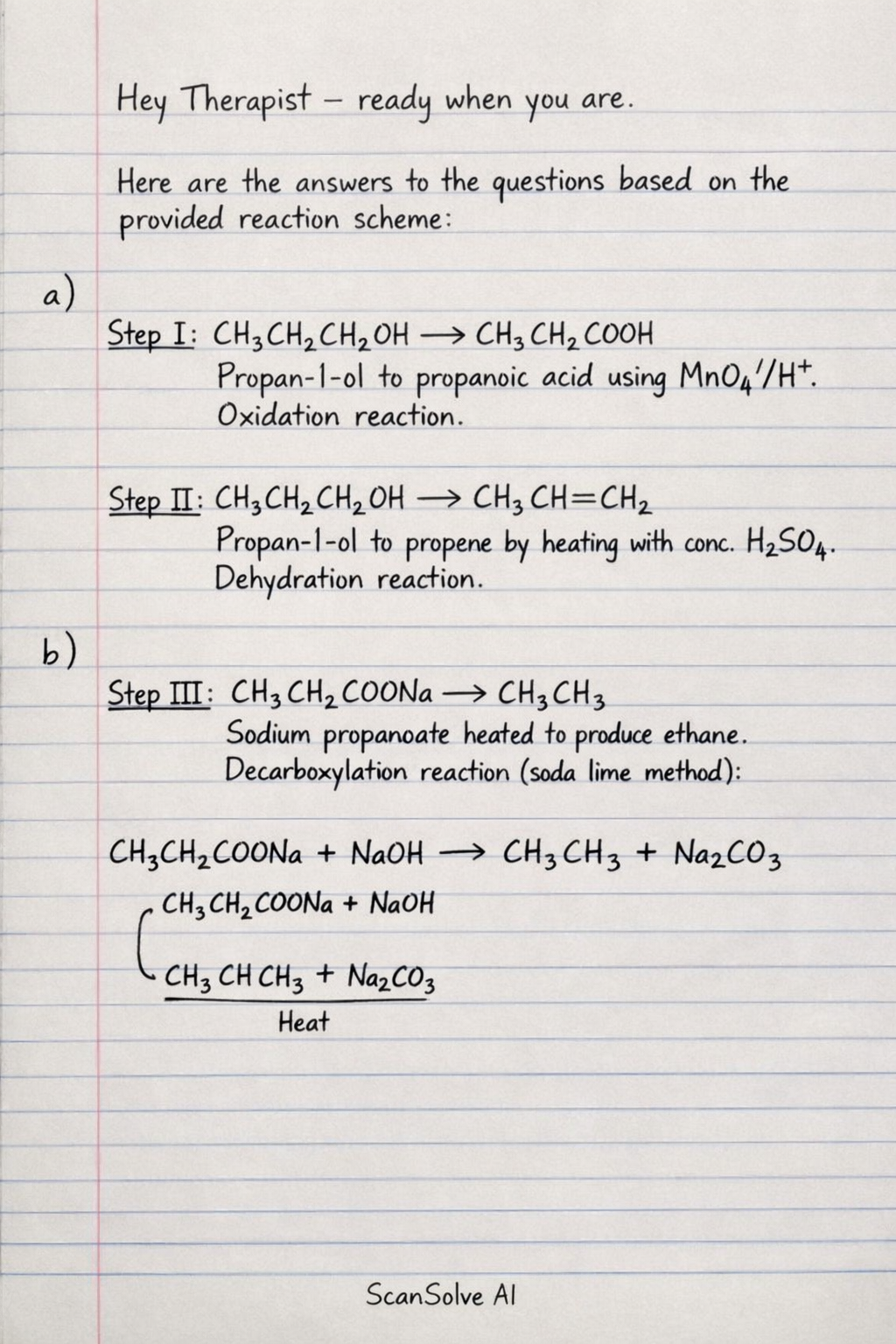
Handwritten Step-by-Step Solution
Get this as a handwritten image on WhatsApp — like a tutor wrote it for you.
Try on WhatsApp