
We read your photo as:
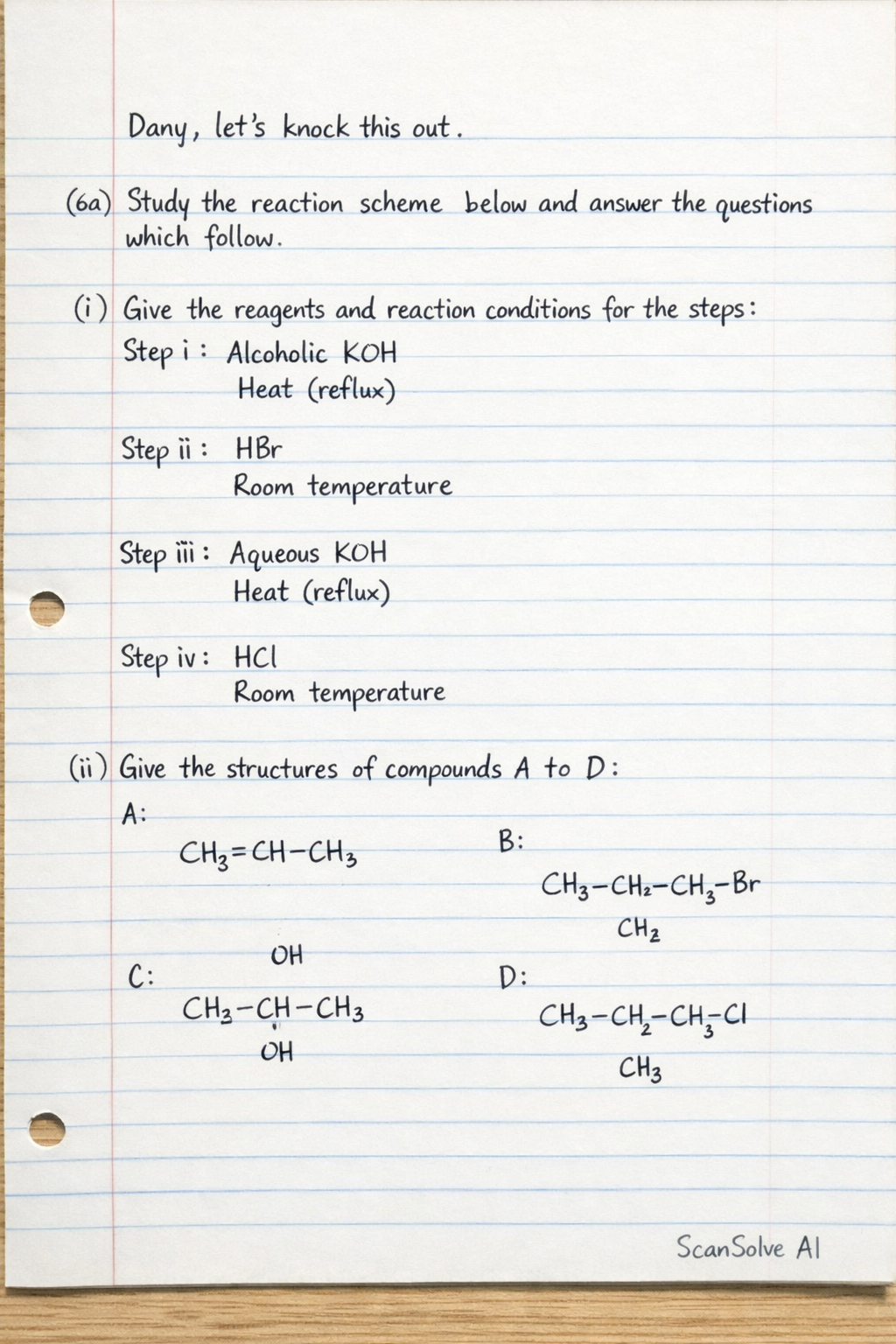
Study the reaction scheme below and answer the questions which follow. (i) Give the reagents and reaction conditions for the steps represented by i to iv. (ii) Give the structures of compounds A to D.
Chemistry
ScanSolve AI Answer
6. (a) Study the reaction scheme below and answer the questions which follow.
(i) Give the reagents and reaction conditions for the steps represented by i to iv.
| Step | Reagent(s) | Reaction conditions |
|---|---|---|
| i | Alcoholic KOH | Heat (reflux) |
| ii | HBr | Room temperature |
| iii | Aqueous KOH | Heat (reflux) |
| iv | HCl | Room temperature |
(ii) Give the structures of compounds A to D.
Based on the reaction scheme:
- Compound D is explicitly given as CH(CH)OH (1-butanol).
- Step iii is the conversion of A (CHBr) to D (1-butanol). This is a nucleophilic substitution where Br is replaced by OH. Therefore, A must be 1-bromobutane.
- Step i is the conversion of A (1-bromobutane) to B (CH). This is an elimination reaction, forming an alkene. Thus, B is but-1-ene.
- Step ii is the conversion of B (but-1-ene) to C (CHBr). This is the addition of HBr to an alkene. According to Markovnikov's rule, the major product is 2-bromobutane.
A: (1-bromobutane)
B: (But-1-ene)
C: (2-bromobutane)
D: $\boxed{CH_3CH_2CH_2\text
Was this helpful?
Still stuck on this one?
Ask a follow-up, and the answer starts from this question.
Got a different question?Ask your own question
More Chemistry Questions
Qb. Study the scheme diagram below and answer the questions that follow: (i) Name the reagent that is…QDescribe the reactions in the scheme, identifying A and D.QProvide the reagents and conditions for the given steps, and the structures of compounds D, E, and F…Qe) Study the reaction below and answer the questions that follow.QStudy the reaction scheme below and answer the questions that follow. i. Name: 1mk A. Precipitate…
Handwritten Step-by-Step Solution
Get this as a handwritten image on WhatsApp — like a tutor wrote it for you.
Try on WhatsApp