ScanSolve logoScanSolve
Toggle sidebar
  • Homework
  • Tutor
  • Humanizer
  • AI Detector
  • Questions
  • Blog
  • History
  • Mobile App

  • Homework
  • Tutor
  • Humanizer
  • AI Detector

  • Questions
  • Math homework helpMath
    Physics homework helpPhysics
    Chemistry homework helpChemistry
    Biology homework helpBiology
    Computer Science homework helpComputer Science
    History homework helpHistory
    More homework helpMore
  • Blog
  • History

  • Mobile App
ScanSolvePLUS
  • Unlimited answers
  • ScanSolve AI Pro
Start Free Trial →
Try on WhatsApp
Home > Chemistry Homework Help > Solution

b. Study the scheme diagram below and answer the questions that follow: (i) Name the reagent that is suitable to carry out the reaction in step (ii) Name the process that takes place in step II. (iii) State the conditions necessary for the reaction in step III to occur. (iv) Name one industrial use for the reaction in step III. (v) Write down the equation for the reaction that takes place in step IV.

Asked on March 26, 2026|Chemistry

This chemistry question involves key chemical concepts and calculations. The detailed solution below walks through each step, from identifying the reaction type to computing the final answer.

ScanSolve AI AnswerAnswered on March 26, 2026
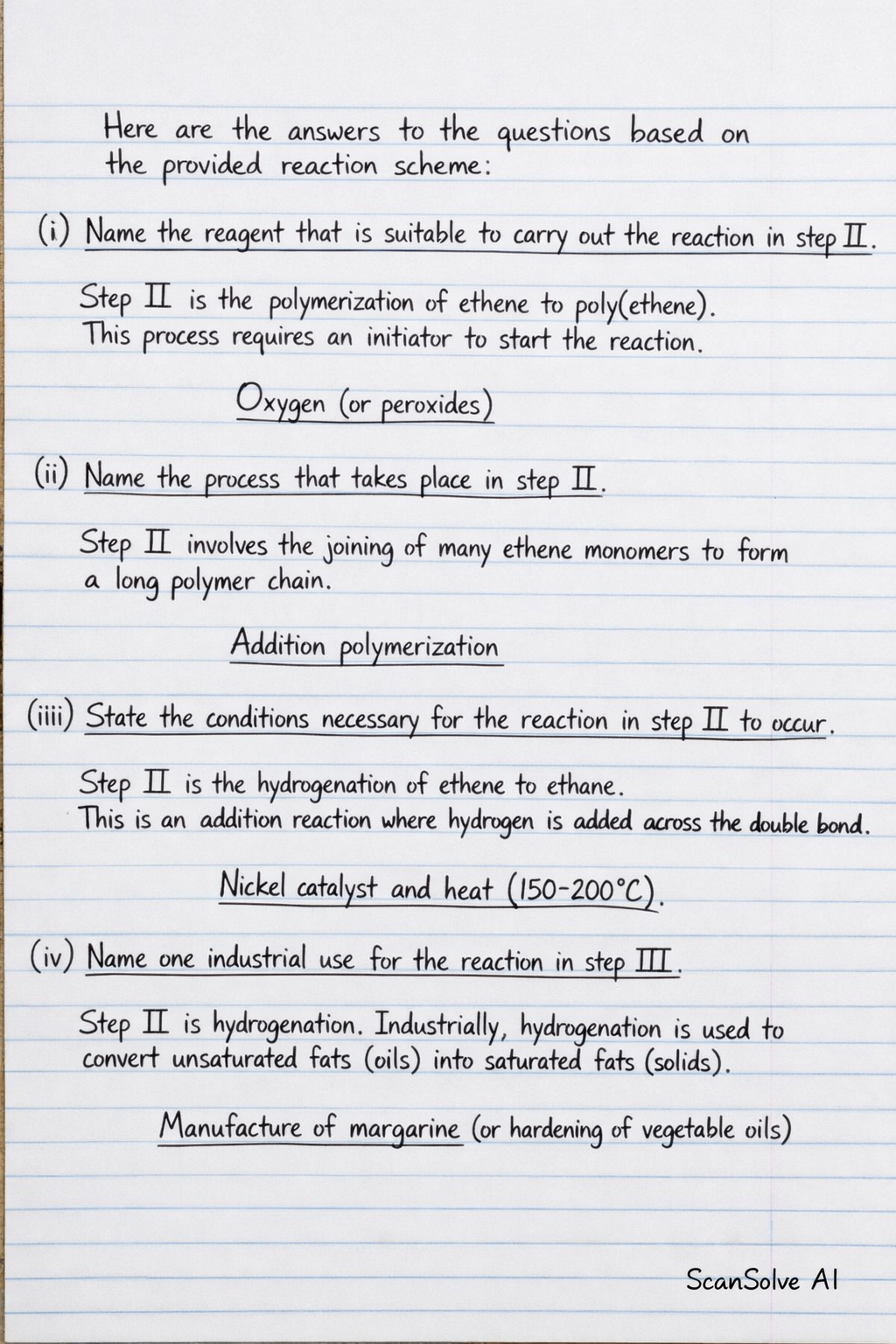
Here are the answers to the questions based on the provided reaction scheme: i) Name the reagent that is suitable to carry out the reaction in step II. Step II is the polymerization of ethene to poly(ethene). This process requires an initiator to start the reaction. Oxygen (or peroxides) ii) Name the process that takes place in step II. Step II involves the joining of many ethene monomers to form a long polymer chain. Addition polymerization iii) State the conditions necessary for the reaction in step III to occur. Step III is the hydrogenation of ethene to ethane. This is an addition reaction where hydrogen is added across the double bond. Nickel catalyst and heat (e.g., $150-200^\circ C$) iv) Name one industrial use for the reaction in step III. Step III is hydrogenation. Industrially, hydrogenation is used to convert unsaturated fats (oils) into saturated fats (solids). Manufacture of margarine (or hardening of vegetable oils) v) Write down the equation for the reaction that takes place in step IV. Step IV is the addition of hydrogen chloride to ethene to form chloroethane. $$CH_2=CH_2(g) + HCl(g) \longrightarrow CH_3CH_2Cl(g)$$

Related Chemistry Questions

  • Identify the base and exponents.
  • Identify the atomic number.
  • Acid, bases and salt
  • SECTION A: PHYSICAL CHEMISTRY
  • The image provided is the cover page of a chemistry examination paper. It contains general instructions and information...
  • I) Compound Words
See all Chemistry questions

This step-by-step solution was generated by ScanSolve AI. Need help with more chemistry problems? Browse Chemistry solutions or ask your own question.

Home›Chemistry Homework Help›b. Study the scheme diagram below and answer the questions t…
Q

b. Study the scheme diagram below and answer the questions that follow: (i) Name the reagent that is suitable to carry out the reaction in step (ii) Name the process that takes place in step II. (iii) State the conditions necessary for the reaction in step III to occur. (iv) Name one industrial use for the reaction in step III. (v) Write down the equation for the reaction that takes place in step IV.

March 26, 2026|Chemistry
b. Study the scheme diagram below and answer the questions that follow: (i) Name the reagent that is suitable to carry out the reaction in step (ii) Name the process that takes place in step II. (iii) State the conditions necessary for the reaction in step III to occur. (iv) Name one industrial use for the reaction in step III. (v) Write down the equation for the reaction that takes place in step IV.

b. Study the scheme diagram below and answer the questions that follow: (i) Name the reagent that is suitable to carry out the reaction in step (ii) Name the process that takes place in step II. (iii) State the conditions necessary for the reaction in step III to occur. (iv) Name one industrial use for the reaction in step III. (v) Write down the equation for the reaction that takes place in step IV.

ScanSolve AI

ScanSolve AI Answer

Answered on March 26, 2026

Here are the answers to the questions based on the provided reaction scheme:

i) Name the reagent that is suitable to carry out the reaction in step II. Step II is the polymerization of ethene to poly(ethene). This process requires an initiator to start the reaction.

  • Oxygen (or peroxides)

ii) Name the process that takes place in step II. Step II involves the joining of many ethene monomers to form a long polymer chain.

  • Addition polymerization

iii) State the conditions necessary for the reaction in step III to occur. Step III is the hydrogenation of ethene to ethane. This is an addition reaction where hydrogen is added across the double bond.

  • Nickel catalyst and heat (e.g., 150−200∘C150-200^\circ C150−200∘C)

iv) Name one industrial use for the reaction in step III. Step III is hydrogenation. Industrially, hydrogenation is used to convert unsaturated fats (oils) into saturated fats (solids).

  • Manufacture of margarine (or hardening of vegetable oils)

v) Write down the equation for the reaction that takes place in step IV. Step IV is the addition of hydrogen chloride to ethene to form chloroethane. CH2=CH2(g)+HCl(g)⟶CH3CH2Cl(g)CH_2=CH_2(g) + HCl(g) \longrightarrow CH_3CH_2Cl(g)CH2​=CH2​(g)+HCl(g)⟶CH3​CH2​Cl(g)

Need help with your own homework?

Get instant step-by-step solutions to any question. Free to start.

Ask Your Question
Handwritten step-by-step solution

Handwritten Step-by-Step Solution

Get this solution as a handwritten image on WhatsApp — just like a tutor wrote it for you.

Try on WhatsApp

More Chemistry Questions

Identify the base and exponents.Identify the atomic number.Acid, bases and saltSECTION A: PHYSICAL CHEMISTRYThe image provided is the cover page of a chemistry examination paper. It contains general instructi…I) Compound Words
See all Chemistryquestions →
Chemistry: b. Study the scheme diagram below and answer the questions that follow: (i) Name... — Step-by-Step Solution | ScanSolve