
We read your photo as:
Which one of the following is not a law-making organ?
ScanSolve AI Answer
Answer
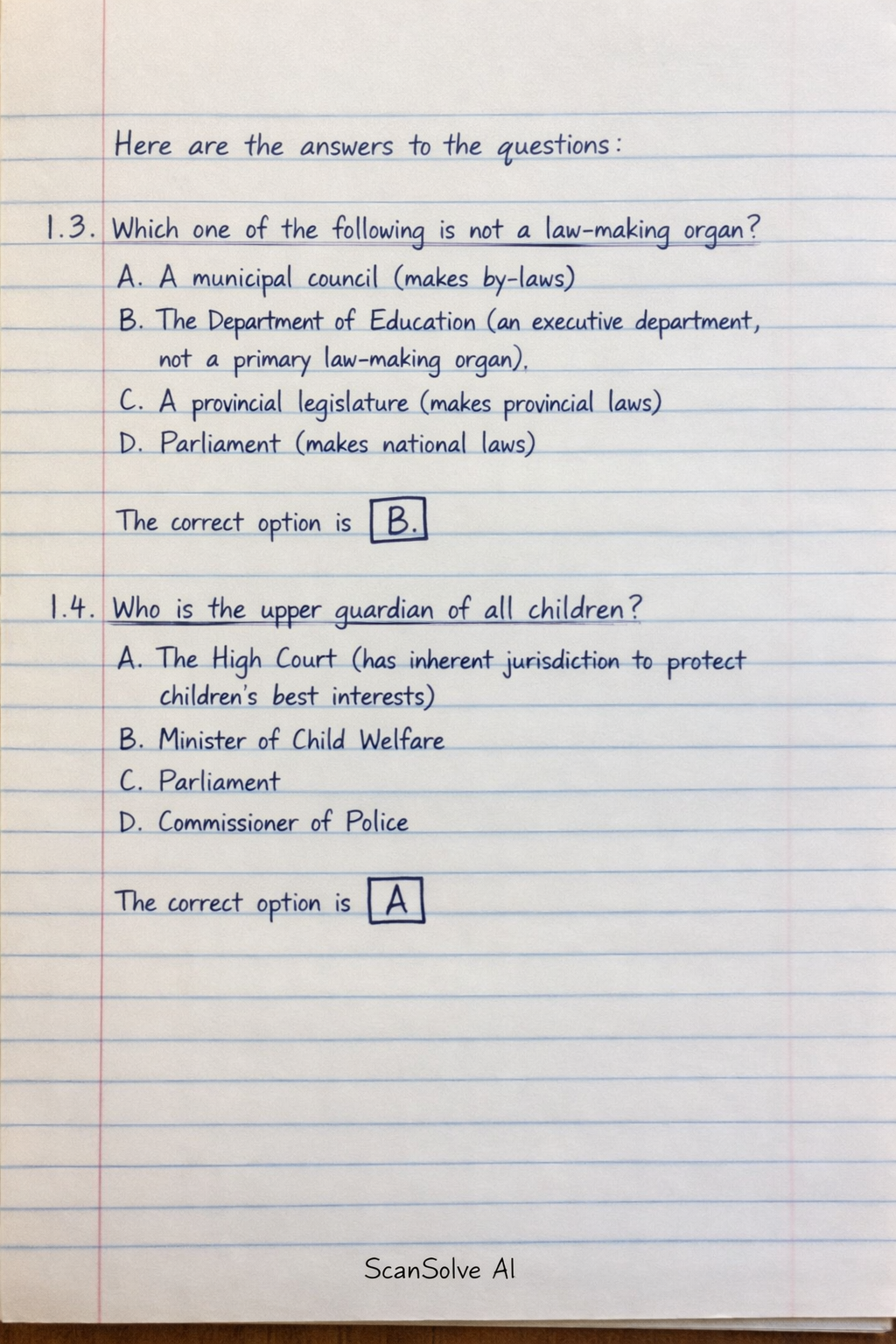
Here are the answers to the questions:
1.3. Which one of the following is not a law-making organ? * A. A municipal council (makes by-laws) * B. The Department of Education (an executive department, not a primary law-making organ) * C. A provincial legislature (makes provincial laws) * D. Parliament (makes national laws)
The correct option is B.
$$
\boxed{\text{B}}
$$
1.4. Who is the upper guardian of all children? * A. The High Court (has inherent jurisdiction to protect children's best interests) * B. Minister of Child Welfare * C. Parliament * D. Commissioner of Police
The correct option is A.
$$
\boxed{\text{A}}
$$
1.5. Which one of these statements is correct? * A. Judicial precedent means that our president elect must be a person. (Incorrect) * B. Judicial precedent means to stand by previous court decisions. (Correct - this is the principle of stare decisis) * C. Judicial precedent means that courts must always set an example for society. (Incorrect) * D. Judicial precedent means that every court must rely on its own decision. (Incorrect)
The correct option is B.
$$
\boxed{\text{B}}
$$
1.6. What is the real purpose of judicial precedent? * A. Legal uniformity. * B. Legal freedom. * C. Legal certainty. * D. It sets out the meaning and extent of legal rules.
The primary purpose of judicial precedent is to ensure consistency and predictability in the application of law, which leads to **legal certainty**.
The correct option is C.
$$
\boxed{\text{C}}
$$
1.7. For a custom to become a law: * A. It must be reasonable. * B. It's content must be clear. * C. It must be accepted by a specific community or group. * D. A, B and C.
All three conditions (reasonableness, clarity, and acceptance by the community) are generally required for a custom to be recognized as law.
The correct option is D.
$$
\boxed{\text{D}}
$$
1.8. Which one of these statements is incorrect? * A. The Constitution is the supreme law of the Republic. (Correct) * B. The Constitution provides for the structure of the state. (Correct) * C. The Constitution provides for the powers of the state. (Correct) * D. The Constitution provides for the powers of the state, but not for the structure of the state. (Incorrect - it provides for both structure and powers.)
The incorrect statement is D.
$$
\boxed{\text{D}}
$$
Try one yourself
A new problem that tests the same skill.
Still stuck on this one?
Ask a follow-up, and the answer starts from this question.
More Biology Questions
Handwritten Step-by-Step Solution
Get this as a handwritten image on WhatsApp — like a tutor wrote it for you.
Try on WhatsApp