
We read your photo as:
Outline the biotic components of an ecosystem.
ScanSolve AI Answer
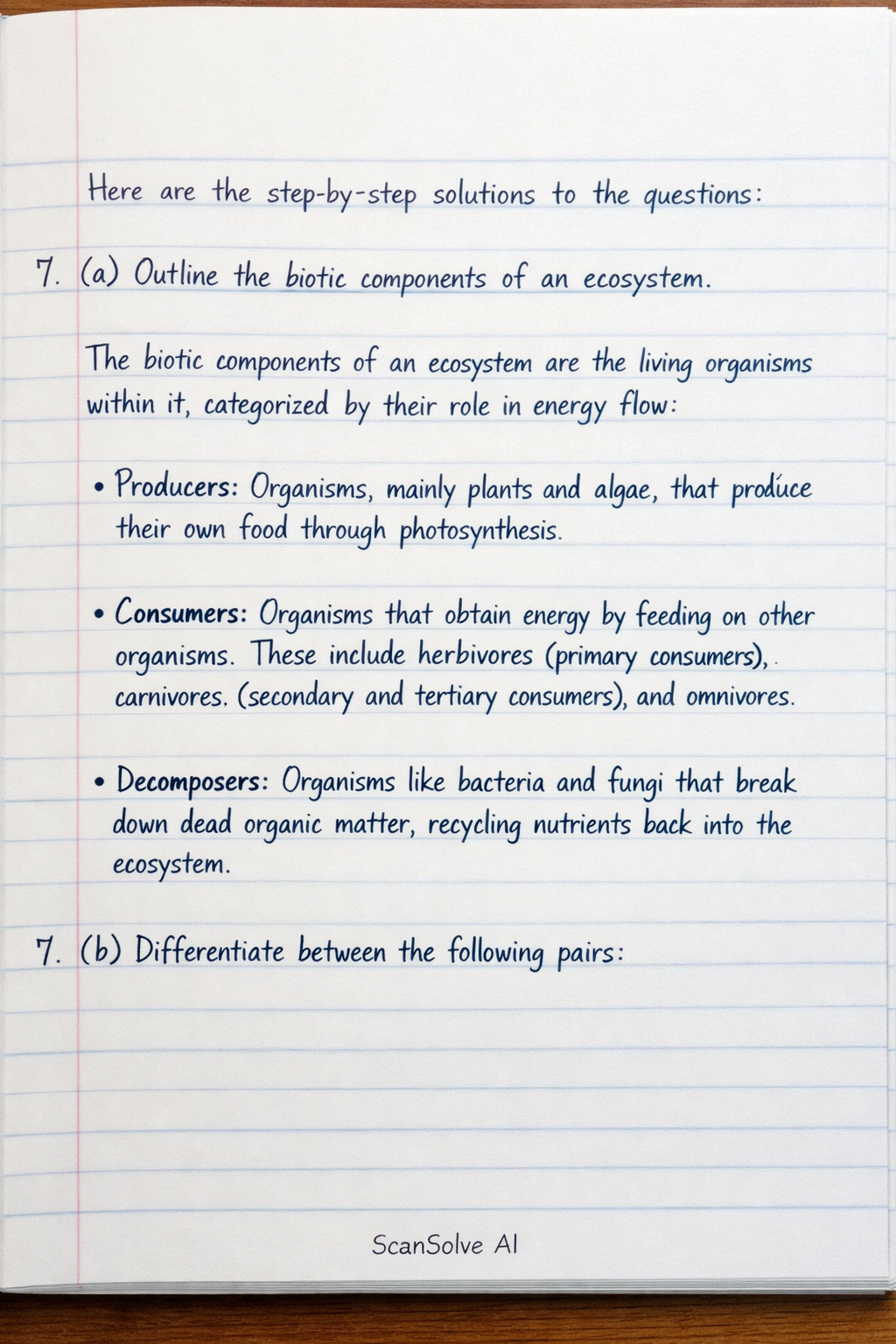
Here are the step-by-step solutions to the questions:
7. (a) Outline the biotic components of an ecosystem.
The biotic components of an ecosystem are the living organisms within it, categorized by their role in energy flow:
- Producers: Organisms, mainly plants and algae, that produce their own food through photosynthesis.
- Consumers: Organisms that obtain energy by feeding on other organisms. These include herbivores (primary consumers), carnivores (secondary and tertiary consumers), and omnivores.
- Decomposers: Organisms like bacteria and fungi that break down dead organic matter, recycling nutrients back into the ecosystem.
7. (b) Differentiate between the following pairs
(i) Primary succession and secondary succession.
- Primary succession occurs in an environment that is initially devoid of life and soil, such as newly formed volcanic rock or sand dunes. It involves the colonization by pioneer species that gradually create soil, allowing more complex communities to establish over a very long period.
- Secondary succession occurs in an area where a pre-existing community has been disturbed or removed (e.g., by fire, logging, or flood), but the soil remains intact. This process is generally faster than primary succession because the soil and some life forms are already present.
(ii) Food chain and food web.
- A food chain illustrates a single, linear pathway of energy transfer from one organism to another, showing who eats whom. For example, grass rabbit fox.
- A food web consists of multiple interconnected food chains within an ecosystem, representing the complex feeding relationships and energy flow among various organisms. It shows that most organisms have more than one food source and are eaten by more than one type of predator.
7. (c) What is the effect of acid rain on the ecosystem?
Acid rain has several detrimental effects on ecosystems:
- It lowers the pH of lakes, rivers, and streams, making them acidic and harmful to aquatic life, leading to the death of fish and other organisms.
- It damages forests by leaching essential nutrients from the soil, making trees more susceptible to disease, insects, and cold weather.
- It can release toxic metals like aluminum from the soil into water bodies, further harming aquatic organisms.
8. (a) State and briefly explain the stages involved in genetic engineering.
The stages involved in genetic engineering are:
- Isolation of desired gene: The specific gene of interest is identified and extracted from the donor organism's DNA.
- Isolation of vector: A suitable vector, typically a plasmid from a bacterium, is isolated.
- Cutting DNA: Both the desired gene and the vector DNA are cut at specific recognition sites using the same restriction enzymes, creating complementary sticky ends.
- Ligation: The isolated gene is inserted into the opened vector DNA, and the complementary sticky ends are joined together by DNA ligase, forming recombinant DNA.
- Transformation: The recombinant DNA is introduced into a host organism, usually a bacterium, which then takes up the new genetic material.
- Selection and Cloning: Host cells that have successfully incorporated the recombinant DNA are identified and multiplied to produce many copies (clones) of the gene.
- Expression: The cloned gene is expressed in the host organism, leading to the production of the desired protein or trait.
8. (b) Describe the biotechnological production of
(i) Bread
The biotechnological production of bread primarily involves the use of Saccharomyces cerevisiae (baker's yeast). Yeast is mixed with flour, water, and other ingredients to form dough. The yeast ferments the sugars present in the flour, producing carbon dioxide gas and ethanol. The carbon dioxide gas gets trapped in the dough, causing it to rise and giving bread its characteristic porous texture. The ethanol evaporates during baking.
(ii) Yeast
The biotechnological production of yeast (for commercial use) involves culturing yeast cells in large bioreactors under controlled conditions. A suitable nutrient-rich medium containing a carbon source (like molasses), nitrogen, and other essential minerals is provided. The yeast cells are allowed to grow and multiply rapidly under optimal temperature, pH, and aeration. Once a sufficient biomass is achieved, the yeast cells are harvested, processed, and packaged for various applications such as baking, brewing, or as a food supplement.
8. (c) What are the advantages of using microorganisms as a food source?
The advantages of using microorganisms as a food source (e.g., Single Cell Protein - SCP) include:
- High growth rate: Microorganisms reproduce very quickly, allowing for rapid biomass production.
- High protein content: Many microorganisms are rich in protein, essential amino acids, vitamins, and minerals.
- Efficient land use: They require significantly less land area compared to traditional agriculture for the same amount of protein production.
- Versatile substrates: Microorganisms can be grown on a wide range of inexpensive and readily available substrates, including agricultural waste products.
- Controlled production: Their growth can be precisely controlled in bioreactors, ensuring consistent quality and yield.
Still stuck on this one?
Ask a follow-up, and the answer starts from this question.
More Biology Questions
Handwritten Step-by-Step Solution
Get this as a handwritten image on WhatsApp — like a tutor wrote it for you.
Try on WhatsApp