

This biology question covers important biological concepts and processes. The step-by-step explanation below helps you understand the underlying mechanisms and reasoning.
ScanSolve AI Answer
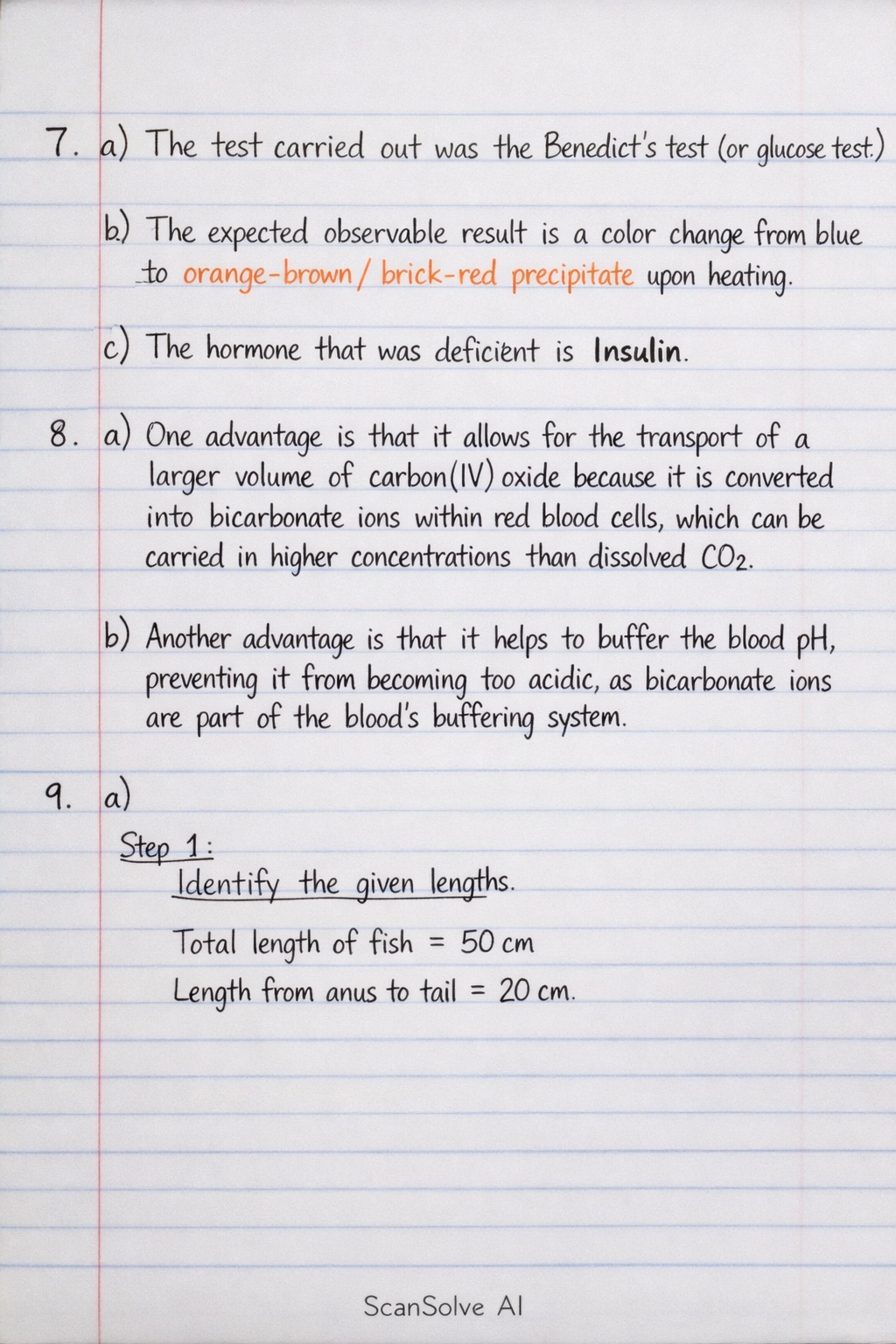
7. a) The test carried out was the Benedict's test (or glucose test). b) The expected observable result is a color change from blue to orange-brown/brick-red precipitate upon heating. c) The hormone that was deficient is insulin. 8. a) One advantage is that it allows for the transport of a larger volume of carbon(IV)oxide because it is converted into bicarbonate ions within red blood cells, which can be carried in higher concentrations than dissolved CO2. b) Another advantage is that it helps to buffer the blood pH, preventing it from becoming too acidic, as bicarbonate ions are part of the blood's buffering system. 9. a) Step 1: Identify the given lengths. Total length of fish = 50 cm Length from anus to tail = 20 cm Step 2: Calculate the tail power. Assuming "tail power" refers to the ratio of the propulsive tail section to the total length. Tail power = Length from anus to tailTotal length Tail power = 20 cm50 cm Tail power = 0.4 The tail power of the fish is 0.4. b) A disadvantage of a low tail power in fish would be reduced swimming speed and maneuverability, making it less efficient at escaping predators or catching prey. Send me the next one 📸