

This biology question covers important biological concepts and processes. The step-by-step explanation below helps you understand the underlying mechanisms and reasoning.
ScanSolve AI Answer
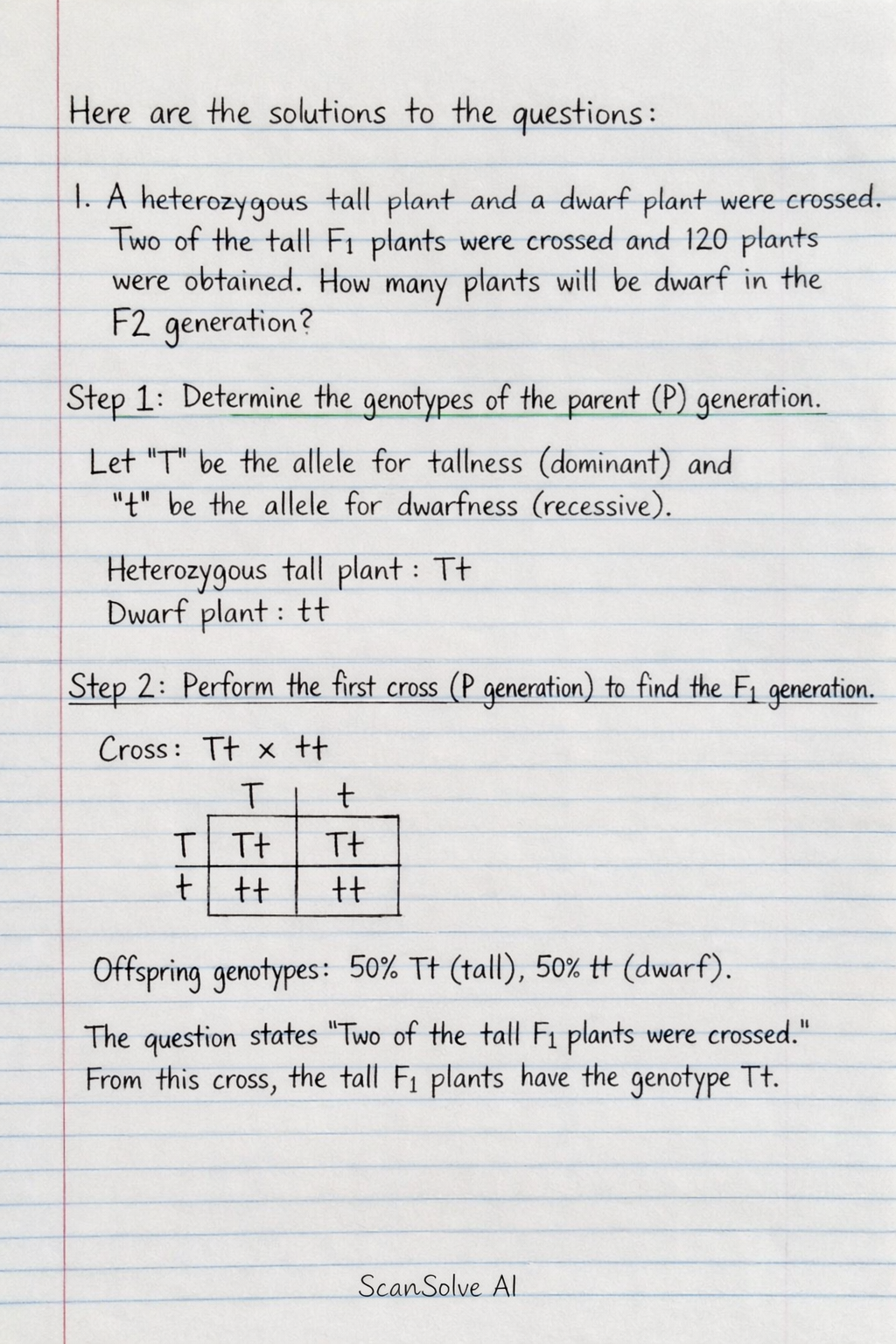
Here are the solutions to the questions: 1. A heterozygous tall plant and a dwarf plant were crossed. Two of the tall F1 plants were crossed and 120 plants were obtained. How many plants will be dwarf in the F2 generation? Step 1: Determine the genotypes of the parent (P) generation. Let 'T' be the allele for tallness (dominant) and 't' be the allele for dwarfness (recessive). Heterozygous tall plant: Tt Dwarf plant: tt Step 2: Perform the first cross (P generation) to find the F1 generation. Cross: Tt × tt Offspring genotypes: 50% Tt (tall), 50% tt (dwarf). The question states "Two of the tall F1 plants were crossed". From this cross, the tall F1 plants have the genotype Tt. Step 3: Perform the second cross (F1 generation) to find the F2 generation. Cross: Tt × Tt Using a Punnett square: |c|c|c| & T & t \\ T & TT & Tt \\ t & Tt & tt \\ Offspring genotypes in F2: 25% TT, 50% Tt, 25% tt. Offspring phenotypes in F2: 75% tall (TT, Tt), 25% dwarf (tt). Step 4: Calculate the number of dwarf plants in the F2 generation. Total F2 plants = 120. Percentage of dwarf plants = 25%. Number of dwarf plants = 0.25 × 120 = 30. The correct option is A. A. 30 2. In a cross between two individuals with genotypes for haemophilia X^HX^h × X^HY, the chances of having a haemophilic son is Step 1: Identify the genotypes of the parents. Parent 1 (female carrier): X^HX^h Parent 2 (normal male): X^HY Haemophilia is an X-linked recessive trait, so X^h is the allele for haemophilia. Step 2: Perform the cross using a Punnett square. Gametes from X^HX^h: X^H, X^h Gametes from X^HY: X^H, Y |c|c|c| & X^H & Y \\ X^H & X^HX^H & X^HY \\ X^h & X^HX^h & X^hY \\ Step 3: Analyze the possible offspring. Possible genotypes: • X^HX^H: Normal female • X^HY: Normal male • X^HX^h: Carrier female • X^hY: Haemophilic male Step 4: Determine the chance of having a haemophilic son. Out of the four possible outcomes, one is a haemophilic son (X^hY). The possible sons are X^HY (normal) and X^hY (haemophilic). If the child is a son, there is a 1 out of 2 chance (50%) that he will be haemophilic. The correct option is C. C. 50% 3. Zigzag dance is a means of communication used by The zigzag dance, also known as the waggle dance, is a complex form of communication used by worker honeybees to inform other bees about the location and distance of food sources. The correct option is A. A. worker honeybee 4. The wings of bats and birds are examples of Convergent evolution occurs when different species independently evolve similar traits due to similar environmental pressures or ecological niches. The wings of bats and birds serve the same function (flight) but have different anatomical structures and evolutionary origins, making them analogous structures. The correct option is B. B. convergent evolution 5. The theory of use and disuse of body parts in evolution is known as Lamarckism is the theory proposed by Jean-Baptiste Lamarck, which suggests that organisms acquire characteristics during their lifetime through the use or disuse of organs and then pass these acquired traits to their offspring. The correct option is C. C. Lamarckism 6. Agglutination would not occur if blood from an individual with blood group B is transfused to a patient with blood group Step 1: Understand blood group B. An individual with blood group B has B antigens on their red blood cells and anti-A antibodies in their plasma. Step 2: Understand agglutination. Agglutination (clumping) occurs when the recipient's antibodies react with the donor's antigens. For no agglutination to occur when donating blood from group B, the recipient's plasma must not contain anti-B antibodies. Step 3: Check recipient blood groups for anti-B antibodies. • Blood group A: Has anti-B antibodies. Agglutination would occur. • Blood group B: Has anti-A antibodies, no anti-B antibodies. No agglutination. • Blood group AB: Has no anti-A or anti-B antibodies. No agglutination. • Blood group O: Has anti-A and anti-B antibodies. Agglutination would occur. Step 4: Identify the options where no agglutination occurs. Agglutination would not occur if the recipient has blood group B or blood group AB. The correct option is B. B. AB or B 7. In the cross between BbFf and bbff, what is the possible number of offspring that would be produced? Step 1: Determine the gametes produced by each parent. Parent 1 (BbFf): Can produce four types of gametes: BF, Bf, bF, bf. Parent 2 (bbff): Can produce only one type of gamete: bf. Step 2: Perform the cross. Combine each gamete from BbFf with the 'bf' gamete from bbff: 1. BF + bf → BbFf 2. Bf + bf → Bbff 3. bF + bf → bbFf 4. bf + bf → bbff Step 3: Count the number of distinct offspring genotypes. There are 4 distinct genotypes produced: BbFf, Bbff, bbFf, and bbff. Each of these genotypes represents a possible type of offspring. The correct option is D. D. Four What's next?