
We read your photo as:
A) i. State the Chargaff's rule. ii. Provide the complementary sequence for 5'-CCTAGTAAG-3'. b) i. Give three (3) structural differences between DNA and RNA.
ScanSolve AI Answer
Here's the answer to question 6:
6. a) i. State the Chargaff's rule.
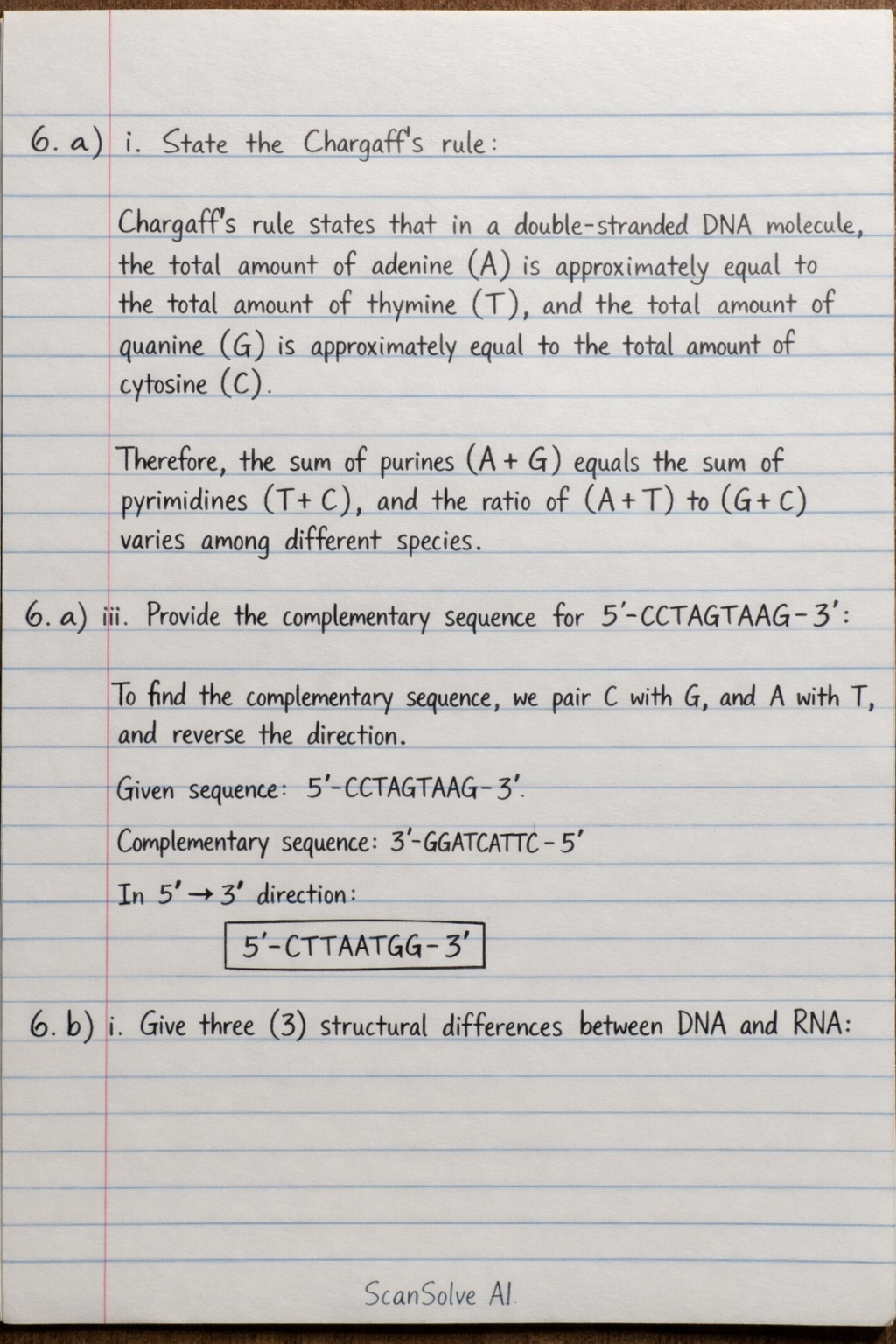
Chargaff's rule states that in a double-stranded DNA molecule, the total amount of adenine () is approximately equal to the total amount of thymine (), and the total amount of guanine () is approximately equal to the total amount of cytosine (). Consequently, the sum of purines () equals the sum of pyrimidines (), and the ratio of to varies among different species.
6. a) ii. Provide the complementary sequence for 5'-CCTAGTAAG-3'.
To find the complementary sequence, we pair C with G, and A with T, and reverse the direction.
Given sequence:
Complementary sequence: or written in the standard direction:
6. b) i. Give three (3) structural differences between DNA and RNA.
- Sugar: DNA contains deoxyribose sugar, which lacks a hydroxyl group at the 2' carbon. RNA contains ribose sugar, which has a hydroxyl group at the 2' carbon.
- Nitrogenous Bases: DNA contains the bases adenine (), guanine (), cytosine (), and thymine (). RNA contains adenine (), guanine (), cytosine (), and uracil () instead of thymine.
- Strandedness: DNA is typically a double-stranded molecule, forming a double helix. RNA is typically a single-stranded molecule, though it can fold into complex secondary and tertiary structures.
6. b) ii. Differentiate between nucleotides and nucleosides.
- Nucleotide: A nucleotide is the basic building block of nucleic acids (DNA and RNA). It consists of three components: a nitrogenous base (purine or pyrimidine), a five-carbon sugar (ribose or deoxyribose), and one or more phosphate groups.
- Nucleoside: A nucleoside consists of only two components: a nitrogenous base and a five-carbon sugar. It lacks the phosphate group(s) that are present in a nucleotide.
6. c) Outline the properties of DNA double helix.
- Antiparallel Strands: The two polynucleotide strands run in opposite directions; one strand runs , and the complementary strand runs .
- Right-Handed Helix: The two strands are coiled around a central axis in a right-handed helical fashion.
- Base Pairing: Specific hydrogen bonding occurs between complementary bases: adenine () always pairs with thymine () via two hydrogen bonds, and guanine () always pairs with cytosine () via three hydrogen bonds.
- Sugar-Phosphate Backbone: The backbone of each strand is composed of alternating sugar and phosphate groups, which are hydrophilic and located on the exterior of the helix.
- Hydrophobic Base Stacking: The nitrogenous bases are stacked in the interior of the helix, perpendicular to the helical axis, and are stabilized by hydrophobic interactions and van der Waals forces.
- Major and Minor Grooves: The helical structure creates two unequal grooves on the surface: a wider major groove and a narrower minor groove, which are important for protein binding.
Still stuck on this one?
Ask a follow-up, and the answer starts from this question.
More Biology Questions
Handwritten Step-by-Step Solution
Get this as a handwritten image on WhatsApp — like a tutor wrote it for you.
Try on WhatsApp