
We read your photo as:
A) Identify the cell shown above.
ScanSolve AI Answer
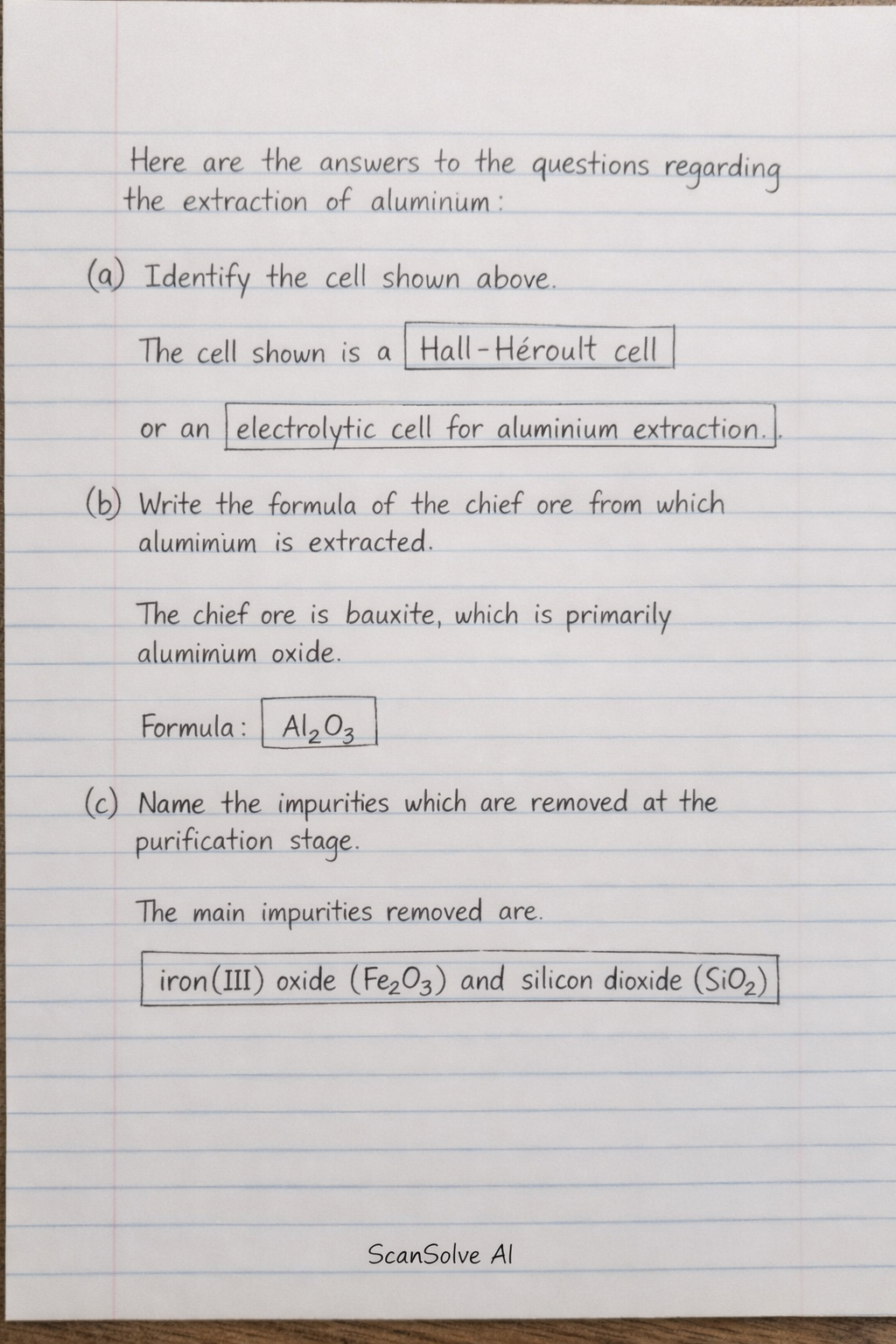
Here are the answers to the questions regarding the extraction of aluminum:
a) Identify the cell shown above.
The cell shown is a or an .
b) Write the formula of the chief ore from which aluminium is extracted.
The chief ore is bauxite, which is primarily aluminium oxide.
Formula:
c) Name the impurities which are removed at the purification stage.
The main impurities removed are .
d) Label on the diagram, the anode, the cathode and region containing the electrolyte.
- Anode: The carbon blocks suspended into the molten mixture.
- Cathode: The graphite lining of the steel tank.
- Electrolyte: The molten mixture of aluminium oxide and cryolite. (Please refer to the diagram provided in the question for the exact labeling points. The carbon blocks are the anodes, the outer lining is the cathode, and the molten substance between them is the electrolyte.)
e) The melting point of aluminium oxide is 2054°C but the electrolysis is carried out at a temperature between 800°C-900°C.
(i) Why is the electrolysis is not carried out at 2054°C?
Carrying out the electrolysis at 2054°C would be required to maintain such a high temperature.
(ii) What is done to lower the temperature?
. Cryolite acts as a solvent, lowering the melting point of the mixture to around 800-900°C.
(iii) The aluminium produced is tapped out as liquid. What does this suggest about its boiling point?
This suggests that the .
f) In the extraction of aluminium from its ore by use of electrolysis, explain the following observations:
(i) The graphite anode is replaced from time to time.
At the anode, oxygen gas is produced from the electrolysis of aluminium oxide. This hot oxygen reacts with the carbon (graphite) anode to form carbon dioxide gas, causing the anode to be .
(ii) The steel tank which can also serve as an electrode is also lined with graphite cathode.
Graphite is used as the cathode lining because it is a and is .
g) Explain why aluminium is heated before it is electrolyzed.
It is the (or dissolve it in molten cryolite). Aluminium oxide must be in a molten state for its ions ( and ) to be mobile and conduct electricity, allowing electrolysis to occur.
Still stuck on this one?
Ask a follow-up, and the answer starts from this question.
More Biology Questions
Handwritten Step-by-Step Solution
Get this as a handwritten image on WhatsApp — like a tutor wrote it for you.
Try on WhatsApp