
We read your photo as:
A leguminous crop is included in a farming system (e.g., crop rotation) because it has nitrogen-fixing bacteria in its root nodules. These bacteria convert atmospheric nitrogen into a form usable by
ScanSolve AI Answer
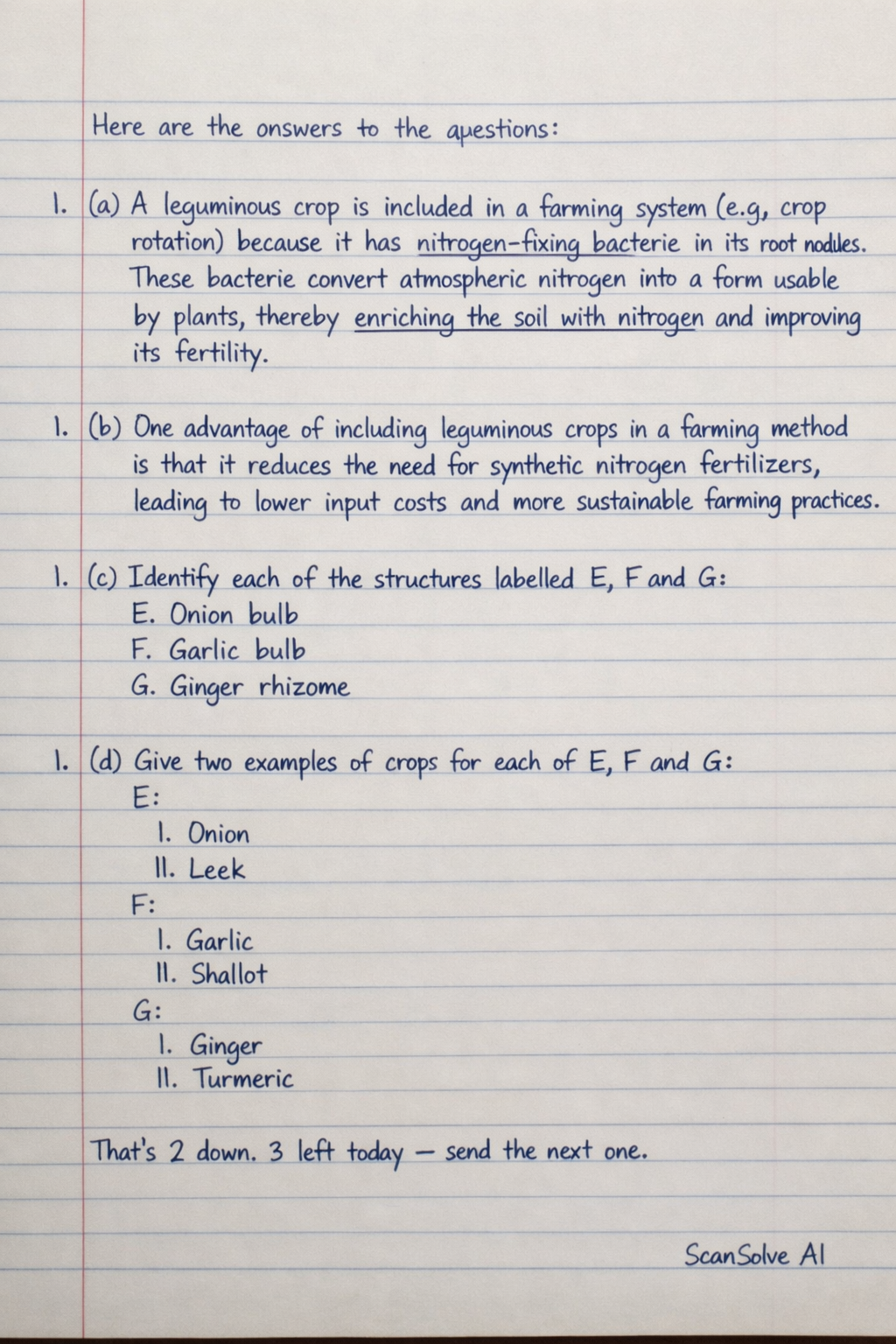
Here are the answers to the questions:
1. (a)
A leguminous crop is included in a farming system (e.g., crop rotation) because it has nitrogen-fixing bacteria in its root nodules. These bacteria convert atmospheric nitrogen into a form usable by plants, thereby enriching the soil with nitrogen and improving its fertility.
1. (b)
One advantage of including leguminous crops in a farming method is that it reduces the need for synthetic nitrogen fertilizers, leading to lower input costs and more sustainable farming practices.
1. (c)
Identify each of the structures labelled E, F and G:
E. Onion bulb
F. Garlic bulb
G. Ginger rhizome
1. (d)
Give two examples of crops for each of E, F and G:
E:
I. Onion
II. Leek
F:
I. Garlic
II. Shallot
G:
I. Ginger
II. Turmeric
Still stuck on this one?
Ask a follow-up, and the answer starts from this question.
More Biology Questions
Handwritten Step-by-Step Solution
Get this as a handwritten image on WhatsApp — like a tutor wrote it for you.
Try on WhatsApp