
We read your photo as:
A man wants a dog with brown fur, a short tail, and sharp canines. These traits are known to be recessive. If the farmer he is dealing with does not currently have such a dog, what would be the most l
ScanSolve AI Answer
Answers
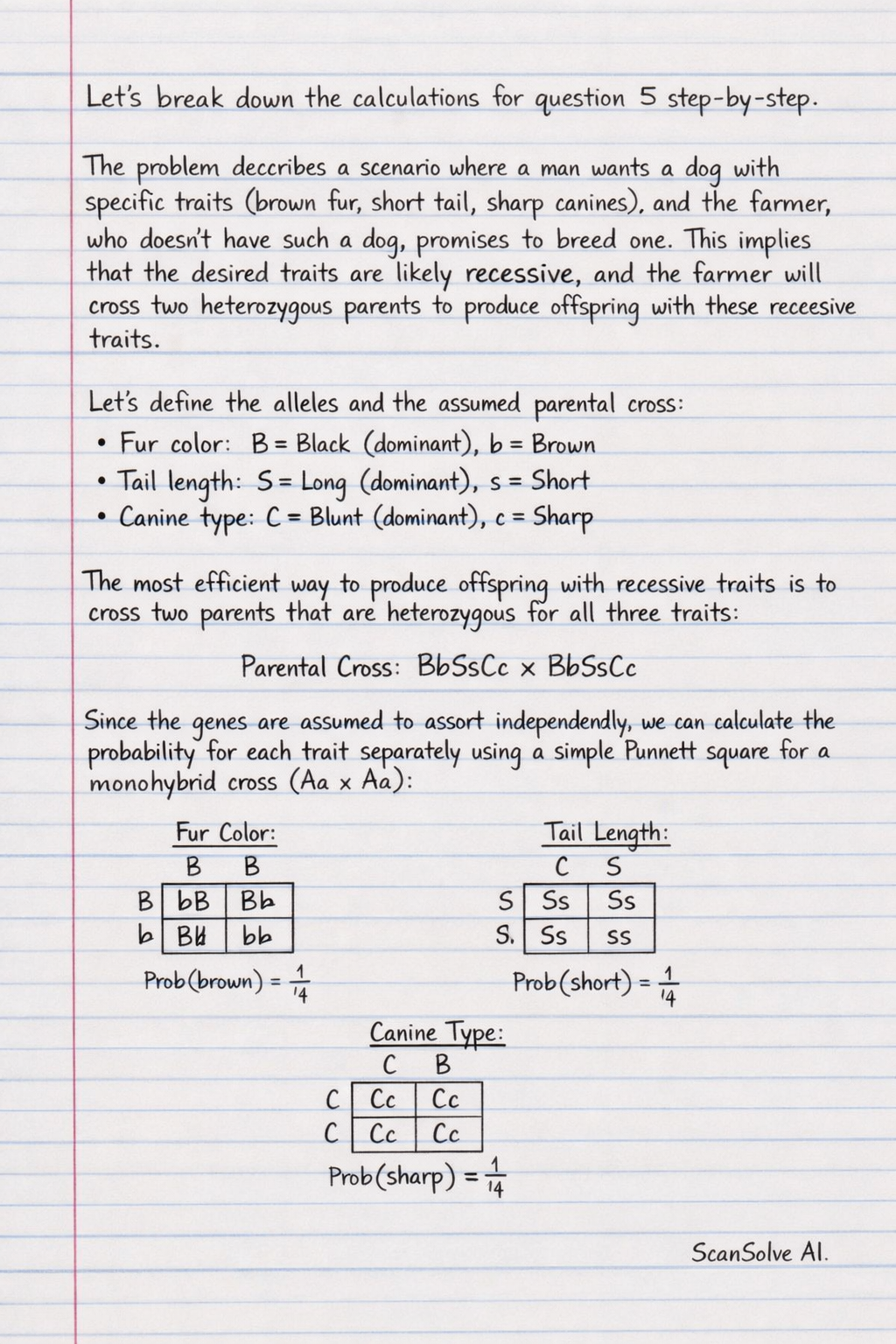
3 partsLet's break down the calculations for question 5 step-by-step.
The problem describes a scenario where a man wants a dog with specific traits (brown fur, short tail, sharp canines), and the farmer, who doesn't have such a dog, promises to breed one. This implies that the desired traits are likely recessive, and the farmer will cross two heterozygous parents to produce offspring with these recessive traits.
Let's define the alleles and the assumed parental cross:
- Fur color: Black () is dominant over Brown ().
- Tail length: Long () is dominant over Short ().
- Canine type: Blunt () is dominant over Sharp ().
The most efficient way to produce offspring with recessive traits is to cross two parents that are heterozygous for all three traits:
Parental Cross:
Since the genes are assumed to assort independently, we can calculate the probability for each trait separately using a simple Punnett square for a monohybrid cross ().
For any single gene (e.g., ):
From this Punnett square, we see:
- Probability of homozygous dominant () =
- Probability of heterozygous () =
- Probability of homozygous recessive () =
Based on these genotypes, the phenotypic probabilities are:
- Probability of the dominant phenotype (, which includes and ) =
- Probability of the recessive phenotype () =
Now, we apply these probabilities to each part of question 5.
i. What is the probability that the man will get a dog with all three traits (brown fur, short tail, sharp canines)? (2 marks)
The desired traits are brown fur (), short tail (), and sharp canines (). All are recessive phenotypes.
- Probability of brown fur () from :
- Probability of short tail () from :
- Probability of sharp canines () from :
To find the probability of all three events occurring together, we multiply their individual probabilities:
The probability is .
ii. Calculate the probability of getting a black fur, short tail and blunt canine dog (2 marks)
The desired traits are black fur (), short tail (), and blunt canines ().
- Probability of black fur (, dominant) from :
- Probability of short tail (, recessive) from :
- Probability of blunt canines (, dominant) from :
Multiply these probabilities:
The probability is .
iii. Calculate the probability of getting a brown, long tail, sharp canine dog (2 mark)
The desired traits are brown fur (), long tail (), and sharp canines ().
- Probability of brown fur (, recessive) from :
- Probability of long tail (, dominant) from :
- Probability of sharp canines (, recessive) from :
Multiply these probabilities:
The probability is .
Try one yourself
A new problem that tests the same skill.
Still stuck on this one?
Ask a follow-up, and the answer starts from this question.
More Biology Questions
Handwritten Step-by-Step Solution
Get this as a handwritten image on WhatsApp — like a tutor wrote it for you.
Try on WhatsApp