
We read your photo as:
What is a nerve impulse (b) Describe how it is transmitted along a neuron (c) How can this impulse be transmitted across a synapse? (d) Differentiate between a nervous and hormonal responses
ScanSolve AI Answer
a) A nerve impulse, also known as an action potential, is an electrical signal that travels rapidly along the membrane of a neuron. It is a momentary reversal of the electrical potential difference across the neuron's membrane, caused by the rapid influx and efflux of ions.
b) Transmission of a nerve impulse along a neuron occurs through a process called propagation of an action potential. When a stimulus reaches a neuron, it causes depolarization as voltage-gated sodium () channels open, allowing ions to rush into the cell, making the inside positive. This depolarization triggers adjacent voltage-gated channels to open, propagating the action potential down the axon. Immediately after, voltage-gated potassium () channels open, and ions flow out, causing repolarization and restoring the negative charge inside. The sodium-potassium pump then actively transports ions to re-establish the resting potential.
c) Transmission of a nerve impulse across a synapse involves chemical signaling. When an action potential arrives at the presynaptic terminal, it triggers the opening of voltage-gated calcium () channels, allowing ions to enter. This influx of causes synaptic vesicles containing neurotransmitters to fuse with the presynaptic membrane and release their contents into the synaptic cleft. The neurotransmitters then diffuse across the cleft and bind to specific receptors on the postsynaptic membrane. This binding opens ion channels on the postsynaptic neuron, causing either depolarization (excitatory postsynaptic potential, leading to a new impulse) or hyperpolarization (inhibitory postsynaptic potential, preventing an impulse).
d)
- Nervous responses are typically rapid and short-lived, mediated by electrical signals (nerve impulses) and chemical neurotransmitters. They target specific cells or organs directly connected by neurons.
- Hormonal responses are generally slower to initiate but have longer-lasting effects, mediated by chemical hormones transported through the bloodstream. Hormones can affect a wide range of target cells or organs throughout the body that possess the appropriate receptors.
Still stuck on this one?
Ask a follow-up, and the answer starts from this question.
More Biology Questions
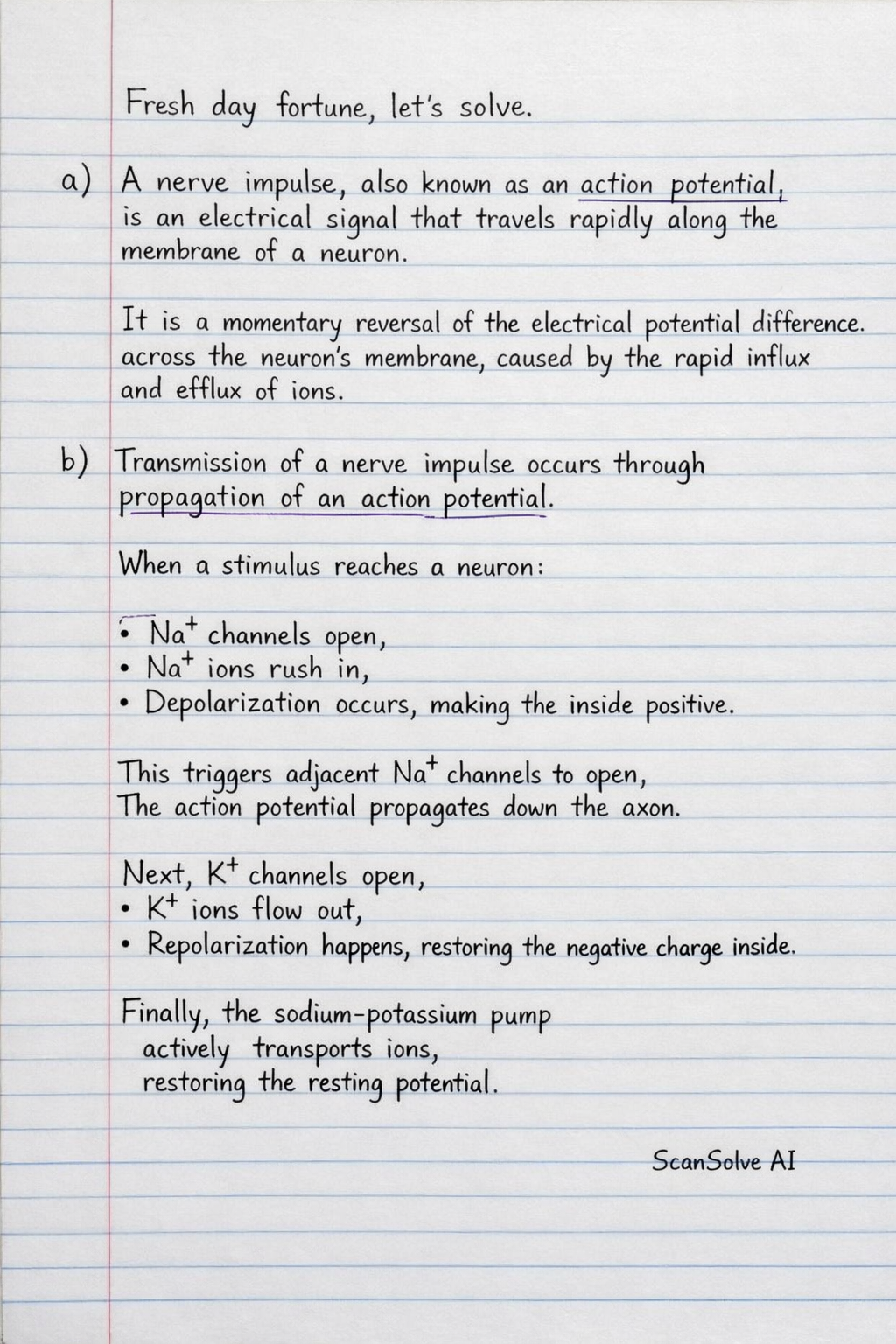
Handwritten Step-by-Step Solution
Get this as a handwritten image on WhatsApp — like a tutor wrote it for you.
Try on WhatsApp