
We read your photo as:
A person exercises for an hour. Starting with the pancreas, what is the correct sequence of events in which the hormone glucagon is involved?
ScanSolve AI Answer
Answer
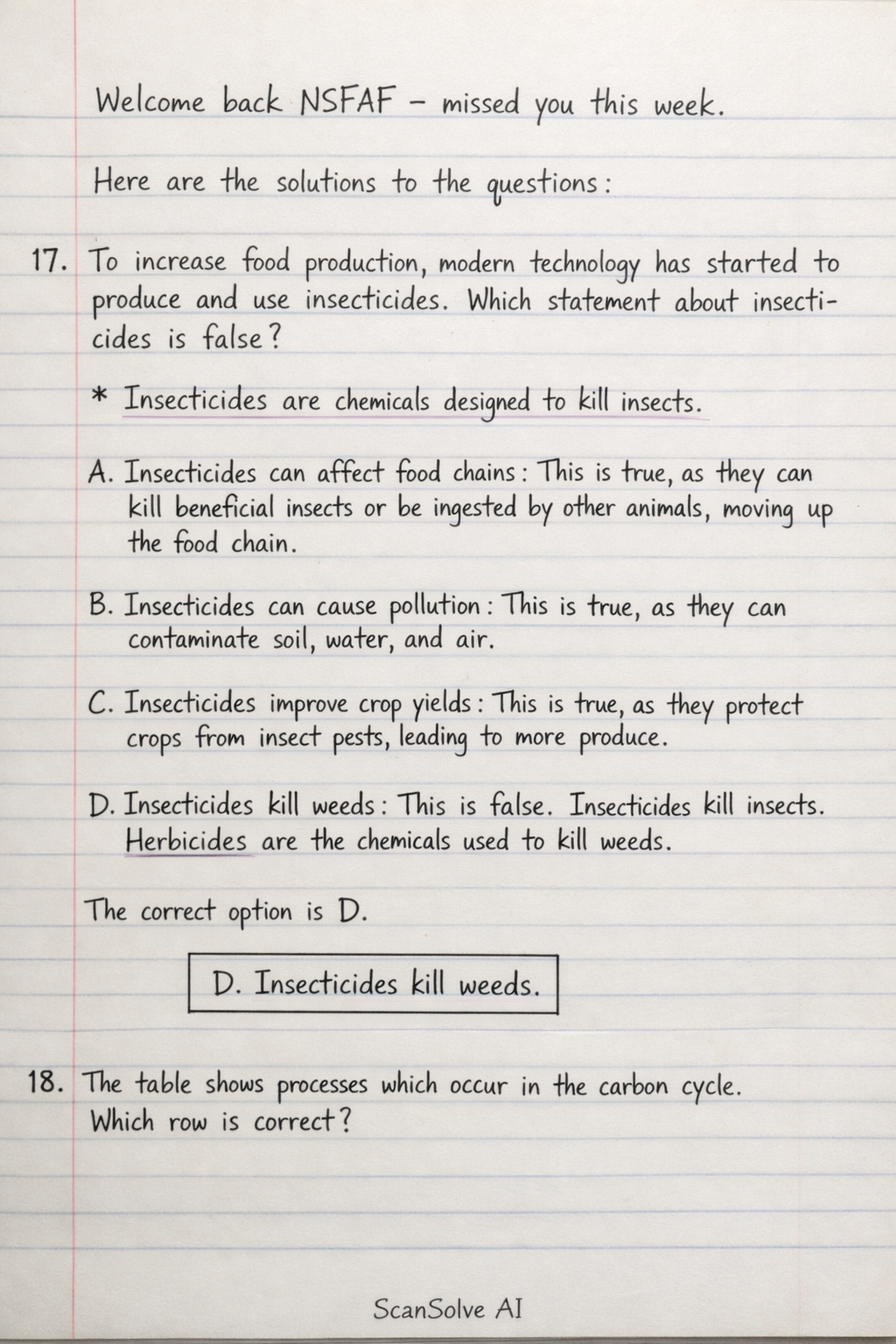
Here are the solutions to the questions:
17. To increase food production, modern technology has started to produce and use insecticides. Which statement about insecticides is false?
- Insecticides are chemicals designed to kill insects.
- A. Insecticides can affect food chains: This is true, as they can kill beneficial insects or be ingested by other animals, moving up the food chain.
- B. Insecticides can cause pollution: This is true, as they can contaminate soil, water, and air.
- C. Insecticides improve crop yields: This is true, as they protect crops from insect pests, leading to more produce.
- D. Insecticides kill weeds: This is false. Insecticides kill insects. Herbicides are the chemicals used to kill weeds.
The correct option is D.
18. The table shows processes which occur in the carbon cycle. Which row is correct?
Let's analyze each process:
- Decay: Decomposers break down organic matter, releasing carbon dioxide into the air.
- Combustion: Burning of fossil fuels or biomass releases carbon dioxide into the air.
- Photosynthesis: Plants take in carbon dioxide from the air to produce glucose. This removes carbon dioxide from the air.
- Respiration: Organisms break down glucose to release energy, releasing carbon dioxide into the air.
Now let's check the rows:
- A: "releases carbon dioxide into the air" - decay (Correct). "removes carbon dioxide from the air" - photosynthesis (Correct). This row is entirely correct.
- B: "releases carbon dioxide into the air" - combustion (Correct). "removes carbon dioxide from the air" - respiration (Incorrect, respiration releases CO).
- C: "releases carbon dioxide into the air" - photosynthesis (Incorrect, photosynthesis removes CO). "removes carbon dioxide from the air" - combustion (Incorrect, combustion releases CO).
- D: "releases carbon dioxide into the air" - respiration (Correct). "removes carbon dioxide from the air" - decay (Incorrect, decay releases CO).
The correct option is A.
19. The following diagram shows part of the mechanism that controls blood sugar concentration. A person exercises for an hour. Starting with the pancreas, what is the correct sequence of events in which the hormone glucagon is involved?
When a person exercises, their body uses up glucose, leading to a decrease in blood glucose concentration.
- Less glucose in the blood (represented by 2) is detected by the pancreas.
- The pancreas responds by releasing more glucagon (represented by 5).
- Glucagon travels to the liver and stimulates the breakdown of stored glycogen into glucose. This results in less glycogen in the liver (represented by 4).
- The glucose released from the liver then enters the bloodstream, increasing blood glucose levels (leading to 1, more glucose in the blood).
Therefore, the correct sequence of events, starting with the pancreas's action involving glucagon, is:
5 (more glucagon released) 4 (less glycogen in the liver) 1 (more glucose in the blood).
The correct option is B.
Try one yourself
A new problem that tests the same skill.
Still stuck on this one?
Ask a follow-up, and the answer starts from this question.
More Biology Questions
Handwritten Step-by-Step Solution
Get this as a handwritten image on WhatsApp — like a tutor wrote it for you.
Try on WhatsApp