

This biology question covers important biological concepts and processes. The step-by-step explanation below helps you understand the underlying mechanisms and reasoning.
ScanSolve AI Answer
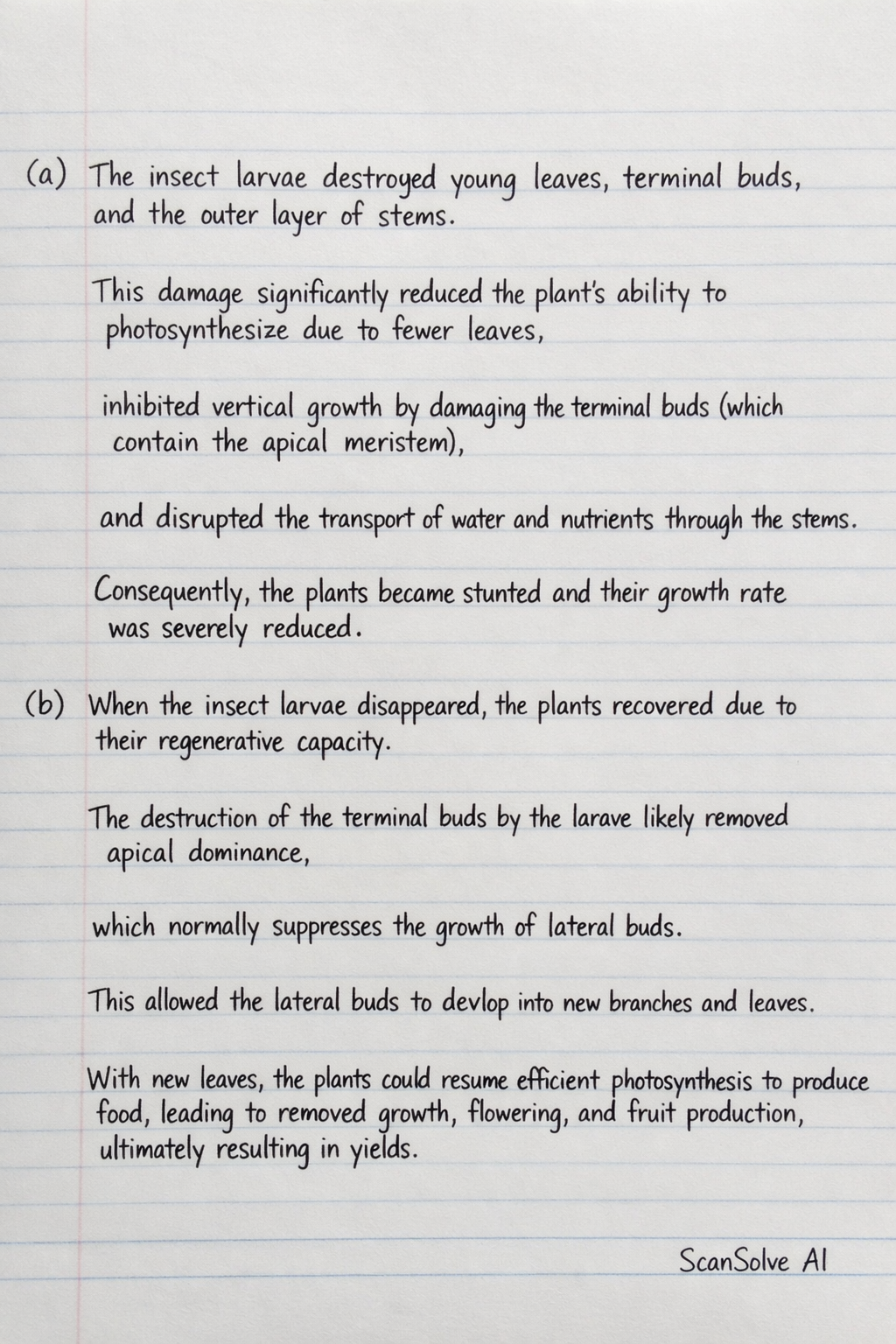
a) The insect larvae destroyed young leaves, terminal buds, and the outer layer of stems. This damage significantly reduced the plant's ability to photosynthesize due to fewer leaves, inhibited vertical growth by damaging the terminal buds (which contain the apical meristem), and disrupted the transport of water and nutrients through the stems. Consequently, the plants became stunted and their growth rate was severely reduced. b) When the insect larvae disappeared, the plants recovered due to their regenerative capacity. The destruction of the terminal buds by the larvae likely removed apical dominance, which normally suppresses the growth of lateral buds. This allowed the lateral buds to develop into new branches and leaves. With new leaves, the plants could resume efficient photosynthesis to produce food, leading to renewed growth, flowering, and fruit production, ultimately resulting in yields.