
We read your photo as:
A) What are the characteristics of insect pollinated flowers?
ScanSolve AI Answer
Step-by-step solution
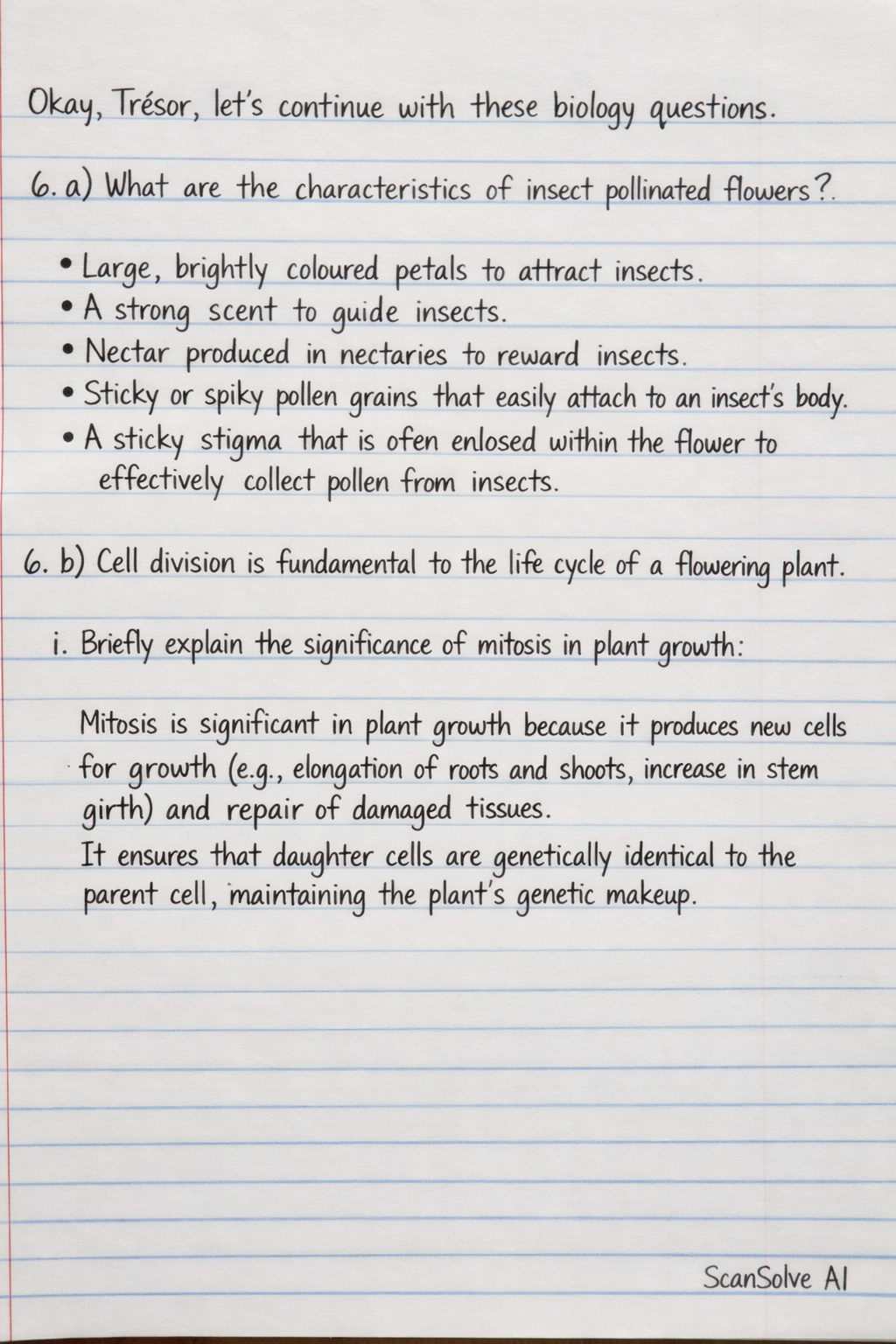
4 stepsOkay, Trésor, let's continue with these biology questions.
6. a) What are the characteristics of insect pollinated flowers?
Insect-pollinated flowers typically have:
- Large, brightly colored petals to attract insects.
- A strong scent to guide insects.
- Nectar produced in nectaries to reward insects.
- Sticky or spiky pollen grains that easily attach to an insect's body.
- A sticky stigma that is often enclosed within the flower to effectively collect pollen from insects.
6. b) Cell division is fundamental to the life cycle of a flowering plant.
i. Briefly explain the significance of mitosis in plant growth.
Mitosis is significant in plant growth because it produces new cells for growth (e.g., elongation of roots and shoots, increase in stem girth) and repair of damaged tissues. It ensures that daughter cells are genetically identical to the parent cell, maintaining the plant's genetic makeup.
ii. Describe the process and importance of meiosis in the formation of gametes in flowering plants.
Meiosis is a type of cell division that reduces the chromosome number by half, producing four haploid cells (gametes) from a single diploid cell. In flowering plants, it occurs in the anthers to form pollen grains (containing male gametes) and in the ovules to form the embryo sac (containing the female gamete). Its importance lies in ensuring that the chromosome number remains constant across generations after fertilization and in introducing genetic variation through crossing over and independent assortment, which is crucial for adaptation.
6. c) State how fertilization occurs in a flowering plant.
Pollination occurs when a pollen grain lands on the stigma.
The pollen grain germinates, growing a pollen tube down through the style towards the ovule.
Two male gametes travel down the pollen tube.
One male gamete fuses with the egg cell to form a diploid zygote.
The other male gamete fuses with the central cell (polar nuclei) to form the triploid endosperm, which provides nourishment for the developing embryo.
This process is known as double fertilization.
6. d) How is water important in seed germination?
Water is crucial for seed germination because:- It hydrates the seed, causing it to swell and rupture the seed coat, allowing the embryo to emerge.
- It activates enzymes within the seed that break down stored food reserves into soluble forms for the embryo's growth.
- It acts as a medium for transporting these dissolved food substances to the growing embryo.
- It is essential for cell expansion and turgor pressure, which drives the growth of the radicle and plumule.
7. a) Define the following terms as used in genetics:
i. Gene
A gene is a segment of DNA that codes for a specific protein or functional RNA molecule, determining a particular inherited trait.ii. Mutation
A mutation is a permanent, heritable change in the DNA sequence of an organism's genome.iii. Phenotype
The phenotype is the observable physical or biochemical characteristics of an organism, resulting from the interaction of its genotype with the environment.iv. Monohybrid cross
A monohybrid cross is a genetic cross between two individuals that differ in only one specific trait.7. b) Albinism is a genetic condition caused by a recessive allele that results in the absence of melanin pigment.
This statement defines albinism as a genetic condition caused by a recessive allele leading to a lack of melanin pigment.
Still stuck on this one?
Ask a follow-up, and the answer starts from this question.
More Biology Questions
Handwritten Step-by-Step Solution
Get this as a handwritten image on WhatsApp — like a tutor wrote it for you.
Try on WhatsApp