
We read your photo as:
A. Write in detail, special specimen collection procedures including [a] transportation temperatures, [b] transport media and [c] preservation for the culture of: 1. Urine (5marks) 2. Sputum (5marks) 3. Cerebrospinal fluid (CSF)(5marks)
Biology
ScanSolve AI Answer
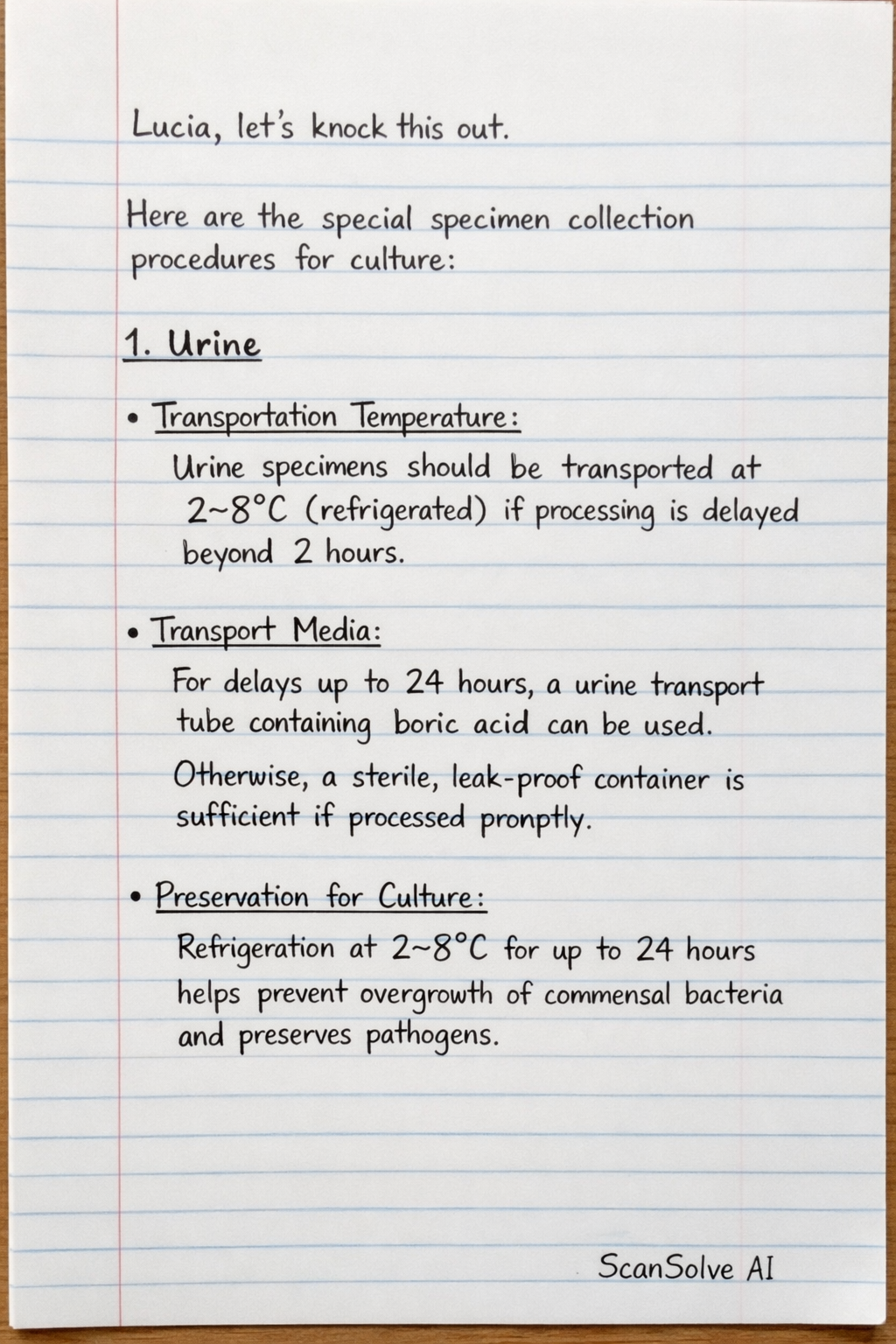
Here are the special specimen collection procedures for culture:
-
Urine
- Transportation Temperature: Urine specimens should be transported at (refrigerated) if processing is delayed beyond 2 hours.
- Transport Media: For delays up to 24 hours, a urine transport tube containing boric acid can be used. Otherwise, a sterile, leak-proof container is sufficient if processed promptly.
- Preservation for Culture: Refrigeration at for up to 24 hours helps prevent overgrowth of commensal bacteria and preserves pathogens.
-
Sputum
- Transportation Temperature: Sputum should be transported at room temperature () if processed within 1-2 hours. If a delay is anticipated, refrigerate at .
- Transport Media: No specific transport media is typically required for routine bacterial culture if collected in a sterile, leak-proof container and processed promptly.
- Preservation for Culture: Refrigeration at for up to 24 hours is recommended to maintain the viability of pathogens and inhibit overgrowth of oral flora.
-
Cerebrospinal Fluid (CSF)
- Transportation Temperature: CSF specimens are critical and must be transported immediately at room temperature (). Refrigeration is contraindicated as it can kill fastidious organisms like Neisseria meningitidis and Haemophilus influenzae.
- Transport Media: No transport media is used for CSF. It is collected in sterile tubes and must be processed without delay.
- Preservation for Culture: The best preservation for CSF is immediate processing. If a very short delay is unavoidable, keep the specimen at room temperature. For enhanced recovery, especially if processing is delayed, some laboratories inoculate CSF directly into a blood culture bottle.
Was this helpful?
Still stuck on this one?
Ask a follow-up, and the answer starts from this question.
Got a different question?Ask your own question
More Biology Questions
QEach candidate should be provided with the following specimens: ... (b) It is essential that each…QObserve specimens J, K, L, M, O and P and use them to answer questions 3(a) to 3(c). 3(a) Complete…QQ1 Write on Medical Laboratory Science with reference to the disciplines therein and explain its…QList the specimens and materials required for each question in the provided biology practical exam…QS-CUPREC SPECIMEN Specimens: A : grasshopper. E: mushroom B: garden snail. F: spider C: toad. G…
Handwritten Step-by-Step Solution
Get this as a handwritten image on WhatsApp — like a tutor wrote it for you.
Try on WhatsApp