
How to calculate the total plate count method
ScanSolve AI Answer
Answer
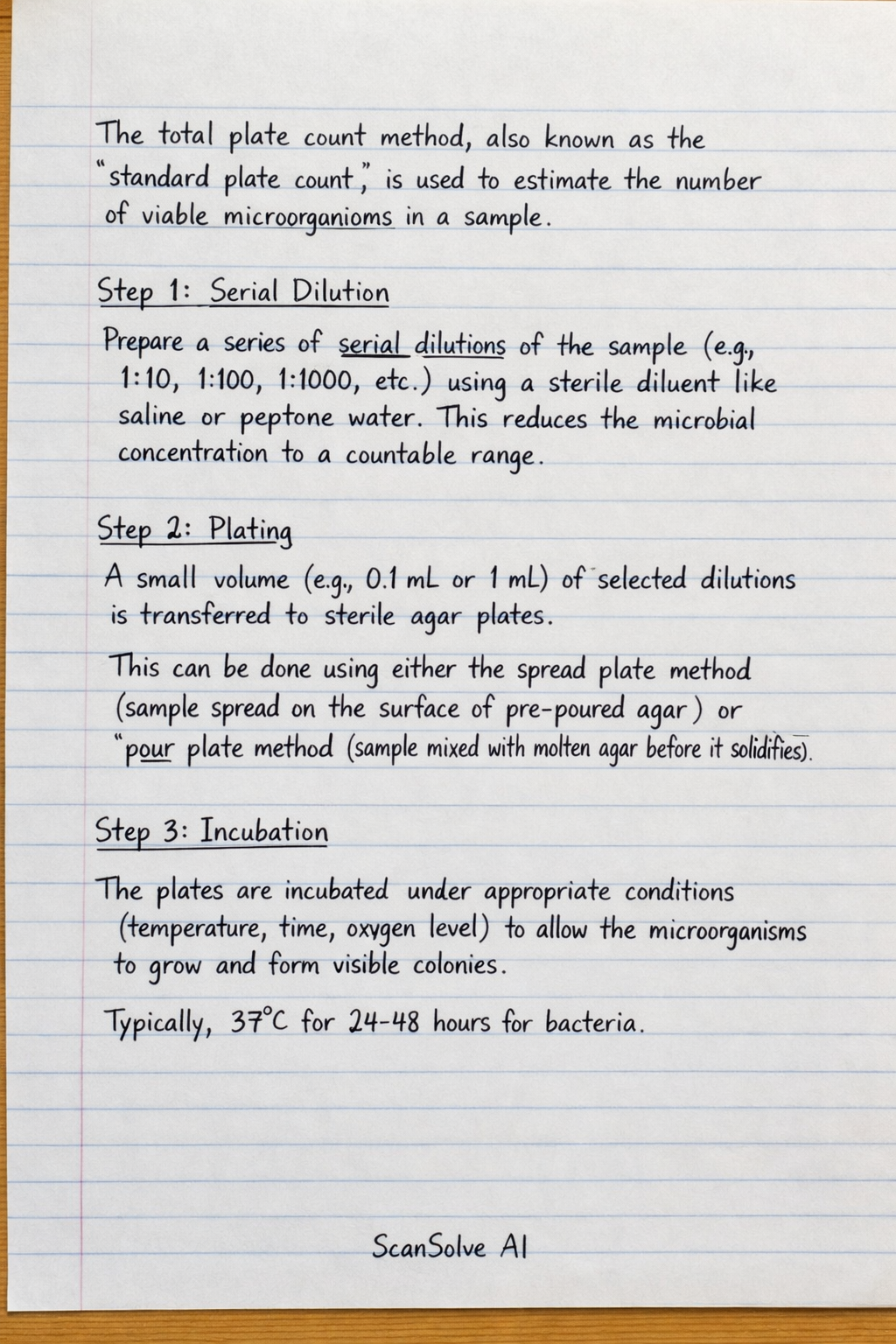
The total plate count method, also known as the standard plate count, is used to estimate the number of viable microorganisms in a sample.
Step-by-step solution
5 stepsSerial Dilution
Prepare a series of serial dilutions of the sample (e.g., $1:10$, $1:100$, $1:1000$, etc.) using a sterile diluent like saline or peptone water. This reduces the microbial concentration to a countable range.
Plating
A small volume (e.g., or ) of selected dilutions is transferred to sterile agar plates. This can be done using either the spread plate method (sample spread on the surface of pre-poured agar) or the pour plate method (sample mixed with molten agar before it solidifies).
Incubation
The plates are incubated under appropriate conditions (temperature, time, oxygen level) to allow the microorganisms to grow and form visible colonies. Typically, for hours for bacteria.
Colony Counting
After incubation, colonies on plates are counted. Select plates that have between 30 and 300 colonies (for bacteria) for accuracy. Plates with fewer than 30 colonies are considered statistically unreliable, and plates with more than 300 are too numerous to count accurately.
Calculation
The number of colonies counted is multiplied by the reciprocal of the dilution factor to determine the original concentration of microorganisms in the sample. The result is expressed as colony-forming units per milliliter () or per gram ().
The formula is:
For example, if 100 colonies were counted on a plate that received of a dilution:
The total plate count method provides an estimate of viable cells, as only cells capable of growth under the given conditions will form colonies.
Still stuck on this one?
Ask a follow-up, and the answer starts from this question.
More Biology Questions
Handwritten Step-by-Step Solution
Get this as a handwritten image on WhatsApp — like a tutor wrote it for you.
Try on WhatsApp