
We read your photo as:
Calculate the Total WBC count given 160 cells in 4 corner squares and a dilution factor of 20. Also, explain why waiting 2-3 mins after mixing with Turk's fluid is necessary.
ScanSolve AI Answer
Step-by-step solution
3 stepsHere are the answers to your physiology questions:
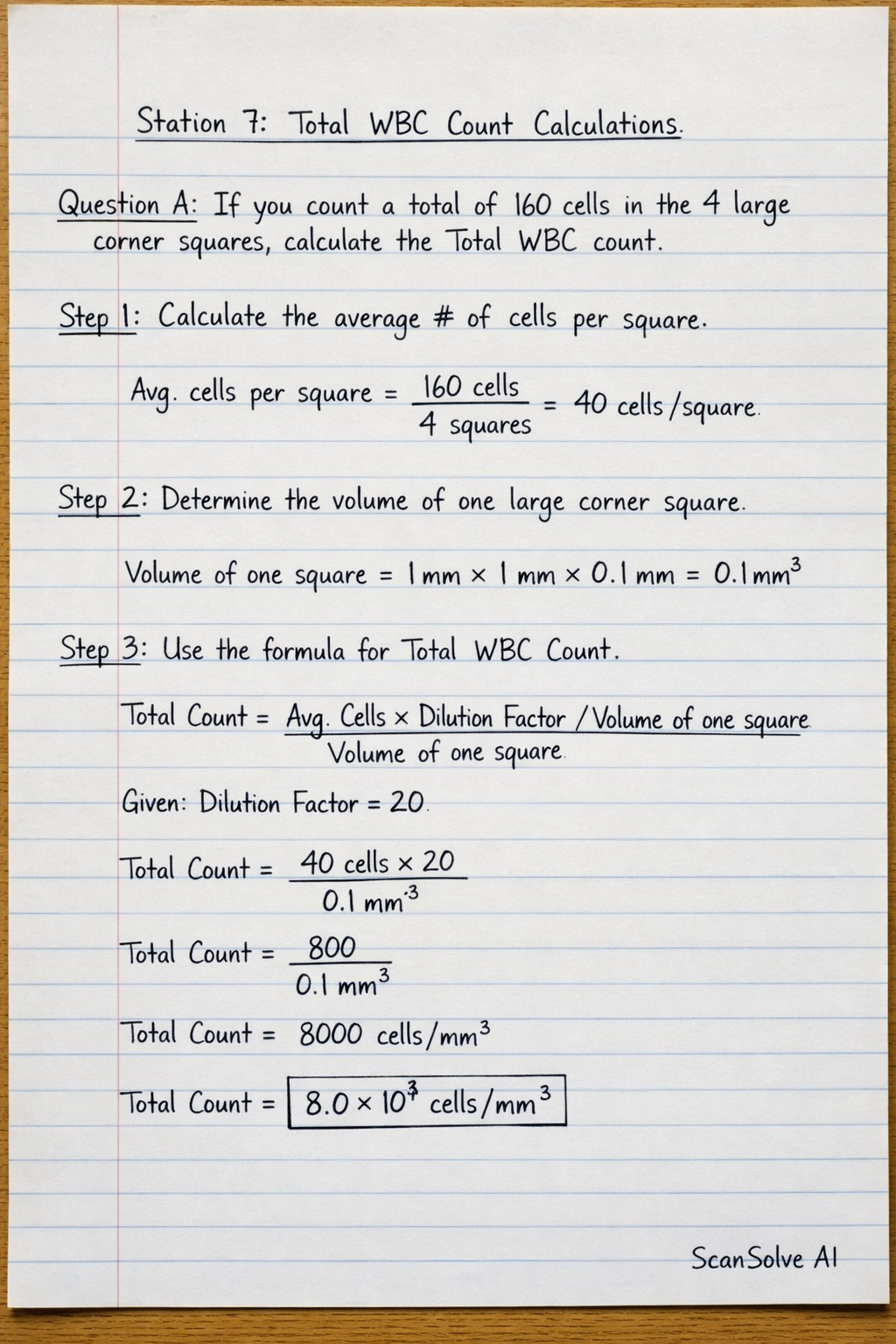
Station 7: Total WBC Count Calculations
- Question A: If you count a total of 160 cells in the 4 large corner squares, calculate the Total WBC count.
Calculate the average number of cells per square.
$$ \text{Average cells per square} = \frac{160 \text{ cells}}{4 \text{ squares}} = 40 \text{ cells/square} $$Determine the volume of one large corner square.
$$ \text{Volume of one square} = 1 \text{ mm} \times 1 \text{ mm} \times 0.1 \text{ mm} = 0.1 \text{ mm}^3 $$Use the formula for Total WBC Count.
$$ \text{Total Count} = \frac{\text{Average Cells} \times \text{Dilution Factor}}{\text{Volume of one square}} $$ Given Dilution Factor = 20 $$ \text{Total Count} = \frac{40 \text{ cells} \times 20}{0.1 \text{ mm}^3} $$ $$ \text{Total Count} = \frac{800}{0.1 \text{ mm}^3} $$ $$ \text{Total Count} = 8000 \text{ cells/mm}^3 $$ $$ \text{Total Count} = \boxed{8.0 \times 10^3 \text{ cells/mm}^3} $$- Question B: Why must you wait 2-3 minutes after mixing blood with Turk's fluid before charging the chamber? To allow the glacial acetic acid in Turk's fluid enough time to completely lyse (break open) the red blood cells (RBCs) so they don't obscure the white blood cells (WBCs) during counting.
Station 8: The "Blood Smear" Quality
-
Question A: Name two common errors in making a blood smear that lead to a "poor tail."
- Pushing the spreader slide too fast.
- Using a spreader with a chipped or dirty edge.
-
Question B: Where on the slide should you perform a Differential Leukocyte Count (DLC)? The monolayer, which is the area just behind the "feathered edge" where the cells are close together but not overlapping.
-
Question C: Identify a condition where you would see a "Shift to the Left" in a neutrophil count. Acute bacterial infection, which is characterized by the presence of immature "band" neutrophils.
Station 9: ESR Mechanisms
-
Question A: What is the primary anticoagulant used in the Westergren method? 3.8% Sodium Citrate (in a ratio of 1 part citrate to 4 parts blood).
-
Question B: Explain why a patient with Spherocytosis (round RBCs) would have a very low ESR. Spherocytes are abnormally round and rigid red blood cells. Their spherical shape prevents them from forming rouleaux (stacks of RBCs) effectively. Rouleaux formation is crucial for increasing the sedimentation rate, so without it, spherocytes settle much slower, resulting in a very low ESR.
Still stuck on this one?
Ask a follow-up, and the answer starts from this question.
More Biology Questions
Handwritten Step-by-Step Solution
Get this as a handwritten image on WhatsApp — like a tutor wrote it for you.
Try on WhatsApp