
We read your photo as:
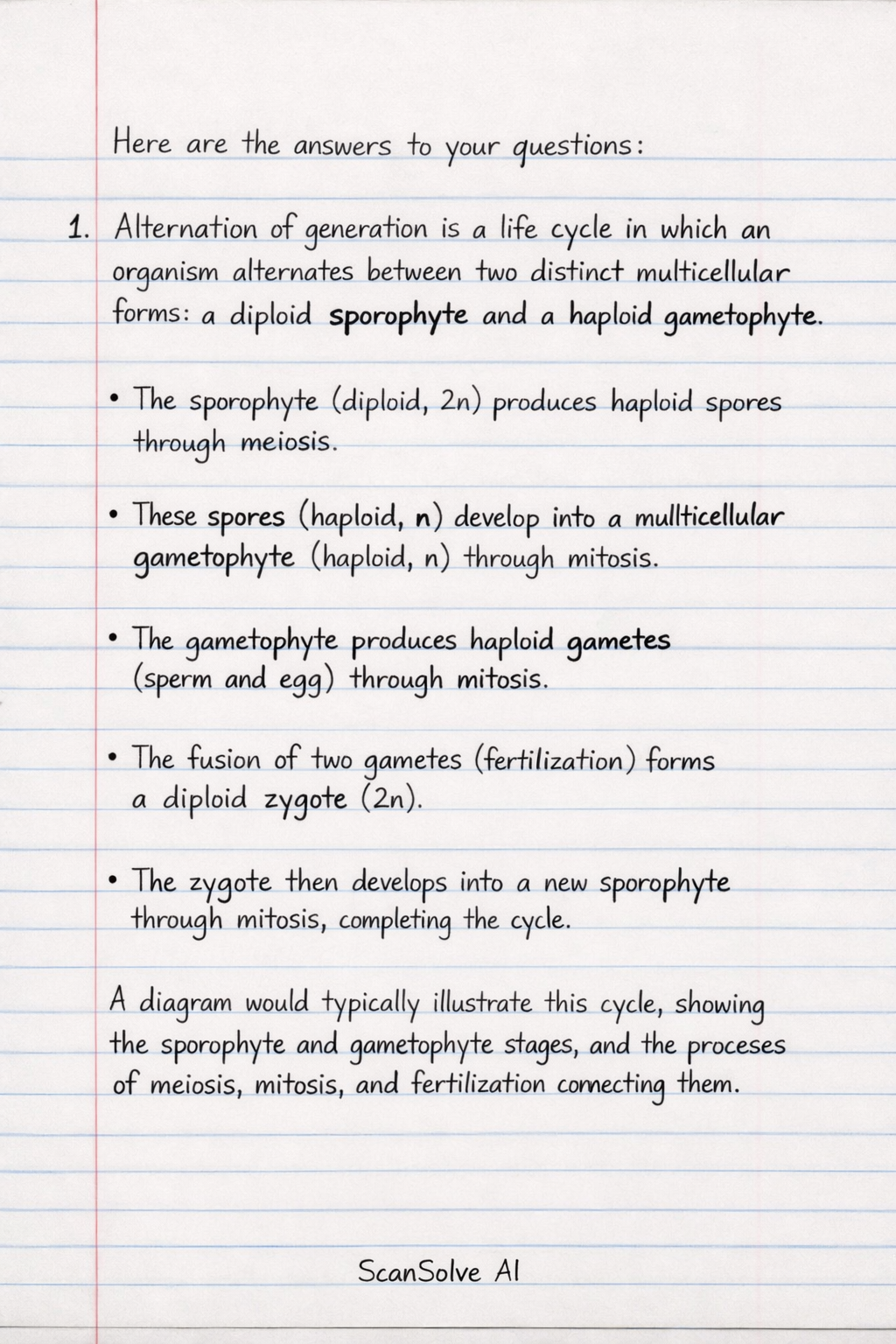
Alternation of generation is a life cycle in which an organism alternates between two distinct multicellular forms: a diploid sporophyte and a haploid gametophyte.
ScanSolve AI Answer
Here are the answers to your questions:
-
Alternation of generation is a life cycle in which an organism alternates between two distinct multicellular forms: a diploid sporophyte and a haploid gametophyte.
- The sporophyte (diploid, 2n) produces haploid spores through meiosis.
- These spores (haploid, n) develop into a multicellular gametophyte (haploid, n) through mitosis.
- The gametophyte produces haploid gametes (sperm and egg) through mitosis.
- The fusion of two gametes (fertilization) forms a diploid zygote (2n).
- The zygote then develops into a new sporophyte through mitosis, completing the cycle. A diagram would typically illustrate this cycle, showing the sporophyte and gametophyte stages, and the processes of meiosis, mitosis, and fertilization connecting them.
-
Pteridophyta (ferns and their allies) are referred to as tracheophytes because they possess true vascular tissues (xylem and phloem). These specialized tissues are responsible for the efficient transport of water, minerals, and nutrients throughout the plant body, a characteristic feature of all tracheophytes.
2b. Five features of Bryophytes: * They are non-vascular plants, lacking true xylem and phloem. * The dominant and more conspicuous stage in their life cycle is the gametophyte. * Their sporophyte is typically small, short-lived, and nutritionally dependent on the gametophyte. * They require water for sexual reproduction, as their flagellated sperm must swim to the egg. * They lack true roots, stems, and leaves, instead possessing simple structures like rhizoids for anchorage.
3a. Five characteristics of Platyhelminthes (flatworms): * They have a dorsoventrally flattened body. * They are acoelomate, meaning they lack a true body cavity. * They exhibit bilateral symmetry. * They are triploblastic, possessing three germ layers (ectoderm, mesoderm, and endoderm). * Most have an incomplete digestive system with a single opening (a blind gut), or no digestive system in some parasitic forms.
3b. Four flukes of medicinal importance with examples: * Schistosoma mansoni: Causes intestinal schistosomiasis (bilharzia). * Fasciola hepatica: Known as the common liver fluke, causes fascioliasis. * Clonorchis sinensis: The Chinese liver fluke, causes clonorchiasis. * Paragonimus westermani: The oriental lung fluke, causes paragonimiasis.
4a. Four differences between Sponges (Phylum Porifera) and Coelenterates (Phylum Cnidaria):
| Feature | Sponges (Porifera) | Coelenterates (Cnidaria) |
|---|---|---|
| Symmetry | Asymmetrical or radially symmetrical | Radially symmetrical |
| Germ Layers | No true tissues or germ layers (parazoa) | Diploblastic (ectoderm and endoderm) |
| Digestion | Primarily intracellular (within choanocytes) | Extracellular (in gastrovascular cavity) and intracellular |
| Special Cells | Choanocytes (collar cells) for feeding | Cnidocytes (stinging cells) for defense and prey capture |
4b. Five ways of controlling malaria and four species of Plasmodium: * Ways of controlling malaria: 1. Use of insecticide-treated bed nets (ITNs). 2. Indoor residual spraying (IRS) with insecticides. 3. Larval source management (e.g., draining stagnant water, using larvicides). 4. Chemoprophylaxis (preventive antimalarial drugs). 5. Early diagnosis and prompt treatment with antimalarial drugs. * Four species of Plasmodium: 1. Plasmodium falciparum 2. Plasmodium vivax 3. Plasmodium ovale 4. Plasmodium malariae
-
Alternation of generation is a type of life cycle found in plants and some algae, characterized by the presence of two distinct multicellular stages: a diploid sporophyte that produces spores, and a haploid gametophyte that produces gametes.
-
Principles of animal distribution (biogeography) include:
- Climate: Temperature, rainfall, and humidity directly influence species survival and range.
- Habitat availability: The presence of suitable environments, food sources, and shelter.
- Geographical barriers: Physical obstacles like oceans, mountains, and deserts limit dispersal.
- Historical factors: Past geological events (e.g., continental drift) and evolutionary history shape current distributions.
- Interspecific interactions: Competition, predation, and symbiotic relationships with other species.
Still stuck on this one?
Ask a follow-up, and the answer starts from this question.
More Biology Questions
Handwritten Step-by-Step Solution
Get this as a handwritten image on WhatsApp — like a tutor wrote it for you.
Try on WhatsApp