

This biology question covers important biological concepts and processes. The step-by-step explanation below helps you understand the underlying mechanisms and reasoning.
ScanSolve AI Answer
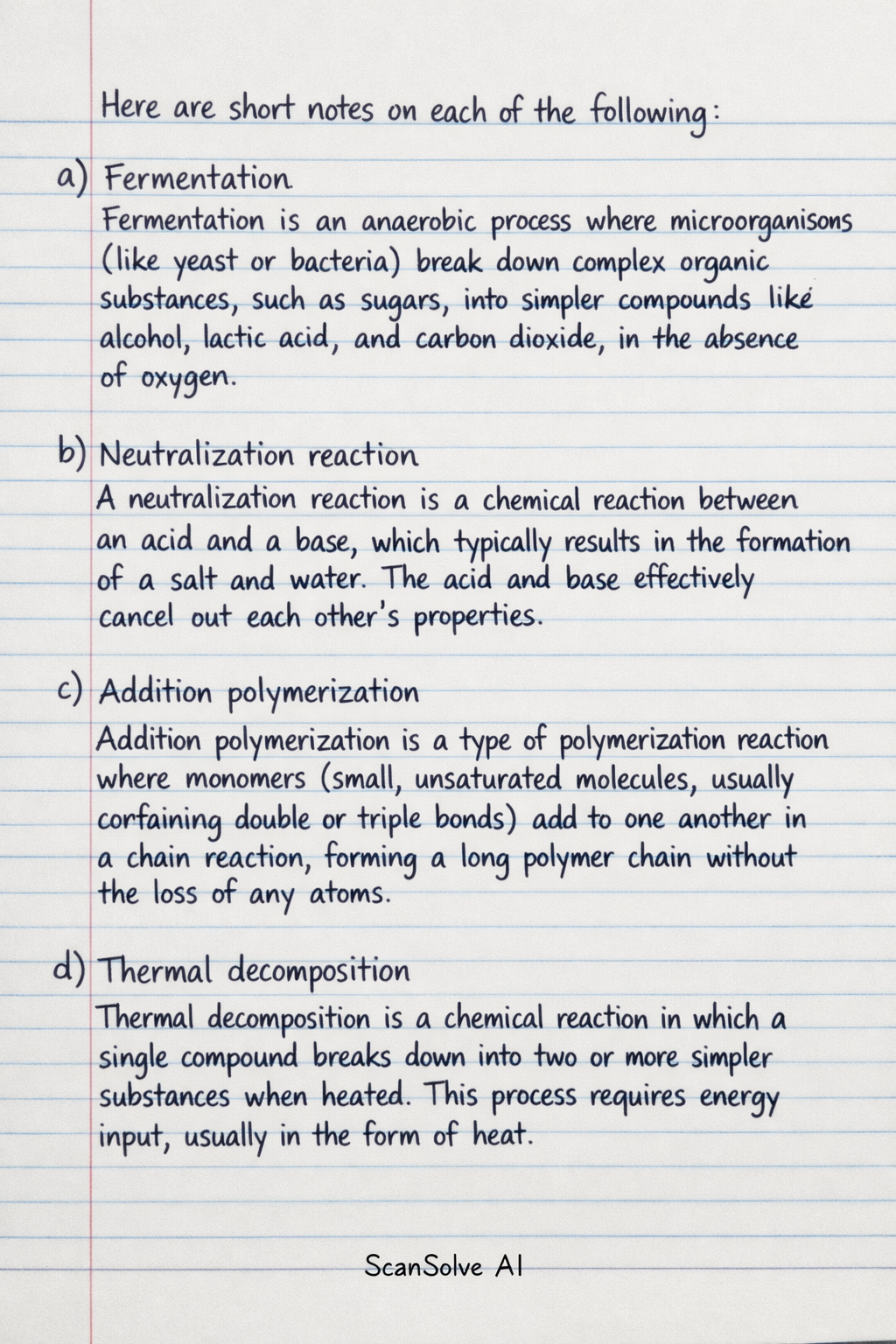
Here are short notes on each of the following: a) Fermentation Fermentation is an anaerobic process where microorganisms (like yeast or bacteria) break down complex organic substances, such as sugars, into simpler compounds like alcohol, lactic acid, and carbon dioxide, in the absence of oxygen. b) Neutralization reaction A neutralization reaction is a chemical reaction between an acid and a base, which typically results in the formation of a salt and water. The acid and base effectively cancel out each other's properties. c) Addition polymerization Addition polymerization is a type of polymerization reaction where monomers (small, unsaturated molecules, usually containing double or triple bonds) add to one another in a chain reaction without the loss of any atoms, forming a long polymer chain. d) Thermal decomposition Thermal decomposition is a chemical reaction in which a single compound breaks down into two or more simpler substances when heated. This process requires energy input, usually in the form of heat. 3 done, 2 left today. You're making progress.