
We read your photo as:
An ecosystem is a community of living organisms interacting with their non-living environment. Its structure refers to its components (biotic, like producers and consumers; and abiotic, like sun
ScanSolve AI Answer
Step-by-step solution
3 stepsAn ecosystem is a community of living organisms interacting with their non-living environment.
Its structure refers to its components (biotic, like producers and consumers; and abiotic, like sunlight and water), while its function involves processes such as energy flow and nutrient cycling.
A trophic level describes the position an organism occupies in a food chain, which is a linear sequence showing how energy is transferred.
A food web illustrates the complex, interconnected feeding relationships among multiple food chains within an ecosystem.
Trophic relationships* are the feeding connections between organisms.
These are often visualized using ecological pyramids, which represent the biomass, number, or energy at each trophic level. Productivity is the rate at which energy is converted into organic substances, and energy flow describes the movement of energy through these trophic levels, typically with a significant loss at each transfer.
Still stuck on this one?
Ask a follow-up, and the answer starts from this question.
More Biology Questions
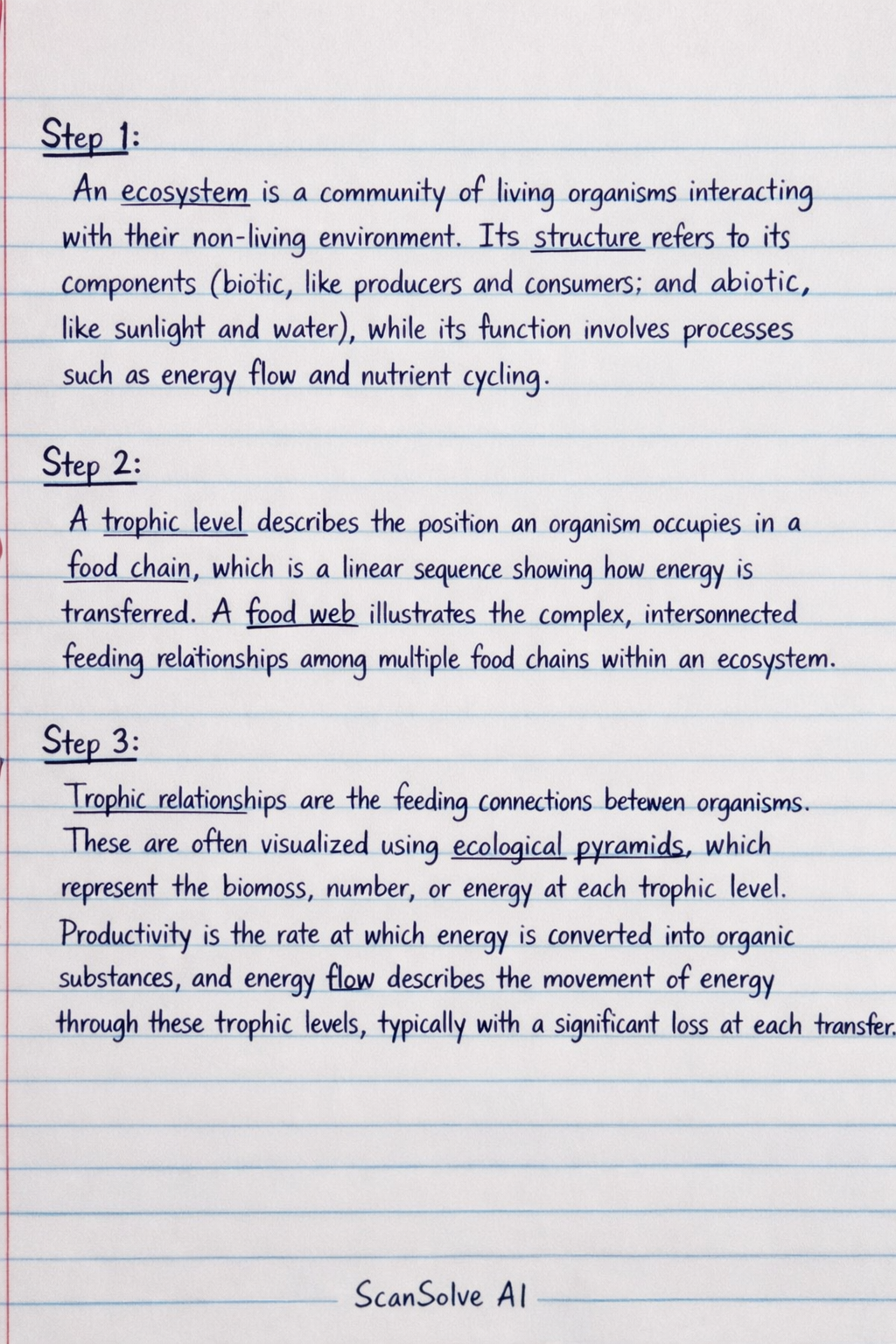
Handwritten Step-by-Step Solution
Get this as a handwritten image on WhatsApp — like a tutor wrote it for you.
Try on WhatsApp