

This biology question covers important biological concepts and processes. The step-by-step explanation below helps you understand the underlying mechanisms and reasoning.
ScanSolve AI Answer
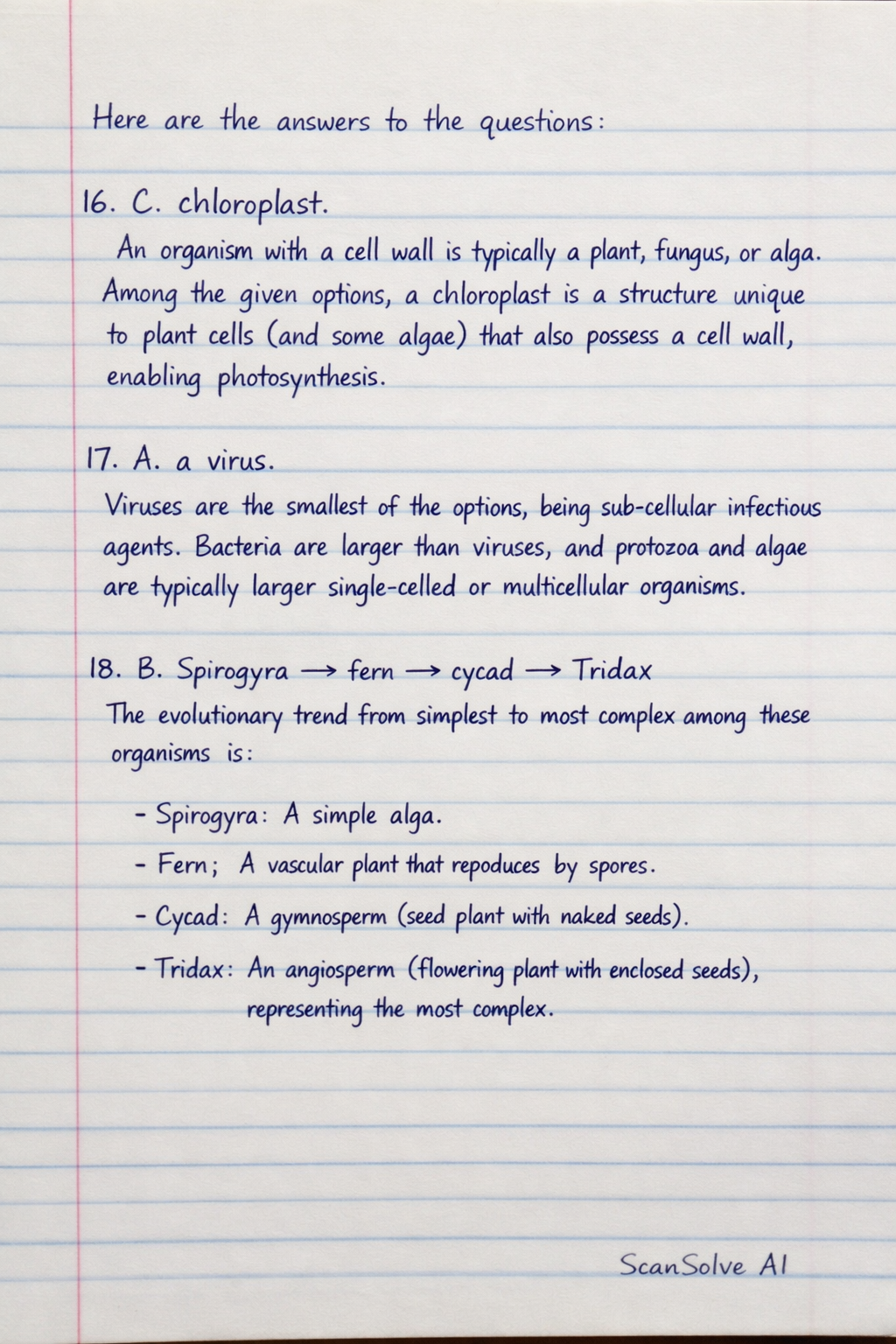
Here are the answers to the questions: 16. C. chloroplast An organism with a cell wall is typically a plant, fungus, or alga. Among the given options, a chloroplast is a structure unique to plant cells (and some algae) that also possess a cell wall, enabling photosynthesis. 17. A. a virus Viruses are the smallest of the options, being sub-cellular infectious agents. Bacteria are larger than viruses, and protozoa and algae are typically larger single-celled or multicellular organisms. 18. B. Spirogyra → fern → cycad → Tridax The evolutionary trend from simplest to most complex among these organisms is: Spirogyra*: A simple alga. Fern*: A vascular plant that reproduces by spores. Cycad*: A gymnosperm (seed plant with naked seeds). Tridax*: An angiosperm (flowering plant with enclosed seeds), representing the most complex. 19. C. possess chlorophyll All the listed organisms (Cycad, Spirogyra, Fern, Tridax) are photosynthetic and therefore contain chlorophyll. They do not all possess true roots and stems (Spirogyra lacks them), bear naked seeds (only Cycad does), or are primarily dispersed by wind in the same manner. 20. B. mitochondrion Heart muscle cells require a continuous and large supply of energy (ATP) for contraction. Mitochondria are the primary sites of ATP production through cellular respiration, so they are abundant in energy-demanding cells like heart muscle cells. 21. A. carbon (IV) oxide Baker's yeast ferments sugars in the dough, producing ethanol and carbon dioxide (CO_2). The trapped carbon dioxide gas causes the dough to rise. 22. A. interphase of mitosis DNA replication occurs during the S phase, which is part of interphase, the stage preceding both mitosis and meiosis. 23. B. 16 Root tip cells are somatic cells and are diploid (2n). Leaf cells are also somatic cells and are diploid. Therefore, if the root tip has 16 chromosomes, the leaf cell will also have 16 chromosomes. 24. C. diabetes Haemophilia, muscular dystrophy (many forms), and colour blindness are well-known examples of sex-linked conditions, typically inherited on the X chromosome. Diabetes mellitus is a metabolic disorder that is primarily multifactorial or autosomal, not sex-linked. 25. D. more variation in a population Natural selection acts on existing variations within a population. The greater the genetic variation, the more raw material there is for natural selection to act upon, increasing the likelihood and rate of evolutionary change. 26. B. evolution The extinction of dinosaurs and the subsequent rise and diversification of birds is a classic example of large-scale biological change over geological time, which is encompassed by the term evolution. 27. D. blood group Physiological variation refers to differences in the functional or metabolic processes of an organism. Blood group is a biochemical characteristic that affects the physiological compatibility of blood, making it an example of physiological variation. Height, leaf shape, and hair colour are morphological variations. 28. B. earthworm and hydrostatic skeleton Earthworms use a hydrostatic skeleton, which is a fluid-filled coelom that muscles act upon to facilitate movement. Grasshoppers and spiders have exoskeletons, while rats have endoskeletons. 3 done, 2 left today. You're making progress.