
We read your photo as:
Answer questions about the circulatory system, including definitions and filling in the blanks about blood flow through the heart.
ScanSolve AI Answer
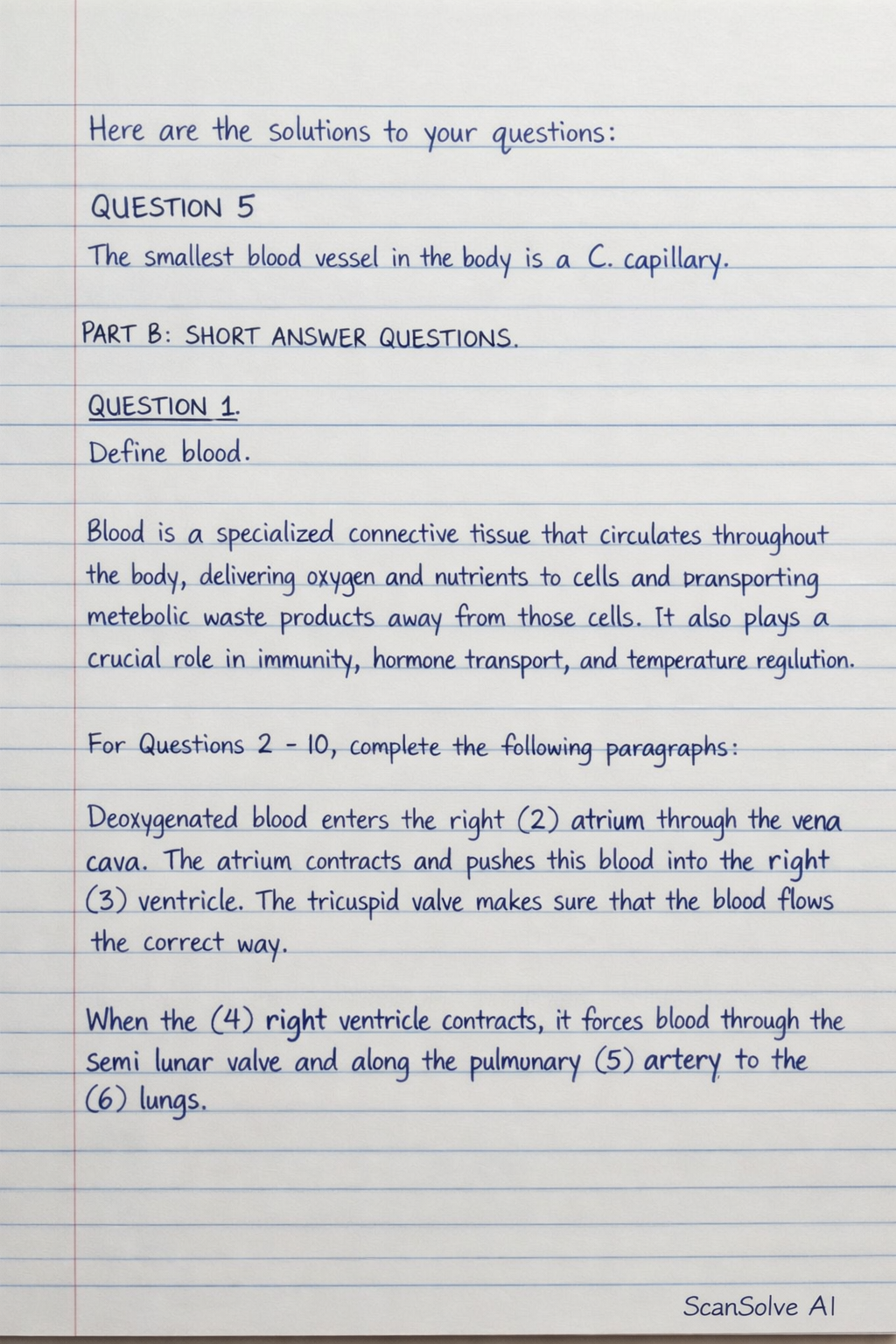
Here are the solutions to your questions:
QUESTION 5
The smallest blood vessel in the body is a C. capillary.
PART B: SHORT ANSWER QUESTIONS
QUESTION 1
Define blood.
Blood is a specialized connective tissue that circulates throughout the body, delivering oxygen and nutrients to cells and transporting metabolic waste products away from those cells. It also plays a crucial role in immunity, hormone transport, and temperature regulation.
For Questions 2 - 10, complete the following paragraphs.
Deoxygenated blood enters the right (2) atrium through the vena cava. The atrium contracts and pushes this blood into the right (3) ventricle. The tricuspid valve makes sure that the blood flows the correct way.
When the (4) right ventricle contracts, it forces blood through the semi lunar valve and along the pulmonary (5) artery to the (6) lungs.
In the lungs the blood becomes oxygenated. It returns to the heart in the pulmonary (7) veins. These enter the left (8) atrium. When this contracts it pushes blood into the left (9) ventricle. This has a thick wall because when it contracts it generates high pressure to force the blood through the (10) aorta to the head and body.
Still stuck on this one?
Ask a follow-up, and the answer starts from this question.
More Biology Questions
Handwritten Step-by-Step Solution
Get this as a handwritten image on WhatsApp — like a tutor wrote it for you.
Try on WhatsApp