
We read your photo as:
Answer the conditions necessary for photosynthesis.
Biology
ScanSolve AI Answer
Step-by-step solution
7 stepsAnswer the conditions necessary for photosynthesis.
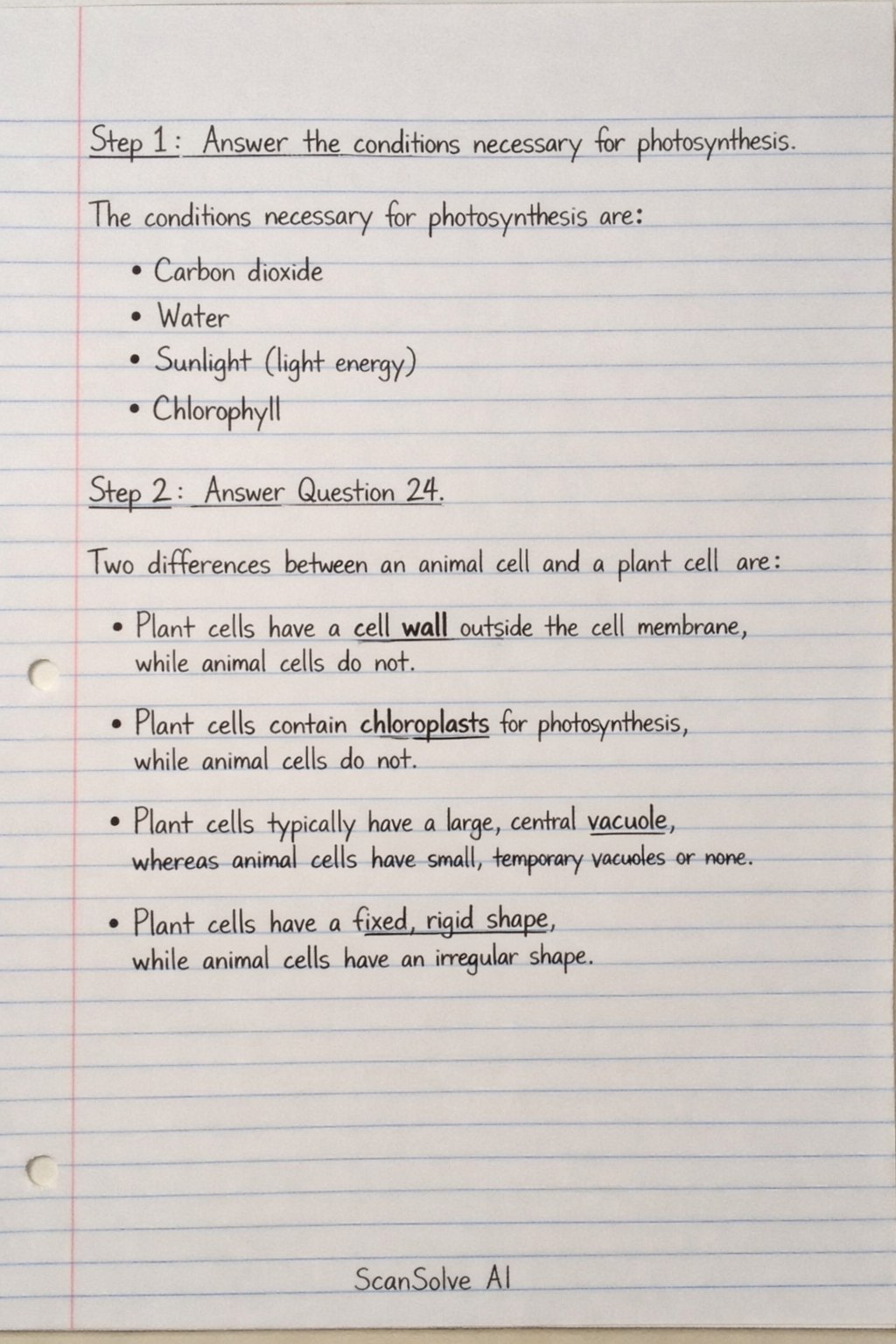
The conditions necessary for photosynthesis are:
- Carbon dioxide
- Water
- Sunlight (light energy)
- Chlorophyll
Answer Question 24.
Two differences between an animal cell and a plant cell are:
- Plant cells have a cell wall outside the cell membrane, while animal cells do not.
- Plant cells contain chloroplasts for photosynthesis, while animal cells do not.
- Plant cells typically have a large, central vacuole, whereas animal cells have small, temporary vacuoles or none.
- Plant cells have a fixed, rigid shape, while animal cells have an irregular shape.
Answer Question 25.
a) Challenges of menstruation faced by girls:
- Lack of access to sanitary products, leading to discomfort and potential health issues.
- Social stigma and cultural taboos, causing embarrassment and limiting participation in daily activities.
- Menstrual pain (dysmenorrhea) and other physical symptoms that can disrupt school attendance and daily life.
- Lack of proper sanitation facilities in schools and public places.
b) Two examples of STIs:
- Chlamydia
- Gonorrhea
- Syphilis
- HIV/AIDS
- Herpes
Answer Question 26.
- Diffusion is the net movement of particles from an area of higher concentration to an area of lower concentration. In living things, it is crucial for the exchange of gases (oxygen and carbon dioxide) in the lungs and tissues, and for the absorption of nutrients in the small intestine.
- Osmosis is the net movement of water molecules across a selectively permeable membrane from a region of higher water potential to a region of lower water potential. In living things, it is vital for water absorption by plant roots, maintaining turgor pressure in plant cells, and regulating water balance in animal cells.
Answer Question 27.
The importance of fertilization in reproduction is:
- It restores the diploid number of chromosomes by combining the haploid nuclei of the male and female gametes.
- It initiates embryonic development by activating the egg.
- It introduces genetic variation by combining genetic material from two different parents, leading to offspring with unique traits.
Answer Question 28.
a) Definitions:
- Renewable energy is energy derived from natural processes that are replenished constantly.
- Non-renewable energy is energy derived from sources that are finite and cannot be replenished on a human timescale.
b) Examples:
- Examples of renewable energy: Solar energy, wind energy, hydroelectric power.
- Examples of non-renewable energy: Coal, petroleum (oil), natural gas.
Answer Question 29.
- Pressure is defined as the force applied perpendicular to the surface of an object per unit area over which that force is distributed.
- Its SI unit is the Pascal (Pa). where is pressure, is force, and is area. The unit Pascal is equivalent to Newtons per square meter ().
Was this helpful?
Still stuck on this one?
Ask a follow-up, and the answer starts from this question.
Got a different question?Ask your own question
More Biology Questions
QInvestigate whether sunlight is necessary for photosynthesis. The aim is to check whether…Q1.1 a) Reactants: B:, D: b) Essential requirement for photosynthesis: A: c) Products: C: 1.1.2…QIdentify and explain the biological processes and conditions described, including osmosis…QThis image describes an experiment to demonstrate that light is necessary for photosynthesis. Here…QWhat are the answers to these multiple-choice questions about photosynthesis and plant biology?
Browse by topic:Biochemistry
Handwritten Step-by-Step Solution
Get this as a handwritten image on WhatsApp — like a tutor wrote it for you.
Try on WhatsApp